
Our Lady of Victories Basilica, Camberwell
Australia·Melbourne·Catholic Archdiocese of Melbourne
Our Lady of Victories Basilica in Camberwell, Melbourne, is a prominent Roman Catholic church distinguished by its Romanesque Revival architecture and a striking copper-clad dome topped with a statue of the Blessed Virgin Mary. It holds the significant status of a Minor Basilica, making it one of only five such churches in Australia.
Key Facts
- ›Designed by diocesan architect Augustus Andrew Fritsch.
- ›Construction began with the laying of the foundation stone on May 25, 1913.
- ›Officially opened on October 6, 1918, by Archbishop Daniel Mannix.
- ›Features a distinctive copper-clad dome with a golden statue of the Blessed Virgin Mary.
- ›Elevated to the status of Minor Basilica by Pope John Paul II on September 30, 1996.
- ›One of five churches in Australia with minor basilica status.

Romanesque Revival
Augustus Andrew Fritsch
About Our Lady of Victories Basilica, Camberwell
Our Lady of Victories Basilica is a significant Roman Catholic church located in Camberwell, a suburb of Melbourne, Australia. Distinguished by its Romanesque Revival architectural style, it stands apart from many contemporary churches of its era, which often favored Gothic Revival designs. The basilica is crowned with a prominent copper-clad dome, itself a notable feature, topped with a golden statue of the Blessed Virgin Mary.
History and Designation
The construction of Our Lady of Victories Basilica commenced with the laying of its foundation stone on May 25, 1913, by Archbishop Thomas Carr. The basilica was designed by Augustus Andrew Fritsch, the diocesan architect, though his initial plans were modified, likely due to budgetary considerations. The builder was Robert Harper. The completed church was officially opened on October 6, 1918, by Archbishop Daniel Mannix, with substantial public attendance necessitating special transport arrangements.
Its religious importance was further recognized when Pope John Paul II elevated the shrine to the status of a Minor Basilica on September 30, 1996, through a decree signed by Cardinal Angelo Sodano. This designation places Our Lady of Victories Basilica among an elite group, being one of only five churches in Australia to hold this title.
Source: Wikipedia ↗
Frequently Asked Questions
When was Our Lady of Victories Basilica completed?
Our Lady of Victories Basilica was completed in 1918. The foundation stone was laid in 1913, and it was officially opened in October 1918.
What is the architectural style of Our Lady of Victories Basilica?
The basilica is designed in the Romanesque Revival style. This is distinctive in Melbourne, where many churches of the era were built in the Gothic Revival style.
What makes Our Lady of Victories Basilica significant?
Its significance stems from its architectural style, its imposing presence, and its status as a Minor Basilica, a designation granted by Pope John Paul II. It is one of only five churches in Australia to hold this title.
What is notable about the dome of the basilica?
The basilica features a distinctive copper-clad dome. It is crowned with a golden statue of the Blessed Virgin Mary, titled 'Our Lady of Victories'.
Who designed Our Lady of Victories Basilica?
The basilica was designed by Augustus Andrew Fritsch, who served as the diocesan architect. His original plans underwent modifications during the design process.
Related Basilicas

St Mary's Cathedral
St. Mary's Cathedral, officially the Cathedral Church and Minor Basilica of the Immaculate Mother of God, Help of Christians, is the Roman Catholic cathedral of Sydney, Australia. It is dedicated to the Blessed Virgin Mary under the title "Our Lady, Help of Christians" and serves as the seat of the Archdiocese of Sydney. Elevated to the status of Minor Basilica in 1932, it is a significant landmark in Sydney's central business district, renowned for its Gothic Revival architecture and rich history dating back to the early colonial period.

Basilica of the Assumption of the Blessed Virgin Mary Queen of Poland (St Mary's Basilica)
The Basilica of the Assumption of the Blessed Virgin Mary Queen of Poland, commonly known as St. Mary's Basilica, is a historic Roman Catholic parish church in Kraków, Poland. It is a prime example of Brick Gothic architecture, renowned for its 14th-century wooden altarpiece by Veit Stoss and its hourly trumpet signal, the Hejnał mariacki. The basilica holds significant religious and cultural importance, serving as a model for Polish diaspora churches and recognized as a UNESCO World Heritage Site.
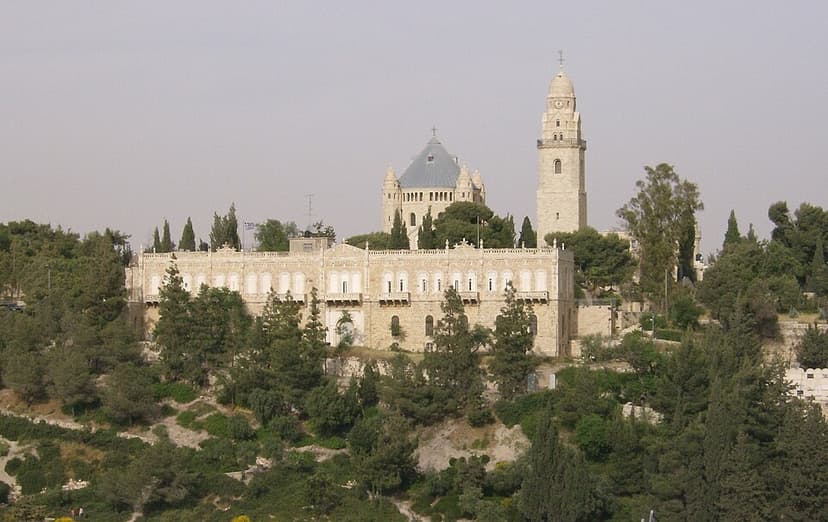
Basilica of the Dormition of the Virgin Mary, Hagia Maria Sion Abbey
The Basilica of the Dormition of the Virgin Mary, Hagia Maria Sion Abbey is a Catholic abbey located in Jerusalem on Mount Zion, believed to mark the spot of Mary's earthly end. The current neo-Romanesque basilica was constructed between 1900 and 1910, built on the foundations of earlier Byzantine and Crusader churches, and serves as a significant pilgrimage site.