
Basilica of the Assumption of the Blessed Virgin Mary Queen of Poland (St Mary's Basilica)
The Basilica of the Assumption of the Blessed Virgin Mary Queen of Poland, commonly known as St. Mary's Basilica, is a historic Roman Catholic parish church in Kraków, Poland. It is a prime example of Brick Gothic architecture, renowned for its 14th-century wooden altarpiece by Veit Stoss and its hourly trumpet signal, the Hejnał mariacki. The basilica holds significant religious and cultural importance, serving as a model for Polish diaspora churches and recognized as a UNESCO World Heritage Site.
Key Facts
- ›Founded between 1221-22 by Bishop Iwo Odrowąż, with foundations dating to the early 13th century.
- ›Rebuilt in the Brick Gothic style between 1355 and 1365, with further additions and modifications in subsequent centuries.
- ›Features a significant wooden altarpiece by Veit Stoss, completed at the end of the 15th century.
- ›The hourly Hejnał mariacki trumpet signal from its taller tower commemorates a legendary 13th-century trumpeter.
- ›Recognized as a UNESCO World Heritage Site in 1978 as part of the Historic Centre of Kraków.
- ›Its interior underwent a late Baroque renovation in the 18th century and a neo-Gothic redesign in the late 19th century.

Brick Gothic, Baroque, Neo-Gothic
Veit Stoss, Jan Matejko, Francesco Placidi, Tadeusz StryjeńSki, StanisłAw WyspiańSki, JóZef Mehoffer, Nicholas Wernher, Maciej Heringh
About Basilica of the Assumption of the Blessed Virgin Mary Queen of Poland (St Mary's Basilica)
St. Mary's Basilica (Basilica of the Assumption of the Blessed Virgin Mary Queen of Poland)
The Basilica of the Assumption of the Blessed Virgin Mary Queen of Poland, commonly known as St. Mary's Basilica, is a historically significant Roman Catholic parish church located in Kraków, Poland. Situated at Mariacki Square, adjacent to the Main Market Square in the Old Town, it stands as one of Poland's most prominent examples of Brick Gothic architecture. Its foundations date back to the early 13th century, with the current structure largely dating from the 14th century, making it a cornerstone of Polish Gothic design.
History and Architecture
Founded between 1221 and 1222 by Bishop Iwo Odrowąż, the original church was destroyed during the Mongol invasions. A new early Gothic church was constructed on its foundations between 1290 and 1300 and consecrated in 1320. The basilica underwent a significant rebuilding between 1355 and 1365 under Casimir III the Great, with substantial contributions from Mikołaj Wierzynek. This period saw the elongation of the presbytery and the addition of tall windows. The main body of the church was completed between 1395 and 1397, featuring a new vault constructed by master Nicholas Wernher. The vault over the presbytery famously collapsed in 1442, an event attributed to a possible earthquake.
Subsequent centuries brought further architectural developments. In the first half of the 15th century, side chapels were added, many designed by master Franciszek Wiechoń. The northern tower was raised to serve as a city watchtower, later receiving a helmet in 1478 and a gilded crown in 1666. The end of the 15th century marked the addition of the sculptural masterpiece, the Altarpiece of Veit Stoss. The church's interior was rebuilt in the late Baroque style in the 18th century by Francesco Placidi, with extensive decoration by Andrzej Radwański and altarpieces by Giambattista Pittoni. In the late 19th century, under Tadeusz Stryjeński, a neo-Gothic design was introduced, along with murals funded by Jan Matejko and stained glass by Stanisław Wyspiański and Józef Mehoffer.
Notable Features and Significance
The basilica is internationally recognized for its hourly trumpet signal, the "Hejnał mariacki," played from the taller of its two towers. This signal, which breaks off mid-note, is said to commemorate a legendary 13th-century trumpeter who was killed while sounding an alarm against a Mongol invasion. The noon-time hejnał is broadcast live by Polish Radio Jedynka.
St. Mary's Basilica has also served as an architectural model for churches built by the Polish diaspora, notably in Chicago. In 1978, the basilica was inscribed as a UNESCO World Heritage Site, as part of the Historic Centre of Kraków, underscoring its immense historical, cultural, and architectural importance.
Religious and Cultural Role
In 1536/37, King Sigismund I decreed that sermons should transition from German to Polish, reflecting the changing demographics of Kraków. The church continues to be an active parish church and a major tourist attraction, drawing visitors interested in its art, history, and the unique hourly trumpet call. In 2010, it hosted the funeral ceremony for Polish President Lech Kaczyński and his wife Maria.
Source: Wikipedia ↗
Frequently Asked Questions
What is the significance of the Hejnał mariacki played from St. Mary's Basilica?
The Hejnał mariacki is a trumpet signal played hourly from the taller of St. Mary's towers. It is said to commemorate a 13th-century trumpeter who was shot while warning the city of a Mongol attack. The noon-day signal is broadcast live across Poland.
What architectural style is St. Mary's Basilica?
St. Mary's Basilica is primarily a Brick Gothic church, built in the 14th century. Its interior has seen later modifications, including a late Baroque renovation in the 18th century and a neo-Gothic redesign in the late 19th century.
What are the most notable artworks within St. Mary's Basilica?
The basilica is most famous for its monumental wooden altarpiece carved by Veit Stoss, a masterpiece of late Gothic art. Additionally, its polychrome murals were designed by Jan Matejko, a leading Polish history painter.
When was St. Mary's Basilica founded and consecrated?
According to chronicler Jan Długosz, the basilica was founded between 1221-22. A new early Gothic church was built on its foundations between 1290 and 1300 and was consecrated in 1320.
Is St. Mary's Basilica a UNESCO World Heritage Site?
Yes, in 1978, St. Mary's Basilica became a UNESCO World Heritage Site. It was recognized alongside the entire Historic Centre of Kraków.
Related Basilicas

Basilica of Our Lady, Ludźmierz
The Sanctuary of Our Lady of Ludźmierz is a significant religious site in Ludźmierz, Poland, deeply connected to the Góral people of the Tatra Mountains. It houses the revered statue of Our Lady of Ludźmierz, also known as the Shepherdess of Podhale, and holds historical importance as the oldest Catholic parish in the region, with roots tracing back to the 13th century.

Basilica of St Mary of Guadalupe, Royal Monastery of St Mary of Guadalupe
The Royal Monastery of Saint Mary of Guadalupe is a significant Roman Catholic monastic establishment in Guadalupe, Extremadura, Spain, with origins in the late 13th century. It served as a principal house for the Hieronymite monks and later the Franciscan Order, playing a crucial role in Spanish history and developing a rich association with the New World, most notably as a pilgrimage site for Christopher Columbus. Declared a UNESCO World Heritage Site in 1993 and a Minor Papal Basilica in 1955, it remains an important religious and historical monument.
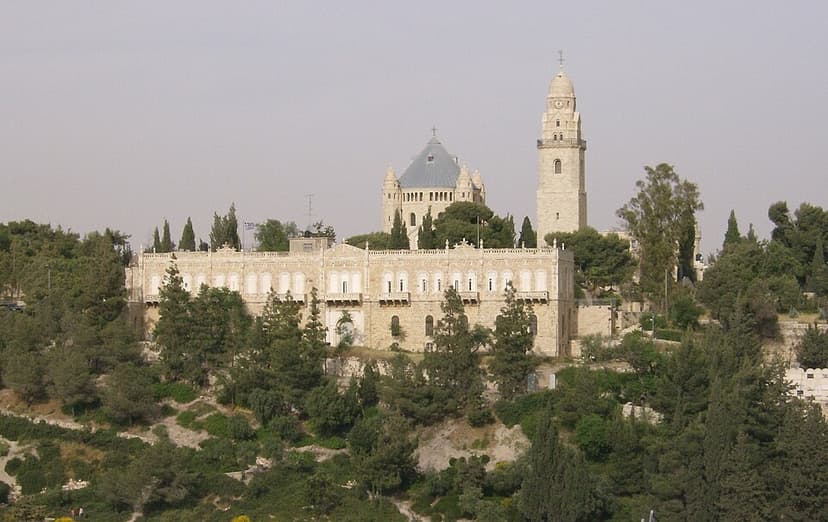
Basilica of the Dormition of the Virgin Mary, Hagia Maria Sion Abbey
The Basilica of the Dormition of the Virgin Mary, Hagia Maria Sion Abbey is a Catholic abbey located in Jerusalem on Mount Zion, believed to mark the spot of Mary's earthly end. The current neo-Romanesque basilica was constructed between 1900 and 1910, built on the foundations of earlier Byzantine and Crusader churches, and serves as a significant pilgrimage site.