
Cathedral of St Mary of the Assumption
Portugal·Évora·Archdiocese of Évora
The Cathedral of Évora, also known as Sé de Évora, is a significant Roman Catholic church and a prominent historical monument in Évora, Portugal. It is recognized as one of the oldest and most important local structures, serving as the seat of the Archdiocese of Évora and a UNESCO World Heritage Site. Its construction history spans centuries, showcasing a blend of Romanesque, Gothic, and Baroque architectural styles, making it a prime example of Portuguese Gothic architecture.
Key Facts
- ›Construction began between 1186 and 1204, with a significant enlargement in early Gothic style between 1280 and 1340.
- ›It is the largest of the medieval cathedrals in Portugal and a key example of Gothic architecture.
- ›The cathedral houses Gothic cloisters (14th century), a Manueline chapel (early 16th century), and a Baroque main chapel (18th century).
- ›Cardinal-King Henrique, who briefly ruled Portugal, was an archbishop of Évora and is historically associated with the cathedral.
- ›The 'School of Évora' of polyphony, important in Portuguese music history, was based at the cathedral in the 16th and 17th centuries.
- ›It was declared a UNESCO World Heritage Site in 1988 as part of Évora's historical city center.

Romanesque, Gothic, Manueline, Baroque
Santo Lenho
Diogo De Arruda, JoãO Frederico Ludovice
About Cathedral of St Mary of the Assumption
Cathedral of Évora (Sé de Évora)
The Cathedral of Évora, known in Portuguese as Sé de Évora, stands as one of Portugal's most significant and historically important religious structures. Located in the city of Évora, it occupies the highest point and is a central monument within the city's historical center, which is recognized as a UNESCO World Heritage Site. The cathedral serves as the principal church of the Archdiocese of Évora and is renowned for its architectural evolution, showcasing a blend of Romanesque, Gothic, Manueline, and Baroque styles.
History and Architectural Development
Following the reconquest of Évora from Arab control in 1166, construction of the first cathedral, dedicated to the Virgin Mary, commenced between 1186 and 1204. This initial edifice was modest but was considerably enlarged between 1280 and 1340, adopting the early Gothic style. Over subsequent centuries, the cathedral received further significant additions. These include the 14th-century Gothic cloisters, the Manueline chapel of the Esporão in the early 16th century, and a grand Baroque main chapel completed in the first half of the 18th century. The Cathedral of Évora is distinguished as the largest medieval cathedral in Portugal and is considered one of the finest examples of Gothic architecture in the country.
Artistic and Architectural Features
The exterior of the cathedral is characterized by its rose granite construction, with two massive towers flanking the main portal, reminiscent of Lisbon Cathedral. The facade features a large Gothic rose window above the entrance. The interior is designed in a Latin cross plan, with a nave that is higher than its two aisles, a triforium, and an apse with three chapels. The crossing is surmounted by a dome and an octagonal lantern. Notable interior elements include the Manueline high choir, the ancient organ (circa 1544, the oldest still active in Portugal), and the Renaissance statue of the Archangel Gabriel. The main chapel, rebuilt between 1718 and 1746 under King John V, is a Baroque masterpiece featuring polychrome marble and significant sculptural work.
Historical and Cultural Significance
The Cathedral of Évora holds deep historical and cultural importance. It is believed that the flags of Vasco da Gama's first expedition to the Orient were blessed in its presbytery in 1497. The cathedral was also closely associated with Cardinal-King Henrique, who served as its archbishop before becoming King of Portugal. Furthermore, in the 16th and 17th centuries, it was the center of the 'School of Évora' of polyphony, a vital contributor to Portuguese music history, with composers such as Mateus de Aranda and Manuel Mendes associated with its musical life.
Source: Wikipedia ↗
Frequently Asked Questions
When was the Cathedral of Évora built?
The initial construction of the Cathedral of Évora took place between 1186 and 1204. It was later enlarged and modified significantly between approximately 1280 and 1340 in the early Gothic style.
What architectural styles can be seen at the Cathedral of Évora?
The cathedral exhibits a blend of architectural styles, beginning with Romanesque influences in its initial design. It features prominent early Gothic elements, with later additions in the Manueline and Baroque styles. The Gothic cloisters are also a notable feature.
Is the Cathedral of Évora a UNESCO World Heritage Site?
Yes, the Cathedral of Évora was declared a UNESCO World Heritage Site in 1988. This designation is part of the recognition of the historical city center of Évora.
What is the significance of Cardinal-King Henrique to the cathedral?
Cardinal-King Henrique, who was also the Archbishop of Évora, is the most important historical figure associated with the cathedral. He ruled Portugal as king from 1578 to 1580.
What notable artifacts are housed in the Cathedral Museum?
The Cathedral Museum displays items such as the sceptre of Cardinal-King Henrique, a rare 13th-century Gothic ivory statue of Mary that opens into a triptych, and a 17th-century reliquary of Santo Lenho supposedly containing pieces of Christ's Cross.
Related Basilicas

Basilica of the Sacred Heart of Jesus, Mafra National Palace
The Palace of Mafra, also known as the Palace-Convent of Mafra, is a monumental Baroque and Neoclassical complex in Mafra, Portugal. Commissioned by King John V as a Franciscan friary and royal palace, its construction began in 1717 and was largely funded by the wealth from colonial Brazil. It is recognized for its vast scale, architectural grandeur, and significant cultural and religious holdings, including a renowned library and a basilica with historical organs.

Sanctuary of Bom Jesus do Monte
The Sanctuary of Bom Jesus do Monte is a significant Portuguese Catholic shrine located in Tenões, near Braga. It is renowned for its monumental Baroque stairway, which climbs 116 meters and features chapels depicting the Passion of Christ and fountains representing the Five Senses and Three Theological Virtues. The site is an important Christian pilgrimage destination and a major tourist attraction, recognized for its unique theological program and influential Baroque and Neoclassic architecture.
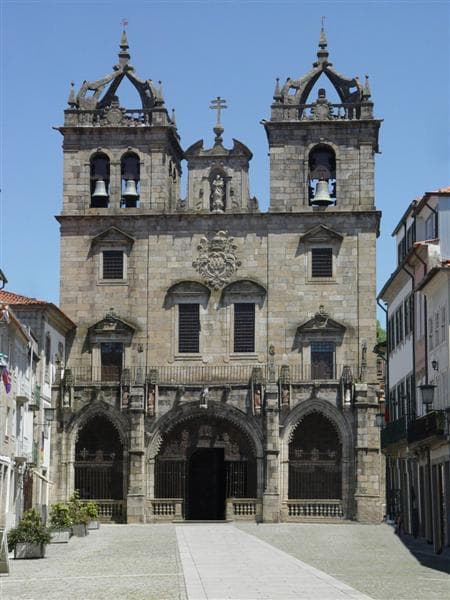
Cathedral of St Mary
The Cathedral of Braga, also known as Sé de Braga, is a Roman Catholic church in Braga, Portugal, significant for its long history and artistic importance. It serves as the seat of the Archdiocese of Braga and the Primate Archbishop of Portugal and Spain, making it a central religious and historical edifice in the country.