
Cathedral Basilica of the Virgin of the Sorrows
Spain·Tortosa·Tortosa
The Cathedral Basilica of the Virgin of the Sorrows in Tortosa, Catalonia, Spain, is the seat of the Diocese of Tortosa. Its current structure, a fine example of Catalan Gothic architecture with a Baroque façade, began construction in 1347 on the site of an earlier Romanesque cathedral and was completed two centuries later. The cathedral is historically significant as the site of the Disputations of Tortosa, a pivotal event in Jewish-Christian relations.
Key Facts
- ›Construction began in 1347 on the foundations of a previous Romanesque cathedral.
- ›The primary architectural style is Catalan Gothic, with an 18th-century Baroque façade.
- ›The apse features a rare heptagonal plan, a complex geometric challenge for medieval builders.
- ›It was the site of the Disputations of Tortosa, a significant religious debate between Jews and Christians.
- ›The cathedral was designed by Benito Dalguayre and features three naves with chapels and an ambulatory.

Catalan Gothic, Baroque
Virgin of the Sorrows
Benito Dalguayre
About Cathedral Basilica of the Virgin of the Sorrows
The Cathedral Basilica of the Virgin of the Sorrows, also known as the Cathedral of Saint Mary of Tortosa, is the principal church and seat of the Diocese of Tortosa, located in Tortosa, Catalonia, Spain.
History and Construction
The present structure began construction in 1347, built upon the foundations of a preceding Romanesque cathedral. The construction spanned two centuries, with the church being completed approximately two hundred years after its commencement. Archeological findings indicate that the site itself has ancient roots, with the Romanesque church previously built on the location of the old Roman forum of Tortosa.
Architectural Significance
Designed primarily in the Catalan Gothic style by Benito Dalguayre, the cathedral features three naves, chapels situated between buttresses, and an ambulatory with radial chapels. A notable architectural element is the apse, which has a rare heptagonal plan. This form presented considerable geometric and construction challenges during the Middle Ages, as no exact classical method existed for laying out a regular heptagon. Archival records suggest a modular proportional system, utilizing a 9:8 ratio, was employed rather than abstract geometric construction. While the main body is Gothic, the cathedral's façade, added in the 18th century, is rendered in the Baroque style.
Religious and Historical Importance
The Cathedral Basilica of the Virgin of the Sorrows holds historical significance as the venue for the famous Disputations of Tortosa. This series of debates, held in the 15th century, saw Jewish participants forced to defend their faith or convert. The outcome of these disputations included a Papal Bull issued by Antipope Benedict XIII, which prohibited the study of the Talmud and other Jewish texts deemed critical of Christianity.
Source: Wikipedia ↗
Frequently Asked Questions
When was the Cathedral Basilica of the Virgin of the Sorrows built?
Construction of the current structure began in 1347 and was completed two centuries later, around the mid-15th century. It was built on the site of an older Romanesque cathedral.
What is the architectural style of the Cathedral Basilica of the Virgin of the Sorrows?
The main body of the cathedral is built in the Catalan Gothic style. However, its façade, dating from the 18th century, exhibits Baroque architectural elements.
What historical events took place at the Cathedral Basilica of the Virgin of the Sorrows?
The cathedral was the location of the notable Disputations of Tortosa. During these events, Jews were compelled to defend their faith, which led to a Papal Bull issued by Antipope Benedict XIII.
What is unique about the apse of the cathedral?
The apse of the Cathedral Basilica of the Virgin of the Sorrows has a rare heptagonal plan. This shape presented significant geometric and construction challenges during the Middle Ages due to the lack of precise classical methods for laying out a regular heptagon.
Related Basilicas
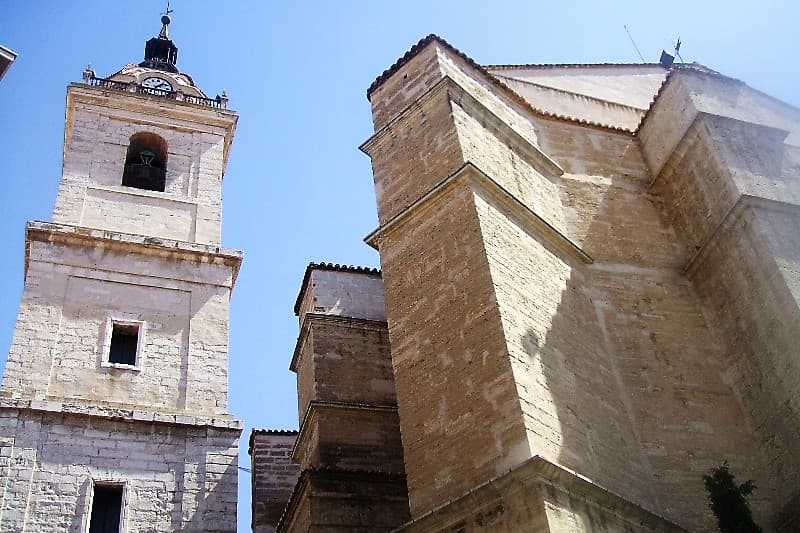
Cathedral Basilica of St Mary of the Meadow
The Holy Priory Church Cathedral Basilica of the Military Orders of Our Lady Saint Mary of the Prado, commonly known as the Cathedral of Saint Mary of the Prado, is a significant religious and architectural landmark in Ciudad Real, Spain. Its construction, spanning centuries and incorporating Gothic, Renaissance, and Baroque elements, makes it a rich historical monument. Since 1875, it has served as the priory for four of Spain's military orders, underscoring its enduring importance.

Basilica of St Mary of the Pine
The Basilica of St Mary of the Pine, known in Catalan as Santa Maria del Pi, is a significant 15th-century Gothic church located in Barcelona, Spain. It stands as a prominent example of Catalan Gothic architecture, characterized by its single nave and minimal ornamentation. The basilica has a long history marked by damage from earthquakes, wars, and fires, necessitating several reconstructions and restorations throughout the centuries.
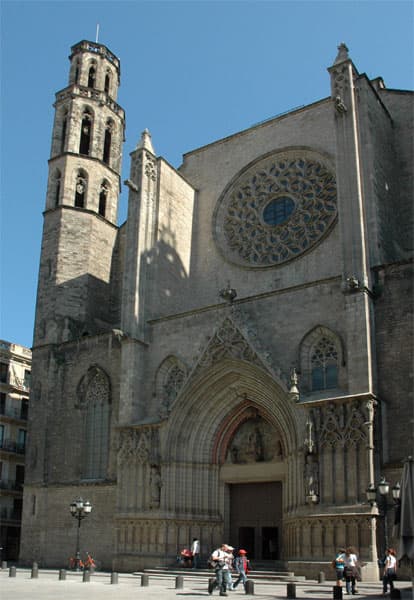
Basilica of St Mary of the Sea
The Basilica of St Mary of the Sea, known in Catalan as Santa Maria del Mar, is a prominent church in Barcelona, Spain, constructed between 1329 and 1383. It stands as a remarkable example of Catalan Gothic architecture, distinguished by its stylistic purity and unity. The basilica holds significance as a testament to the maritime and mercantile power of the Principality of Catalonia during the medieval period, and notably, its construction was supported by the common people rather than the nobility.