
Cathedral Basilica of St Augustine
United States·St. Augustine·St. Augustine
The Cathedral Basilica of St. Augustine is a historic religious landmark in St. Augustine, Florida, holding the distinction of being the seat of the Catholic Bishop of St. Augustine. Its congregation is the oldest Christian congregation in the contiguous United States, established in 1565, making it a site of immense historical and religious significance.
Key Facts
- ›The congregation was established in 1565, making it the oldest Christian congregation in the contiguous United States.
- ›The current structure was constructed over five years, from 1793 to 1797.
- ›It was designated a U.S. National Historic Landmark on April 15, 1970.
- ›The cathedral's facade exhibits an eclectic blend of Spanish mission and Neoclassical architectural styles.
- ›The building was rebuilt and enlarged in the late 19th century by architect James Renwick Jr. after a fire.
- ›It became a cathedral in 1870 and was designated a minor basilica in 1976.
Spanish Mission, Neoclassical, Spanish Renaissance
Bell From 1682
James Renwick Jr.
About Cathedral Basilica of St Augustine
Cathedral Basilica of St. Augustine
The Cathedral Basilica of St. Augustine, known in Spanish as Catedral basílica de San Agustín, stands as a significant religious and historical landmark in St. Augustine, Florida. It serves as the seat of the Catholic Bishop of St. Augustine and is renowned for housing the oldest Christian congregation in the contiguous United States, with its origins tracing back to 1565.
History and Congregation
The establishment of St. Augustine in the mid-1560s by Spanish settlers marked the beginning of a continuous European settlement on the mainland United States. As Catholicism was integral to the Spanish monarchy, a Catholic shrine was immediately established. The early history of the church in St. Augustine is marked by several structures, with the first being of simple design and quickly built. This initial church was destroyed during an attack by Sir Francis Drake in 1586. Subsequent churches, built of straw and palmetto, or timber, also succumbed to fires and the elements over the following centuries. Rebuilding efforts were hampered by various factors, including misspent royal funds and periods of British rule. The current large-scale construction of the church commenced after Spain regained control of the colony in 1784, taking place from 1793 to 1797. The building officially became a cathedral in 1870 and was designated a minor basilica in 1976.
Architecture and Reconstruction
The cathedral's facade presents an eclectic architectural style, blending features of Spanish mission design with Neoclassical elements. Spanish mission influences are visible in its curving bell gables, limited windows, clay roof tiles, and semicircular tympanum. Neoclassical details are prominent around the entrance, featuring an entablature with triglyphs and a broken pediment supported by Doric columns. A significant event in its architectural history occurred on April 12, 1887, when the old Spanish structure burned. While the coquina block exterior was salvageable, the church was rebuilt and enlarged with a rectangular-cruciform layout and a European-style transept by architect James Renwick Jr., who incorporated an elegant roof truss system and a Spanish Renaissance-style bell tower. The bell tower houses four bells, one of which is a salvaged relic from an earlier church, inscribed with "Sancte Joseph. Ora Pro Nobis. D 1682."
National Historic Landmark Status
Recognizing its deep historical roots and architectural significance, the Cathedral Basilica of St. Augustine was designated a U.S. National Historic Landmark on April 15, 1970. Its enduring congregation and the evolution of its structures over centuries underscore its importance as a continuous center of Christian faith and a tangible link to the early colonial history of the United States.
Source: Wikipedia ↗
Frequently Asked Questions
What is the history of the Cathedral Basilica of St. Augustine?
The congregation dates back to 1565, making it the oldest in the contiguous United States. The current structure was built between 1793 and 1797, following several earlier churches that were lost to fire or decay. It underwent significant rebuilding and enlargement in the late 19th century.
What architectural styles are present in the Cathedral Basilica of St. Augustine?
The cathedral features an eclectic facade that combines elements of Spanish mission architecture, such as curving bell gables and limited fenestration, with Neoclassical details around the entrance, including an entablature and Doric columns.
When was the Cathedral Basilica of St. Augustine designated a National Historic Landmark?
The cathedral was officially designated a U.S. National Historic Landmark on April 15, 1970, recognizing its historical and architectural importance.
What is the significance of the coquina stone used in its construction?
The cathedral's original coquina stone walls, made from deposited seashells, were an unusual building material inspired by Native American techniques. This material was cheap to quarry and transported, and it hardened when exposed to air, yet remained workable.
Who was the architect responsible for the late 19th-century reconstruction?
The rebuilding and enlargement of the church after the 1887 fire was overseen by New York City architect James Renwick Jr. He introduced a rectangular-cruciform layout and a European-style transept.
What relics are housed in the Cathedral Basilica of St. Augustine?
One of the bells in the bell tower is salvaged from a previous church and inscribed with 'Sancte Joseph. Ora Pro Nobis. D 1682.', indicating its age and dedication.
Related Basilicas

Basilica of St Augustine
The Basilica of Saint Augustine is a Catholic basilica and pro-cathedral situated in Annaba, Algeria, dedicated to Saint Augustine of Hippo. Construction began in 1881 and was completed in 1900, with the church dedicated in 1914. It is notable for housing a relic of Saint Augustine's arm and its architecture, which blends Roman, Byzantine, and Moorish influences.
Basilica of St Fidelis
The Basilica of St. Fidelis, also known as the Cathedral of the Plains, is a Romanesque-style Catholic parish church located in Victoria, Kansas. It was constructed between 1908 and 1911 and was elevated to the status of a minor basilica in 2014. Its impressive architecture and prominent location have made it a significant landmark in western Kansas.
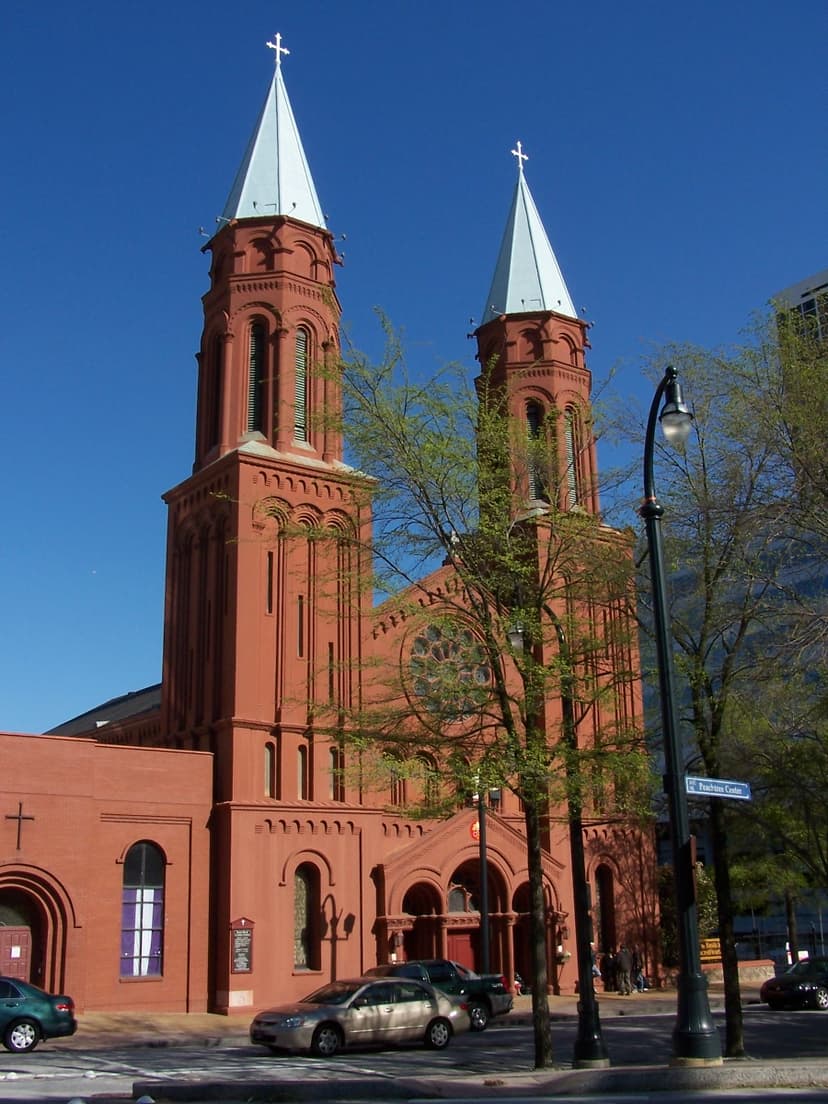
Basilica of the Sacred Heart of Jesus
The Basilica of the Sacred Heart of Jesus is a Roman Catholic church located in downtown Atlanta, Georgia. Completed in 1898, it is recognized for its French Romanesque and Romanesque Revival architecture and was designated a minor basilica in 2010. The church holds historical significance as one of the few remaining structures from Atlanta's early 20th-century development and has served its congregation for over a century.