
Basilica of the visitation, Święta Lipka
Poland·Święta Lipka
The Basilica of the Visitation, Święta Lipka, is a renowned pilgrimage sanctuary located in northeastern Poland, celebrated for its Baroque architecture and significant pipe organ. Originally established around a legend of a miraculous statue of Mary placed on a linden tree, the site has been a place of worship and pilgrimage since at least the late 15th century, evolving through periods of destruction and rebuilding by various religious orders and rulers.
Key Facts
- ›The sanctuary's name, Święta Lipka (Holy Linden), is derived from a legend involving a miraculous statue of Mary placed on a linden tree.
- ›A chapel at the site was first documented in a 1491 deed from the Grand Master of the Teutonic Knights.
- ›The original chapel was destroyed around 1525 during the Protestant Reformation.
- ›The site was rebuilt by the Jesuits and consecrated in 1619, becoming a popular pilgrimage destination.
- ›The current Baroque church's cornerstone was laid in 1688 and consecrated in 1693.
- ›The basilica is recognized as a Historic Monument of Poland, particularly for its pipe organ.

Baroque
Figurine of Mary
Jesuits
About Basilica of the visitation, Święta Lipka
The Basilica of the Visitation, Święta Lipka, is a significant pilgrimage sanctuary and a prominent example of Baroque architecture situated in the small village of Święta Lipka in northeastern Poland. It is particularly renowned for its magnificent pipe organ, which is designated as a Historic Monument of Poland. The sanctuary's name itself, Święta Lipka, translates to 'Holy Linden' and stems from a local legend.
Legend and Early History
According to legend, the name Heiligelinde (the German equivalent) and Święta Lipka refer to a linden tree under which miracles occurred. One tale speaks of a convicted criminal who carved a wooden statue of Mary. Upon his subsequent release, he placed the figurine on a linden tree, which was reputed to have healing properties. Historical accounts suggest the name might also originate from a sacred grove of the Old Prussians. A chapel at the site was first documented in 1491, during which time it was already a pilgrimage destination and part of the Kingdom of Poland as a fief of the Teutonic Knights.
Reformation and Jesuit Reconstruction
The early chapel was destroyed around 1525 during the Protestant Reformation, a period that saw the region become predominantly Lutheran. Despite this, the Roman Catholic faith was re-established in the Duchy of Prussia in 1605. The Jesuits undertook the rebuilding of the chapel, which was consecrated in 1619 by Warmian prince-bishop Szymon Rudnicki. It quickly regained its status as a popular pilgrimage site for Roman Catholics within the Polish-Lithuanian Commonwealth and even attracted Lutheran Masurians.
Baroque Construction and Later History
In 1688, Warmian Bishop Michał Stefan Radziejowski laid the cornerstone for the grand Baroque church that stands today. This new structure was consecrated in 1693 by his successor, Bishop Jan Stanisław Zbąski. From the 18th century onwards, the village became part of the Kingdom of Prussia. Although the Jesuit monastery was abolished, King Frederick II allowed the Jesuits to continue as secular administrators of the church complex. After World War II, in 1945, Święta Lipka, along with the rest of Masuria, was returned to Poland.
Source: Wikipedia ↗
Frequently Asked Questions
What is the origin of the name Święta Lipka?
The name Święta Lipka, meaning 'Holy Linden,' originates from a legend. This story tells of a convicted criminal who carved a figurine of Mary and, upon his release, placed it on a linden tree believed to have healing properties.
When was the first chapel at Święta Lipka mentioned?
The first mention of a chapel at the site dates back to a 1491 deed issued by Johann von Tiefen, the Grand Master of the Teutonic Knights. At that time, it was already a functioning pilgrimage site.
What happened to the original chapel?
The original chapel was destroyed around 1525. This destruction occurred during the Protestant Reformation, a period when the region largely became Lutheran.
Who rebuilt the sanctuary after the Reformation?
Following the reapproval of the Roman Catholic faith in the Duchy of Prussia in 1605, the chapel was rebuilt by the Jesuits. It was subsequently consecrated in 1619.
When was the current Baroque church constructed?
The cornerstone for the current Baroque church was laid in 1688 by Warmian Bishop Michał Stefan Radziejowski. The church was consecrated in 1693 by his successor, Bishop Jan Stanisław Zbąski.
Is the pipe organ at Święta Lipka significant?
Yes, the pipe organ at the Basilica of the Visitation, Święta Lipka, is highly significant. It is recognized as a Historic Monument of Poland, contributing to the basilica's fame.
Related Basilicas

Co-Cathedral Basilica of the Assumption (St Mary's Church)
The Co-Cathedral Basilica of the Assumption, commonly known as St. Mary's Church (Bazylika Mariacka), is a magnificent Roman Catholic church and co-cathedral located in Gdańsk, Poland. Completed in 1502 and renowned as the "Crown of Gdańsk," it stands as one of the world's largest brick churches and a prominent landmark of the city. It serves as a co-cathedral for the Archdiocese of Gdańsk, sharing this role with Oliwa Cathedral.
Basilica of St Mary of the Sea
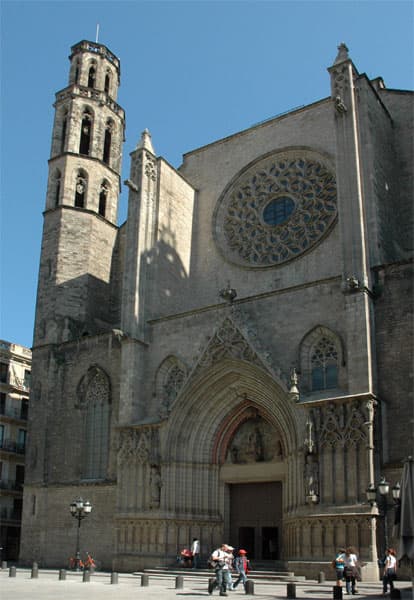
The Basilica of St Mary of the Sea, known in Catalan as Santa Maria del Mar, is a prominent church in Barcelona, Spain, constructed between 1329 and 1383. It stands as a remarkable example of Catalan Gothic architecture, distinguished by its stylistic purity and unity. The basilica holds significance as a testament to the maritime and mercantile power of the Principality of Catalonia during the medieval period, and notably, its construction was supported by the common people rather than the nobility.

Basilica of St Mary the Royal
The Basilica of St Mary the Royal, officially known as Basílica de Santa María la Real de Covadonga, is a Neo-Romanesque Catholic church located in Covadonga, Asturias, Spain. Designated a basilica in 1901, it serves as a monumental sanctuary built to replace an older temple destroyed by fire in 1777, and is dedicated to Our Lady of Covadonga.