
Basilica of the Nativity of Mary
Austria·Mariazell
The Mariazell Basilica, also known as Basilica Mariä Geburt, is Austria's most significant Christian pilgrimage site and a major European shrine. It houses a venerated miraculous wooden image of the Virgin Mary and was elevated to the status of a minor basilica by Pope Pius X in 1907. The basilica is also recognized as the national shrine for all German-speaking countries.
Key Facts
- ›The basilica is Austria's most important Christian pilgrimage destination and one of Europe's most visited shrines.
- ›It houses a miraculous wooden image of the Virgin Mary, known as the 'Magna Mater Austria'.
- ›Pope Pius X raised the sanctuary to a minor basilica on November 10, 1907.
- ›The church was significantly redesigned in the Baroque style by Domenico Sciassia between 1644 and 1683.
- ›The high altar was designed by Johann Bernhard Fischer von Erlach and consecrated in 1704.
- ›The basilica underwent a general restoration between 1992 and 2007.

Gothic, Baroque
Miraculous Wooden Image of the Virgin Mary
St. Lambert's Abbey
Domenico Sciassia, Johann Bernhard Fischer Von Erlach
About Basilica of the Nativity of Mary
Mariazell Basilica
The Mariazell Basilica, also known by its German name Basilica Mariä Geburt (Basilica of the Birth of the Virgin Mary), stands as the preeminent Christian pilgrimage site in Austria and ranks among the most frequently visited shrines in Europe. Its profound religious significance is centered on the veneration of a miraculous wooden image of the Virgin Mary housed within its walls.
Historical and Religious Importance
The origins of the sanctuary trace back to around 1103 when the territory was granted to St. Lambert's Abbey, leading monks to establish a "cell" to serve the local populace. While tradition dates the town's founding to December 21, 1157, historical documentation first appears in 1243. A Marian altar was dedicated in 1266, marking an early step in its devotional history. The church's status was significantly elevated when Pope Pius X personally raised it to the rank of a minor basilica on November 10, 1907, through a Motu proprio. He further decreed the coronation of the Marian image on September 8, 1908. Mariazell holds the unique distinction of being named the national shrine for all German-speaking countries.
Architectural Evolution
The current church building showcases a rich architectural history. In the fourteenth century, a Gothic church with a striking 90-meter high spire and an ogive portal stood on the site. This structure was unfortunately ravaged by fire in 1420 and again in 1474. Subsequently, between 1644 and 1683, the church was substantially expanded and reimagined in the Baroque style by Domenico Sciassia. This transformation included the addition of Baroque towers flanking the Gothic spire, the lengthening and widening of the nave, and the incorporation of a dome on the eastern side. The majestic high altar, consecrated in 1704, was a design by the renowned Johann Bernhard Fischer von Erlach. The interior is further adorned with twelve side chapels, each featuring a Baroque altar. The intricate plaster stucco work of the organ gallery and the 1737 organ console were crafted by the Viennese sculptor Johann Wagner in 1740. Two life-sized lead statues, created by Balthasar Moll in 1757, stand before the main entrance: King Ludwig I of Hungary to the left and Heinrich, Margrave of Moravia, to the right.
The Holy Image and Chapel
At the heart of the basilica's pilgrimage tradition is the Gnadenkapelle (Chapel of Grace), built in 1690. This chapel stands on the very spot of the first "cell" and enshrines the Late Romanesque miraculous image of the Virgin Mary, referred to as the "Magna Mater Austria." This statuette, carved from linden wood and standing 48 cm tall, is adorned annually with an elaborately designed "mercy dress." Over 150 of these dresses are preserved, either displayed in the treasury or carefully conserved, many having been donated as votive offerings by pilgrims and wealthy patrons. The honor of designing a mercy dress remains highly esteemed today.
Pilgrimage Development and Legends
Pilgrimage to the Marian sanctuary at Mariazell commenced as early as the 12th century. Significant increases in pilgrim numbers are recorded from around 1330, partly due to a secular court imposing a "Zellfahrt" (Zell journey) as penance for criminals. In the subsequent years, the flow of pilgrims grew from neighboring lands. Following the Counter-Reformation, the Habsburgs officially designated Mariazell as a national sanctuary. However, Emperor Joseph II's policies in the late 18th century led to the abandonment of the monastery and a temporary ban on pilgrimages. Despite these interruptions, following the withdrawal of restrictions, Mariazell now attracts approximately one million pilgrims annually. The basilica was also chosen as the central motif for an Austrian collector's coin in 2007, commemorating its enduring significance.
Several legends surround the founding of Mariazell and its early development. The founding legend tells of a monk named Magnus in 1157 whose path was cleared by a rock moving aside when he placed his Marian figurine upon it. He then built a wooden cell on a nearby bank. A second legend speaks of Henry, Margrave of Moravia, and his wife being healed by the Virgin Mary's intercession, prompting them to make a pilgrimage and commission the first stone church. The third legend attributes the construction of the Gothic church to King Ludwig I of Hungary after a victorious battle against a superior Turkish army, as a form of thanksgiving.
Source: Wikipedia ↗
Frequently Asked Questions
What is the significance of the Mariazell Basilica?
The Mariazell Basilica is the most important Christian pilgrimage destination in Austria and one of the most visited shrines in Europe. It is recognized as the national shrine for all German-speaking countries.
When was the Mariazell Basilica designated as a basilica?
Pope Pius X personally raised the sanctuary to the status of a minor basilica on November 10, 1907.
What is housed in the Mariazell Basilica?
The basilica venerates a miraculous wooden image of the Virgin Mary, a 48 cm tall statuette made of linden wood known as the 'Magna Mater Austria'. The older part of the building, the Gnadenkapelle, holds this sacred image.
What architectural styles are present in the Mariazell Basilica?
The basilica exhibits a mix of styles. It originally had a Gothic church with a tall spire, which was later expanded and redesigned in the Baroque style. Baroque towers were added, the nave was lengthened and widened, and a dome was incorporated.
What legends are associated with the founding of Mariazell?
There are three main legends. One tells of a monk named Magnus building a cell after a rock moved for him. Another involves Henry, Margrave of Moravia, and his wife being healed and commissioning the first stone church. A third legend recounts King Ludwig I of Hungary building the Gothic church after a victory.
Has the Mariazell Basilica undergone any renovations?
Yes, the basilica has been undergoing a general restoration since 1992, which was completed in 2007. The facade of the basilica was also featured on an Austrian commemorative coin in 2007.
Related Basilicas

Basilica of Our Lady, Geras Abbey
The Basilica of Our Lady, Geras Abbey, is a Premonstratensian monastery church located in Geras, Lower Austria. Originally a Romanesque basilica, it was significantly reworked in the Baroque style in the 18th century. It was elevated to the status of a minor basilica in 1953 and remains an active religious and cultural site, often hosting classical music recitals.

Basilica of Our Lady, Klosterneuburg Monastery
The Basilica of Our Lady, Klosterneuburg Monastery, also known as Stift Klosterneuburg, is a significant Augustinian monastery and basilica located in Lower Austria. Founded in 1114, it is renowned for its historical depth, architectural evolution from Romanesque to Baroque and Neo-Gothic styles, and its housing of the celebrated Verduner Altar.
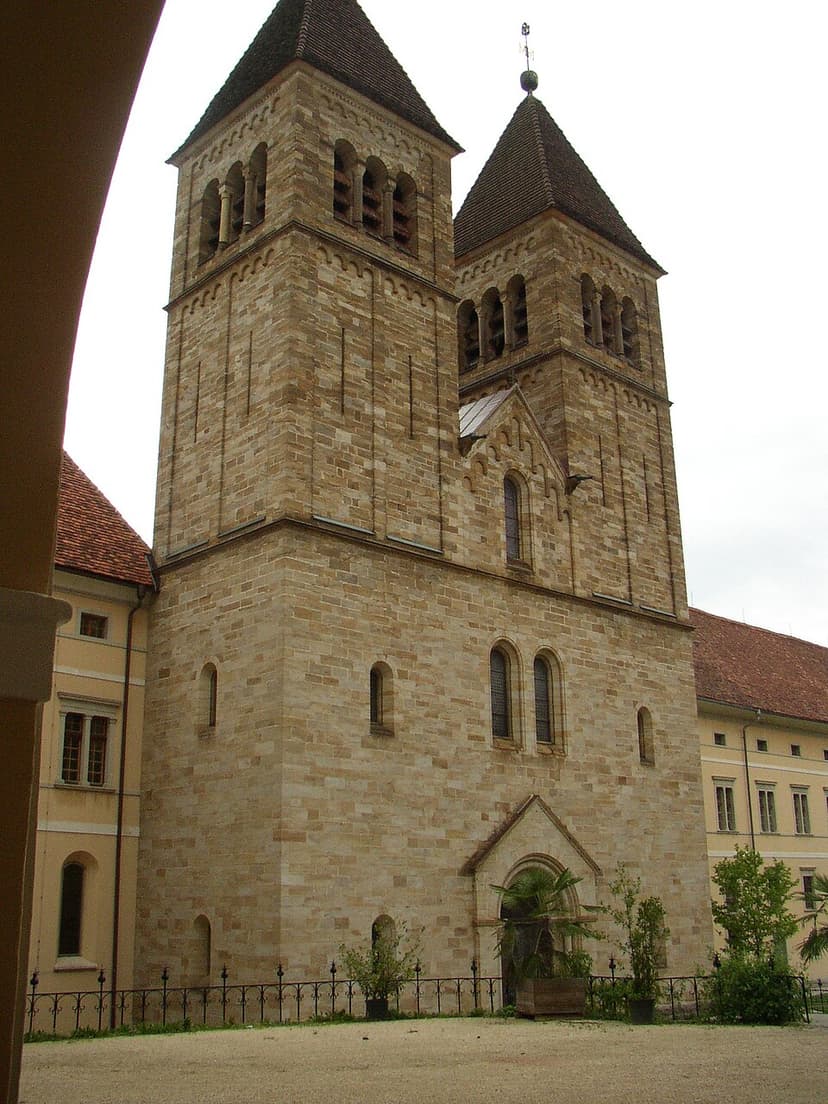
Cathedral and Abbey Church of the Assumption
Seckau Abbey, officially known as the Abbey Church of Our Dear Lady, is a Benedictine monastery and Co-Cathedral located in Seckau, Styria, Austria. Originally founded as an Augustinian canonry in the 12th century, it transitioned to Benedictine rule in the late 19th century. The abbey church itself is a significant example of Romanesque basilica architecture and has served as a burial site for a line of the Habsburgs.