
Basilica of the National Shrine of the Assumption of the Blessed Virgin Mary
United States·Baltimore·Catholic Archdiocese of Baltimore
The Basilica of the National Shrine of the Assumption of the Blessed Virgin Mary, also known as the Baltimore Basilica, is a significant Catholic cathedral in Baltimore, Maryland. It holds the distinction of being the first Catholic cathedral built in the United States after the nation's founding and was among the earliest major religious structures erected post-Constitution. It is a co-cathedral, a parish church ranked as a minor basilica, and a national shrine, considered the masterpiece of Benjamin Henry Latrobe.
Key Facts
- ›Construction began in 1806 and concluded in 1863, designed by Benjamin Henry Latrobe.
- ›It was built under the guidance of John Carroll, the first American bishop.
- ›The basilica was blessed and opened for use on May 31, 1821, and consecrated on May 25, 1876.
- ›It hosted significant 19th-century meetings shaping the Catholic Church in America, including the Third Plenary Council which commissioned the Baltimore Catechism.
- ›Pope Pius XI elevated the cathedral to the rank of Minor Basilica in 1937.
- ›It was designated a National Historic Landmark in 1971 and a National Shrine in 1993.

Neoclassical
Benjamin Henry Latrobe
About Basilica of the National Shrine of the Assumption of the Blessed Virgin Mary
The Basilica of the National Shrine of the Assumption of the Blessed Virgin Mary
The Basilica of the National Shrine of the Assumption of the Blessed Virgin Mary, commonly known as the Baltimore Basilica, stands as a pivotal landmark in American Catholic history and architecture. It holds the distinction of being the first Catholic cathedral constructed in the United States following the nation's formation and was among the earliest significant religious edifices erected after the U.S. Constitution was adopted. Today, it serves a multifaceted role as a co-cathedral for the Archdiocese of Baltimore, a parish church, and a national shrine, holding the honorary rank of a minor basilica.
History and Significance
Construction of the Basilica commenced in 1806 and concluded in 1863, under the visionary design of Benjamin Henry Latrobe, a figure widely regarded as the 'Father of American Architecture.' Latrobe, who also served as Thomas Jefferson's Architect of the Capitol, developed two design proposals for John Carroll, the first American bishop: one in the Gothic style and another in Neoclassical. Bishop Carroll's choice of the Neoclassical design was a deliberate statement, aligning American Catholicism with the Enlightenment and the spirit of the newly independent republic, rather than with the Old World's historical associations of Gothic architecture. The Basilica was officially blessed and opened for worship on May 31, 1821, by Archbishop Ambrose Maréchal of Baltimore and was later consecrated on May 25, 1876, by Archbishop James Roosevelt Bayley.
The Basilica has been the site of numerous historically significant events. It hosted the funeral Mass for Charles Carroll of Carrollton, the sole Catholic signatory of the Declaration of Independence and its last surviving member. Furthermore, it served as the consecration site for most of the first American bishops, essential for the burgeoning dioceses that accompanied the young country's territorial expansion and the rapid growth of the Catholic population. For many years, more priests were ordained within its walls than in any other church in the United States. The building also played host to crucial 19th-century meetings that shaped the Catholic Church in America, including seven Provincial Councils and three Plenary Councils. These assemblies were instrumental in the founding of The Catholic University of America, and the Third Plenary Council, notable for being the largest gathering of Catholic bishops outside Rome since the Council of Trent, led to the creation of the Baltimore Catechism.
In recognition of its historical and religious importance, Pope Pius XI elevated the cathedral to the rank of Minor Basilica in 1937. It was subsequently listed on the National Register of Historic Places in 1969 and declared a National Historic Landmark in 1971. In 1993, the United States Conference of Catholic Bishops officially designated it a National Shrine. The Basilica's location is so central to the area's historical identity that it gives its name to the Cathedral Hill Historic District. Several individuals recognized for their holiness by the Catholic Church are associated with the Basilica, including Mother Mary Lange, a founder of the Oblate Sisters of Providence, and Michael J. McGivney, the founder of the Knights of Columbus, who was ordained a priest there.
Architecture
The architectural design of the Basilica is a testament to Latrobe's genius, presenting a monumental neoclassical structure that adheres to a Latin cross basilica plan. This design was a departure from previous American church architecture but aligned with established European cathedral traditions, ingeniously combining a domed central space with a longitudinal axis. The exterior is characterized by a classical Greek portico with Ionic columns, flanked by a pair of cylindrical towers topped with distinctive onion-shaped domes, which are believed to be Latrobe's original conception. The interior is dominated by a massive dome at the crossing of the transepts, creating a centralizing effect that contrasts with the building's linear exterior appearance. This expansive central space is complemented by a sophisticated system of barrel vaults and shallow, saucer-like secondary domes, bathing the interior in light, a stark contrast to the darker recesses often found in traditional Gothic cathedrals. The Basilica also houses significant works of art, including two large portraits gifted by King Louis XVIII.
Restoration and Preservation
In 2006, a comprehensive 32-month restoration project, costing $34 million, was completed. This extensive renovation aimed to restore the interior to Latrobe's original vision, correcting later additions and reintroducing the original pale yellow, blue, and rose wall colors. The project also involved re-opening 24 skylights in the main dome and replacing stained glass windows from the 1940s with clear glass. Crucially, the restoration made the Basilica's crypt and its expansive masonry undercroft accessible to the public, finally realizing Latrobe and Carroll's vision for a Chapel in the undercroft by removing sand that had filled it since construction. The Basilica reopened in November 2006, coinciding with its Bicentennial celebration. In 2012, a seven-month, $3 million restoration was completed to repair damage caused by an earthquake that occurred in August 2011.
Source: Wikipedia ↗
Frequently Asked Questions
What is the architectural style of the Baltimore Basilica?
The basilica is a monumental neoclassical-style building, designed in conformity to a Latin cross basilica plan. Its interior features a massive dome, barrel vaults, and shallow, saucer-like secondary domes, creating a light-filled space.
Who designed the Basilica of the National Shrine of the Assumption of the Blessed Virgin Mary?
The basilica was designed by Benjamin Henry Latrobe, often called the 'Father of American Architecture'. He was America's first professionally trained architect and also served as the Architect of the Capitol under Thomas Jefferson.
What is the historical significance of the Baltimore Basilica?
It was the first Catholic cathedral built in the United States after the nation's founding and was among the first major religious buildings constructed after the adoption of the U.S. Constitution. It played a crucial role in the development of the Catholic Church in America, hosting important councils and ordinations.
What important events took place at the Basilica?
The basilica hosted the funeral Mass of Charles Carroll of Carrollton, the last surviving Catholic signatory of the Declaration of Independence. Many of the first American bishops were consecrated there, and it was the site of numerous church councils that shaped Catholicism in the U.S.
What relics or notable interments are found at the Basilica?
The basilica's historic crypt beneath the main altar is the resting place for nine of the fourteen deceased Archbishops of Baltimore, including the first American bishop, John Carroll. The crypt is accessible to the public.
Has the Basilica undergone any major renovations?
Yes, a significant 32-month, $34 million restoration project was completed in 2006, restoring the interior to Latrobe's original design and incorporating modern systems. Another restoration was completed in 2012 following earthquake damage in 2011.
Related Basilicas

Cathedral Basilica of Our Lady of Seven Sorrows
The Cathedral Basilica of Our Lady of Seven Sorrows is a significant Roman Catholic church located in Navrongo, Ghana, serving as the seat for the Diocese of Navrongo–Bolgatanga. Originally built in 1906 and expanded in 1920, its elevation to a minor basilica in 2006 recognized its historical, artistic, and pastoral importance, making it one of Ghana's oldest churches. The basilica is notable for its unique mud-brick construction and interior decorations reflecting local life and Christian themes.
Cathedral Shrine of Our Lord and the Virgin of the Miracle
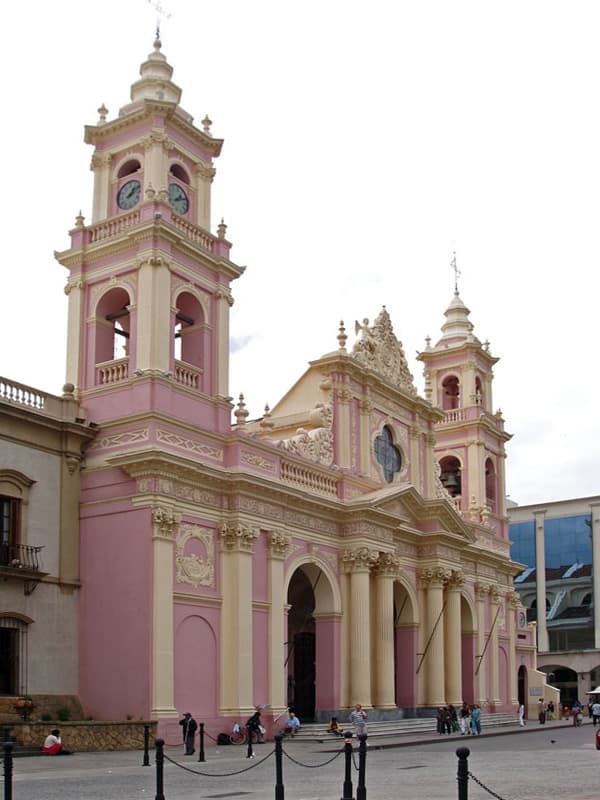
Salta Cathedral, officially the Cathedral Basilica of Salta, is the metropolitan cathedral of the Archbishop of Salta in Argentina. It is dedicated to Jesus Christ as the "Lord of Miracles" and the Blessed Virgin Mary as the "Our Lady of the Miraculous Rosary." The cathedral holds significant religious importance, having received a pontifical coronation for its enshrined images in 1902.
Basilica of the Visitation, Mariánska hora
The Basilica of the Visitation of the Blessed Virgin Mary, located on Mariánska hora in Levoča, Slovakia, is a significant pilgrimage site. Its current form was constructed between 1906 and 1922, and it has a history of religious devotion dating back to at least the 13th century. The basilica was elevated to the status of a Basilica Minor by Pope John Paul II in 1984.