
Basilica of the Holy Cross, Valle de los Caídos
The Basilica of the Holy Cross, Valle de los Caídos, also known as the Valley of Cuelgamuros, is a monumental memorial site in Spain dedicated to the memory of those who died in the Spanish Civil War. Commissioned by dictator Francisco Franco and constructed between 1940 and 1958, it features a massive basilica hewn into a granite ridge and the world's tallest memorial cross. The site has been a subject of controversy due to its association with Franco's regime and its use of convict labor.
Key Facts
- ›The Basilica of the Holy Cross, Valle de los Caídos, was constructed between 1940 and 1958.
- ›It houses the world's tallest memorial cross, standing at 150 meters (490 feet).
- ›The basilica itself is an underground crypt carved out of solid granite.
- ›Francisco Franco was buried here from 1975 until his exhumation in 2019.
- ›The site is considered a prominent example of the Spanish Neo-Herrerian architectural style.
- ›The monument's construction involved convict labor, with prisoners trading work for reduced sentences.

Neo-Herrerian
Benedictines
Pedro Muguruza, Diego MéNdez
About Basilica of the Holy Cross, Valle de los Caídos
The Basilica of the Holy Cross, Valle de los Caídos, officially known as the Valley of Cuelgamuros since 2022, is a significant memorial site located in the Sierra de Guadarrama mountain range near San Lorenzo de El Escorial, Spain. Commissioned by the Nationalist dictator Francisco Franco in 1940, the monument was constructed over eighteen years, concluding in 1958, and opened to the public in 1959. Franco described it as a "national act of atonement" and reconciliation. The site served as Franco's burial place from his death in 1975 until his exhumation in 2019, following a contentious legal process aimed at removing public glorification of his dictatorship.
Architectural Significance and Design
Considered a landmark of 20th-century Spanish architecture, the monument was designed by Pedro Muguruza and Diego Méndez to achieve a grandeur intended to "defy time and memory." It is a prime example of the Spanish Neo-Herrerian style, a revival of Juan de Herrera's architectural approach, which was popular for post-war public buildings and influenced by international fascist classicism. The complex encompasses over 13.6 square kilometers of woodland and granite formations. Its most striking feature is the 150-meter-high (490-foot) Christian cross, the tallest of its kind globally, erected over a granite outcrop and visible for over 30 kilometers.
The Basilica and Abbey
The Basílica de la Santa Cruz del Valle de los Caídos is hewn directly out of a granite ridge. In 1960, Pope John XXIII declared the underground crypt a basilica. Its excavated dimensions are noted as being larger than those of St. Peter's Basilica in Rome, though a partitioning wall was built near the entrance to avoid direct competition. The basilica features memorial sculptures by Luis Sanguino and monumental works by Juan de Ávalos. The complex also includes the Benedictine Abbey of the Holy Cross of the Valley of the Fallen, where resident priests conduct perpetual Masses for the repose of the fallen of the Spanish Civil War and subsequent conflicts.
Historical Context and Controversy
The Valley of Cuelgamuros is situated beneath the monument, containing the remains of approximately 40,000 individuals. While it includes both Nationalist and Republican graves, the dedication inscribed reads "Fallen for God and for Spain," a phrase associated with Francoist Spain. Many Republicans were interred there without their families' consent, and concerns have been raised about families' difficulties in recovering remains. The site has been a focal point for debate since Spain's transition to democracy, with governmental efforts to redefine it as a "place of democratic memory" and to remove elements glorifying the Franco regime. The monument was controversially closed to visitors from 2009 to 2012, and subsequent changes have been implemented to reinterpret its historical significance.
Source: Wikipedia ↗
Frequently Asked Questions
What is the Basilica of the Holy Cross, Valle de los Caídos?
This is a monumental memorial site in Spain dedicated to those who died in the Spanish Civil War. It features a large basilica carved into a mountain and is crowned by the world's tallest memorial cross.
Who commissioned the Basilica of the Holy Cross, Valle de los Caídos?
The memorial was constructed by order of the Nationalist dictator Francisco Franco, starting in 1940.
What is the architectural style of the basilica?
The monument is a prominent example of the Spanish Neo-Herrerian style, which draws inspiration from Juan de Herrera's architecture and is rooted in international fascist classicism.
Was Francisco Franco buried at the Basilica of the Holy Cross, Valle de los Caídos?
Yes, Francisco Franco was buried in the basilica from 1975 until his remains were exhumed on October 24, 2019.
What is the significance of the cross at the Valle de los Caídos?
The towering 150-meter-high Christian cross is the tallest of its kind in the world and is a dominant feature of the memorial, visible from a great distance.
Has the site been controversial?
Yes, the site has been the subject of significant debate due to its association with the Franco dictatorship and the use of convict labor during its construction.
Related Basilicas
Basilica of St Lawrence, El Escorial
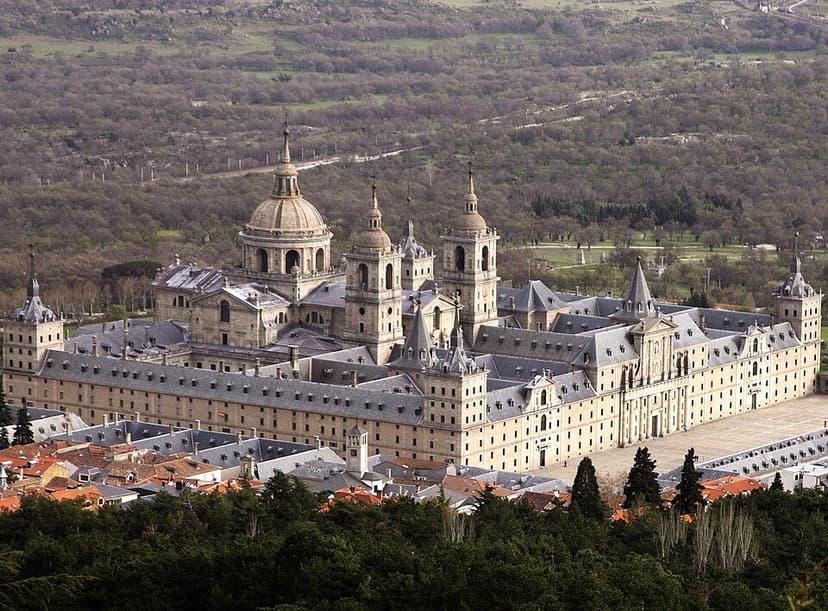
The Royal Site of San Lorenzo de El Escorial, commonly known as El Escorial, is a vast historical complex in Spain that includes a basilica, royal palace, monastery, and pantheon. Commissioned by King Philip II and built between 1563 and 1584, it was designed as a monument to Spain's role as a center of the Christian world and a royal necropolis. Its unique grid-like architecture, inspired by various historical models including the Temple of Solomon, established a new architectural style known as Herrerian.

Cathedral Basilica of the Holy Cross and St Eulalia
The Cathedral Basilica of the Holy Cross and Saint Eulalia, commonly known as Barcelona Cathedral, is the principal church of the Archdiocese of Barcelona. Constructed primarily between the 13th and 15th centuries, its Catalan Gothic architecture is characterized by expansive interior spaces and balanced proportions, rather than soaring heights. It is significant for housing the relics of Saint Eulalia and for its historical role in significant events, including hosting chapters of the Order of the Golden Fleece.

Basilica of the Exaltation of the Holy Cross and St. Jadwiga
St. Jadwiga's Basilica, located in Legnickie Pole, Poland, is a significant religious site serving as the parish church for the Holy Cross and St. Jadwiga. It is also a central component of the monastery founded there by the Order of Saint Benedict.