
Basilica of St Willibrord
Netherlands·Hulst·Breda
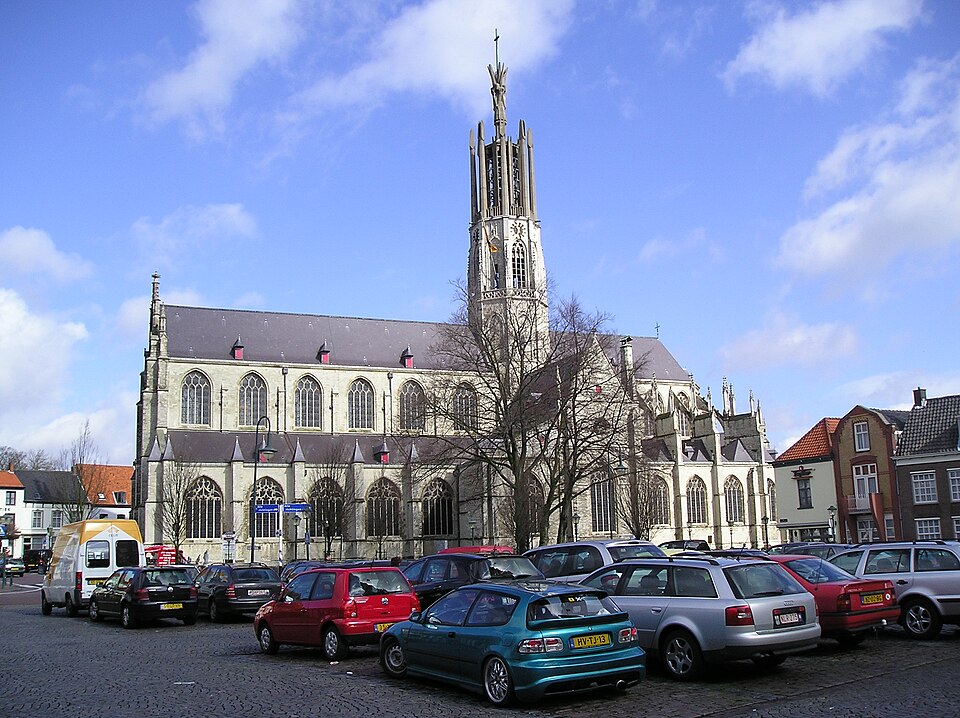
The Basilica of St. Willibrord is a historic Roman Catholic church located in Hulst, Netherlands. Dedicated to St. Willibrord, the apostle of the Benelux countries, the basilica showcases a significant architectural evolution from Romanesque to Brabantine Gothic styles. It holds religious importance as a place of worship and houses notable artistic works, including paintings and a historic organ.
Key Facts
- ›The nave of the Basilica of St. Willibrord dates from the 13th to 15th centuries, with significant rebuilding occurring in the 15th century under master builder Everaert Spoorwater.
- ›The church was rebuilt in Gothic style, specifically Brabantine Gothic, and its crossing tower was constructed during the 15th century.
- ›During World War II, the tower was shelled by Polish forces attempting to disable a German lookout post, resulting in its destruction.
- ›Pope Pius XI elevated the church to the status of a basilica on November 24, 1935, after it became fully Catholic again in 1929.
- ›The basilica houses a significant French-Flemish organ built by Loys Isoré in the early 17th century, which has undergone several restorations and reconstructions.
- ›A major restoration of the basilica took place between 1996 and 1999, involving extensive repairs to the stone, roof, and stained-glass windows.
Romanesque, Brabantine Gothic
Everaert Spoorwater, Herman De Waeghemazeker, Matthijs Ii Keldermans, Laurens Ii Keldermans, Pierre Cuypers, Jan Brouwer
About Basilica of St Willibrord
The Basilica of St. Willibrord in Hulst
The Basilica of St. Willibrord stands as a significant religious and architectural landmark in the center of Hulst, a fortress city in the east of Zeelandic Flanders, Netherlands. The church is dedicated to Saint Willibrord, a pivotal missionary figure often recognized as the apostle of the Benelux countries. Its history is marked by a long construction and rebuilding process, reflecting evolving architectural styles and historical events.
Architectural Evolution and History
The earliest structure on the site was a small Romanesque church, erected around 1200. This was succeeded in the first half of the 15th century by a church built in the Brabantine Gothic style, which also saw the construction of its striking crossing tower. Major rebuilding efforts commenced in 1462 under master builder Everaert Spoorwater, and despite setbacks such as a fire that destroyed the tower and nave, construction continued. The work was later overseen by Antwerp architect Herman de Waeghemazeker and involved the Keldermans family of builders, with the church's construction largely completed by 1535.
Religious and Artistic Significance
Historically, the church's religious affiliation changed significantly. It was originally Roman Catholic, then became Dutch Reformed during the Eighty Years' War. Under Napoleon, it served as a simultaneous church, with Catholics and Protestants sharing the space, separated by a wall, until 1929 when it became exclusively Catholic again. This re-establishment of sole Catholic use led to Pope Pius XI elevating the church to the status of a basilica on November 24, 1935. The interior features notable artworks, including the painting 'The Good Samaritan' by Jan Baptist Maes and scenes of the Way of the Cross by Jan Jozef Deloose. The basilica also houses a historically important French-Flemish organ built by Loys Isoré in the early 17th century, which has undergone extensive restoration.
Wartime and Restoration
The basilica's central tower played a role in military history, notably being used as a lookout post by German troops during the Second World War. In an effort to disable this post, Polish forces shelled the tower on September 18, 1944, causing significant damage and fire. The tower has been rebuilt and modified several times, with its modern appearance largely dating from the 1950s, featuring a spire designed by Jan Brouwer. A comprehensive restoration project for the basilica took place between 1996 and 1999, addressing structural issues, replacing roofing, and renewing stained-glass windows.
Source: Wikipedia ↗
Frequently Asked Questions
What is the history of the Basilica of St. Willibrord?
The first Romanesque church was built around 1200, replaced by a Gothic structure in the 15th century. Significant rebuilding and completion occurred in the late 15th and early 16th centuries. The church's religious affiliation shifted over time, eventually becoming fully Catholic again in 1929, leading to its designation as a basilica.
What architectural styles are present in the Basilica of St. Willibrord?
The basilica exhibits a transition from Romanesque in its earliest form to Brabantine Gothic for its main structure and tower. Later additions and restorations have incorporated modern elements, such as the prestressed concrete spire spire from 1957.
What notable artworks or features are inside the Basilica of St. Willibrord?
The basilica contains the painting 'The Good Samaritan' by Jan Baptist Maes and 'Way of the Cross' scenes by Jan Jozef Deloose. It also features a historic French-Flemish organ built by Loys Isoré, which is considered an artistic showpiece.
Why was the tower of the Basilica of St. Willibrord destroyed?
The tower was destroyed multiple times throughout its history, most significantly during the Second World War. Polish forces shelled the tower in 1944 to disable a German military lookout post, causing it to burn.
When was the church designated as a basilica?
The church was elevated to the status of a basilica by Pope Pius XI on November 24, 1935. This designation followed its return to full Catholic ownership in 1929.
Related Basilicas

Basilica of St Willbrord, Echternach Abbey
The Abbey of Echternach, now a basilica, is a Benedictine monastery in Luxembourg founded in the 7th century by St. Willibrord. It was a significant center of learning and religious pilgrimage, particularly known for its scriptorium and the annual dancing procession honoring its founder. The abbey has undergone numerous reconstructions throughout its history, with the current structure dedicated in 1953.

Basilica of St Nicholas
The Co-cathedral Basilica of Saint Nicholas in Amsterdam is the city's principal Roman Catholic church, dedicated to its patron saint. Originally constructed in the Neo-Baroque and neo-Renaissance styles, it was elevated to the status of a basilica minor in 2012 and later designated as a co-cathedral for the Diocese of Haarlem-Amsterdam in 2025. The basilica is significant for its prominent location near the main railway station and its role in the city's religious and musical life.

Basilica of St Servatius
The Basilica of Saint Servatius is a significant Roman Catholic church located in the heart of Maastricht, Netherlands. It is a hybrid architectural masterpiece, predominantly Romanesque, built over the tomb of Saint Servatius, an Armenian missionary and bishop. The basilica has been a major pilgrimage site for centuries, drawing visitors to its relics and the saint's grave, and remains a central hub for Catholicism in the region.