
Basilica of St Servatius
Netherlands·Maastricht·Roermond
The Basilica of Saint Servatius is a significant Roman Catholic church located in the heart of Maastricht, Netherlands. It is a hybrid architectural masterpiece, predominantly Romanesque, built over the tomb of Saint Servatius, an Armenian missionary and bishop. The basilica has been a major pilgrimage site for centuries, drawing visitors to its relics and the saint's grave, and remains a central hub for Catholicism in the region.
Key Facts
- ›Built on the burial site of Saint Servatius, an Armenian missionary bishop who died in 384 AD.
- ›The present structure is likely the fourth church on the site, with construction spanning over a century, primarily in the 11th and 12th centuries.
- ›Features a hybrid architectural style, with a dominant Romanesque core and Gothic additions from the 14th and 15th centuries.
- ›The church's westwork and east choir have been influential in the development of Romanesque architecture in the Meuse and Rhine valleys.
- ›Designated a Basilica Minor by Pope John Paul II in 1985.
- ›Houses a significant treasury with relics associated with Saint Servatius, including his reliquary shrine and bust.

Romanesque, Gothic, Baroque
Servatius
- Reliquary Shrine of Saint Servatius
- Reliquary Bust of Saint Servatius
- Key of Saint Servatius
- Cup of Saint Servatius
- Crozier of Saint Servatius
- Pectoral Cross of Saint Servatius
- Fragments From the 14th-Century Choir Rood Screen
Pierre Cuypers, Etienne Fayen
About Basilica of St Servatius
Basilica of Saint Servatius
The Basilica of Saint Servatius in Maastricht, Netherlands, is a significant Roman Catholic church renowned for its hybrid Romanesque and Gothic architecture and its deep historical and religious importance. Situated next to the Church of Saint John on the Vrijthof square, the basilica stands as a testament to centuries of faith and architectural evolution.
History and Construction
The present structure is believed to be the fourth church built on the site of the grave of Saint Servatius, an Armenian missionary and bishop who died in Maastricht around 384 AD. The initial memorial chapel gave way to a stone church by bishop Monulph around 570, followed by a larger pilgrim church in the late 7th century. The current basilica was constructed in stages over more than a century, with the nave built in the first half of the 11th century, the transept in the latter half, and the choir and westwork in the 12th century. This Romanesque construction period was marked by close ties to the Holy Roman Emperors, influencing the church's design to resemble a German imperial church. Emperor Henry III attended its dedication in 1039. The sculpted Bergportaal, a transitionary work between late Romanesque and early Gothic styles, was begun around 1180. Subsequent centuries saw the addition of Gothic chapels and vaulted ceilings in the 14th and 15th centuries, a late Gothic spire in 1556, and Baroque helmet spires in 1770. The church's interior has undergone numerous transformations, including the demolition of a Gothic choir rood screen and later whitewashing of the interior, giving it a Baroque appearance by the end of the 18th century. The French Revolution in 1797 led to the dissolution of the chapter, use of the church as a stable, and the loss or destruction of many furnishings and treasures. Subsequent damage occurred when the 11th-century Chapel of Saint Maternus and the 15th-century Koningskapel were demolished, and the 11th-century crypt was removed to lower the choir. Major restorations between 1866 and 1900, led by architect Pierre Cuypers, reversed some damage. A fire in 1955 necessitated further restoration in the 1980s, during which Cuypers' colourful interior decoration scheme was largely removed.
Religious and Artistic Significance
For centuries, the presence of Saint Servatius's grave and numerous relics have drawn large numbers of pilgrims, fostering a tradition of a seven-yearly pilgrimage in cooperation with nearby Aachen and Kornelimünster. This tradition, the Pilgrimage of the Relics, continued until 1632 and was revived in the 19th century, persisting to the present day. Today, the Basilica of Saint Servatius serves as the main church for the Deanery of Maastricht and belongs to the Diocese of Roermond. It was officially designated a Basilica Minor by Pope John Paul II in 1985. Art historically, the church is considered one of the most important religious buildings in the former Prince-Bishopric of Liège. Its East choir and Westwork have significantly influenced Romanesque architecture in the Meuse and Rhine valleys. The South portal's late Romanesque sculpture is particularly noted for its contribution to the early development of Gothic sculpture in France. The Westwork contains elaborately carved capitals depicting scenes from theological texts and bestiaries, notable for their botanical ornaments, animals, and human figures. A sculpted Romanesque choir screen within the Westwork depicts the Virgin and Child and Christ with Saints Peter and Servatius. The church's treasury houses a rich collection of relics and treasures, including reliquaries, liturgical vessels, medieval ivories, and textiles, many of which date back to the donation by Einhard, Charlemagne's biographer, around 830 AD.
Source: Wikipedia ↗
Frequently Asked Questions
Where is the Basilica of Saint Servatius located?
The Basilica of Saint Servatius is located in the center of Maastricht, Netherlands, next to the Church of Saint John, backing onto the town's main square, Vrijthof.
What is the architectural style of the Basilica of Saint Servatius?
The basilica is architecturally hybrid, but primarily Romanesque in its core structure. It features significant Gothic elements from later periods, including chapels, vaulted ceilings, and a late Gothic spire. The westwork also received Baroque helmet spires in the 18th century.
Why is the Basilica of Saint Servatius religiously significant?
Its religious significance stems from being built over the grave of Saint Servatius, an important early missionary bishop. The church has a long history as a pilgrimage destination, drawing many visitors to its relics and the saint's tomb, and continues to be a major center of Catholicism in Maastricht.
What notable relics are housed in the Basilica of Saint Servatius?
The basilica's treasury holds numerous important relics, including the reliquary shrine and reliquary bust of Saint Servatius. It also contains his key, cup, crozier, pectoral cross, a large patriarchal cross, and various other reliquaries, liturgical vessels, medieval ivories, and textiles.
What is the history of the pilgrimage tradition at the Basilica of Saint Servatius?
A significant pilgrimage tradition, known as the Pilgrimage of the Relics (Heiligdomsvaart), has drawn large numbers of pilgrims since at least the 14th century. This tradition, often organized in cooperation with nearby Aachen Cathedral, continued until the 17th century and was revived in the 19th century, with the tradition continuing to the present day.
Related Basilicas

Basilica of St Nicholas
The Co-cathedral Basilica of Saint Nicholas in Amsterdam is the city's principal Roman Catholic church, dedicated to its patron saint. Originally constructed in the Neo-Baroque and neo-Renaissance styles, it was elevated to the status of a basilica minor in 2012 and later designated as a co-cathedral for the Diocese of Haarlem-Amsterdam in 2025. The basilica is significant for its prominent location near the main railway station and its role in the city's religious and musical life.
Basilica of St Willibrord
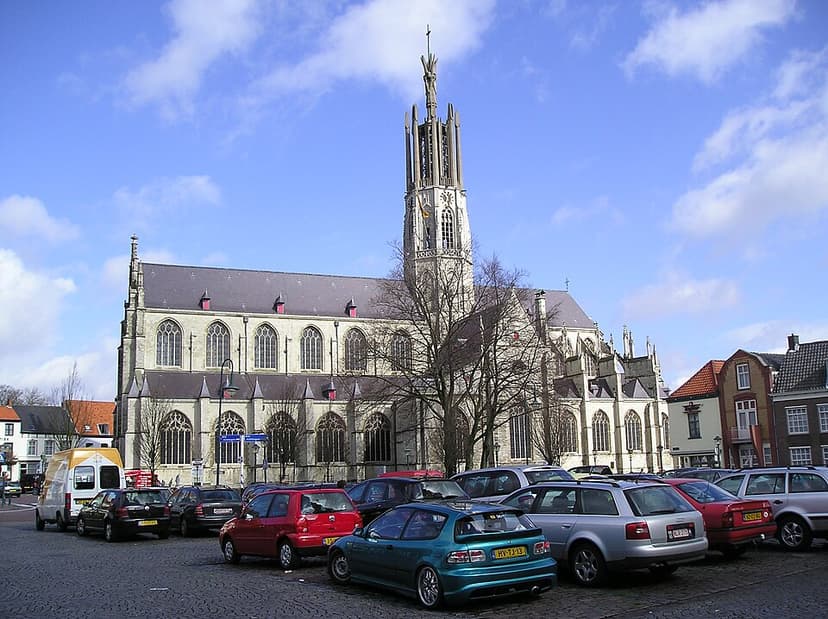
The Basilica of St. Willibrord is a historic Roman Catholic church located in Hulst, Netherlands. Dedicated to St. Willibrord, the apostle of the Benelux countries, the basilica showcases a significant architectural evolution from Romanesque to Brabantine Gothic styles. It holds religious importance as a place of worship and houses notable artistic works, including paintings and a historic organ.

Cathedral Basilica of St John the Evangelist
The Cathedral Basilica of St. John the Evangelist, also known as Sint-Janskathedraal, is a significant Catholic cathedral in 's-Hertogenbosch, Netherlands. It is the largest cathedral in the country and a prime example of Brabantine Gothic architecture in Europe, serving as the seat of the Bishopric of 's-Hertogenbosch. Its history spans centuries, evolving from a Romanesque parish church to a grand Gothic structure that has undergone numerous restorations and adaptations.