
Basilica of Santo Domingo de Silos
Spain·Santo Domingo de Silos
The Basilica of Santo Domingo de Silos is a Benedictine monastery located in the village of Santo Domingo de Silos in northern Spain. Originally dating back to the 7th century, it gained prominence in the 11th century under Saint Dominic of Silos. The monastery is renowned for its exceptional Romanesque cloister, considered a masterpiece of the art form, featuring intricate carvings and sculptures.
Key Facts
- ›The monastery's origins trace back to the Visigothic period in the 7th century.
- ›It was named after Saint Dominic of Silos, who was entrusted with its renovation in the 11th century.
- ›The two-story Romanesque cloister, with its detailed capitals and relief panels, is a significant surviving example of this architectural style.
- ›The cloister was dedicated on September 29, 1088, with construction continuing into the 12th century.
- ›The Silos Library holds the Missal of Silos, noted as the oldest Western manuscript on paper.
- ›The monks gained international fame for their Gregorian chant recordings, particularly the best-selling album 'Chant'.

Romanesque, Neoclassical
Dominic of Silos
Tomb of Saint Dominic of Silos
Benedictine
Ventura RodríGuez
About Basilica of Santo Domingo de Silos
The Basilica of Santo Domingo de Silos is a historic Benedictine monastery situated in the village of Santo Domingo de Silos, within the Burgos Province of northern Spain. Its origins date back to the 7th century, during the Visigothic period. The monastery acquired its current name and significant prominence in the 11th century, largely due to the influence and renovation efforts of Saint Dominic of Silos, who was entrusted with the site by King Fernando the Great of Castile and León.
History and Architecture
The monastery's rich history is most visibly represented by its exceptional Romanesque cloister. Construction on the church, designed with a central nave, two side aisles, and chapels, was initiated under Saint Dominic and completed by his successor, Abbot Fortunius. However, the cloister, dedicated in 1088, is widely considered a masterpiece of Romanesque art. Its two stories feature intricately carved capitals depicting a diverse range of subjects, including animals, foliage, and biblical narratives, as well as relief panels showcasing scenes from the Post-Passion of Christ. The cloister's construction was interrupted by political and economic difficulties, leading to variations in style between its galleries, indicating the involvement of different workshops.
The monastery's library is also of historical importance, having been a major repository for Mozarabic rite manuscripts. It famously houses the Missal of Silos, recognized as the oldest Western manuscript written on paper. The monastery was closed in 1835 but was later revived in 1880 by Benedictine monks from Solesmes, France, who have maintained its traditions.
Musical Legacy
Beyond its architectural and historical significance, the monks of Santo Domingo de Silos have achieved international acclaim for their performances of Gregorian chant. Their 1994 album "Chant" became a global phenomenon, topping music charts and earning triple platinum certification, making it the best-selling Gregorian chant album of all time. This success brought widespread attention to the monastery's authentic practice of Gregorian chant as part of their daily monastic worship.
Source: Wikipedia ↗
Frequently Asked Questions
What is the history of the Basilica of Santo Domingo de Silos?
The monastery's history begins in the 7th century during the Visigothic period. It was renamed in the 10th century after Saint Dominic of Silos undertook its renovation. The church itself was later rebuilt by neoclassical architect Ventura Rodríguez.
What is significant about the cloister at Santo Domingo de Silos?
The two-story cloister is considered a masterpiece of Romanesque art. It is adorned with extensive carvings on its capitals, depicting a variety of animals, foliage, and narrative scenes, as well as relief panels with biblical subjects.
What are some notable items or features within the monastery?
The monastery houses the Silos Library, which contains the Missal of Silos, the oldest Western manuscript on paper. It also features a historic pharmacy with a specialist library and significant Romanesque sculptural works.
Is the Basilica of Santo Domingo de Silos open to the public?
Yes, the cloisters and the pharmacy are accessible to the public. Visitors can also attend religious services such as vespers in the abbey church.
What is the musical legacy of Santo Domingo de Silos?
The monks of Santo Domingo de Silos became internationally famous for their recordings of Gregorian chant. Their 1994 album 'Chant' achieved significant commercial success, becoming the best-selling Gregorian chant album ever.
Related Basilicas
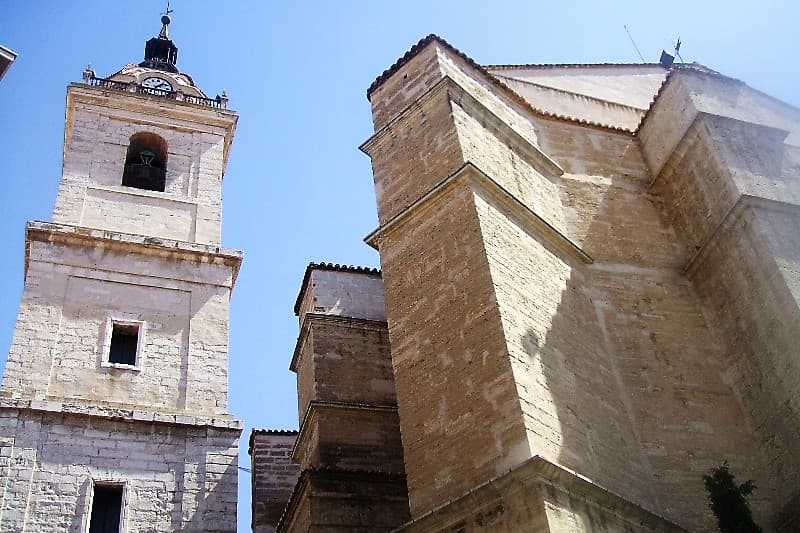
Cathedral Basilica of St Mary of the Meadow
The Holy Priory Church Cathedral Basilica of the Military Orders of Our Lady Saint Mary of the Prado, commonly known as the Cathedral of Saint Mary of the Prado, is a significant religious and architectural landmark in Ciudad Real, Spain. Its construction, spanning centuries and incorporating Gothic, Renaissance, and Baroque elements, makes it a rich historical monument. Since 1875, it has served as the priory for four of Spain's military orders, underscoring its enduring importance.

Basilica of St Mary of the Pine
The Basilica of St Mary of the Pine, known in Catalan as Santa Maria del Pi, is a significant 15th-century Gothic church located in Barcelona, Spain. It stands as a prominent example of Catalan Gothic architecture, characterized by its single nave and minimal ornamentation. The basilica has a long history marked by damage from earthquakes, wars, and fires, necessitating several reconstructions and restorations throughout the centuries.
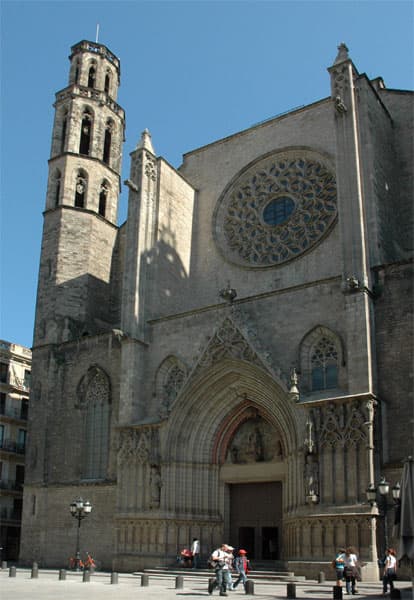
Basilica of St Mary of the Sea
The Basilica of St Mary of the Sea, known in Catalan as Santa Maria del Mar, is a prominent church in Barcelona, Spain, constructed between 1329 and 1383. It stands as a remarkable example of Catalan Gothic architecture, distinguished by its stylistic purity and unity. The basilica holds significance as a testament to the maritime and mercantile power of the Principality of Catalonia during the medieval period, and notably, its construction was supported by the common people rather than the nobility.