
Jyotisar
Jyotisar is a significant Hindu pilgrimage site located in Kurukshetra, Haryana, India, on the banks of the Jyotisar Sarovar wetland. It is traditionally believed to be the exact location where Lord Krishna delivered the sermon of the Bhagavad Gita to Arjuna and revealed his universal form. The site is named for its meaning, 'the essence of enlightenment,' and is central to the Krishna circuit of religious destinations.
Key Facts
- ›Jyotisar is considered the sacred site where Krishna delivered the Bhagavad Gita to Arjuna.
- ›Adi Shankara identified Jyotisar as the precise location of the Gita sermon in the 8th century.
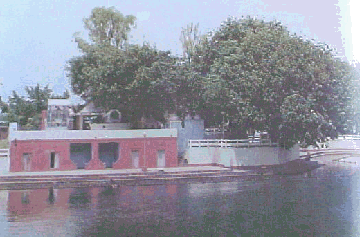
- ›A banyan tree, believed to be an offshoot of the original under which Krishna preached, stands at the site.
- ›The site features an old Shiva temple where the Kauravas and Pandavas are said to have worshipped.
- ›Jyotisar is a focal point for the annual International Gita Mahotsav, culminating in the Gita Deepotsav festival.
- ›A 40-foot-tall statue of Krishna's cosmic form was installed in 2021.
Krishna, Shiva
Religious Pilgrimage Site, Location of Bhagavad Gita Sermon, Associated With Mahabharata Epic, Part of Krishna Circuit
International Gita Mahotsav, Gita Deepotsav
Marble, Ashtadhatu, Bronze
Adi Shankara
- Marble Chariot Statue Depicting Krishna Preaching To Arjuna
- 40-Foot-Tall Statue of Krishna's Cosmic Form
Jyotisar Sarovar, Sarasvati River
About Jyotisar
Jyotisar is a revered Hindu pilgrimage site situated on the banks of the Jyotisar Sarovar wetland in Kurukshetra, Haryana, India. Its name, translating to 'the essence of enlightenment,' reflects its profound spiritual significance. The site is traditionally identified as the very spot where Lord Krishna delivered the pivotal sermon of the Bhagavad Gita to his disciple Arjuna, guiding him through his ethical dilemma on the battlefield. It is also believed to be the place where Krishna revealed his divine, universal form (vishvarupa) to Arjuna.
Historical and Traditional Context
The identification of Jyotisar as the exact location of the Bhagavad Gita's revelation is attributed to the 8th-century Hindu scholar Adi Shankara. According to the epic Mahabharata, Krishna's discourse took place beneath a sacred banyan tree. While the original tree is no longer present, a local banyan tree, considered an offshoot, stands on a raised platform at the site. An ancient Shiva temple also exists here, with local traditions suggesting that both the Kauravas and Pandavas worshipped at this shrine.
Religious Heritage and Development
Jyotisar is an integral part of the Krishna circuit, a pilgrimage route connecting significant sites related to Lord Krishna's life. The site is managed by the Kurukshetra Development Board and is undergoing significant development as part of a joint venture between the Government of Haryana and India's Ministry of Culture, aimed at enhancing religious heritage tourism. This project includes the creation of a Bhagavad Gita and Mahabharata museum, the installation of numerous statues depicting characters and events from the epic, and the beautification of the Sarasvati Riverfront.
Festivals and Modern Attractions
Jyotisar plays a central role in the annual International Gita Mahotsav, celebrated in December. The festival's highlight is the Gita Deepotsav, a spectacular 'festival of lights' where hundreds of thousands of traditional earthen lamps illuminate the water bodies and surrounding areas. The site is also home to a 40-foot-tall statue of Krishna's cosmic form, cast in an alloy of eight sacred metals, and a marble chariot statue commemorating the Gita sermon. A daily laser, light, and sound show at Jyotisar Lake recreates key episodes from the Mahabharata, drawing visitors and pilgrims.
Source: Wikipedia ↗
Frequently Asked Questions
What is the significance of Jyotisar?
Jyotisar holds immense religious significance as the traditional site where Lord Krishna delivered the sermon of the Bhagavad Gita to Arjuna. It is also believed to be where Krishna revealed his vishvarupa (universal form) to his friend. This makes it a crucial pilgrimage destination for Hindus.
What does the name Jyotisar mean?
The name Jyotisar is derived from Sanskrit words. 'Jyoti' signifies light or enlightenment, and 'Sar' means the core or essence. Therefore, Jyotisar translates to 'the core meaning of light' or 'the essence of enlightenment'.
What is the historical connection of Jyotisar to the Mahabharata?
According to tradition and the Mahabharata epic, Lord Krishna delivered his sermon to Arjuna beneath a banyan tree at Jyotisar. The site also has an old Shiva temple where the Pandavas and Kauravas are said to have worshipped.
What are the recent developments at Jyotisar?
Jyotisar is part of a religious heritage tourism project by the Government of Haryana and India's Ministry of Culture. This includes the construction of a Bhagavad Gita and Mahabharata museum, infrastructure development, and the installation of monumental statues depicting scenes from the epic.
What festivals are celebrated at Jyotisar?
Jyotisar is a central location for the annual International Gita Mahotsav, which takes place every December. The festival culminates in the Gita Deepotsav, where thousands of earthen lamps are lit along the Jyotisar Sarovar and other nearby water bodies.
What notable statues are located at Jyotisar?
A significant recent addition is a 40-foot-tall statue of Krishna's cosmic form, made of an alloy of eight sacred metals, installed in 2021. There is also a marble chariot statue depicting Krishna preaching to Arjuna, commemorating the revelation of the Bhagavad Gita.
Related Temples (Hindu)
Bathu Temples
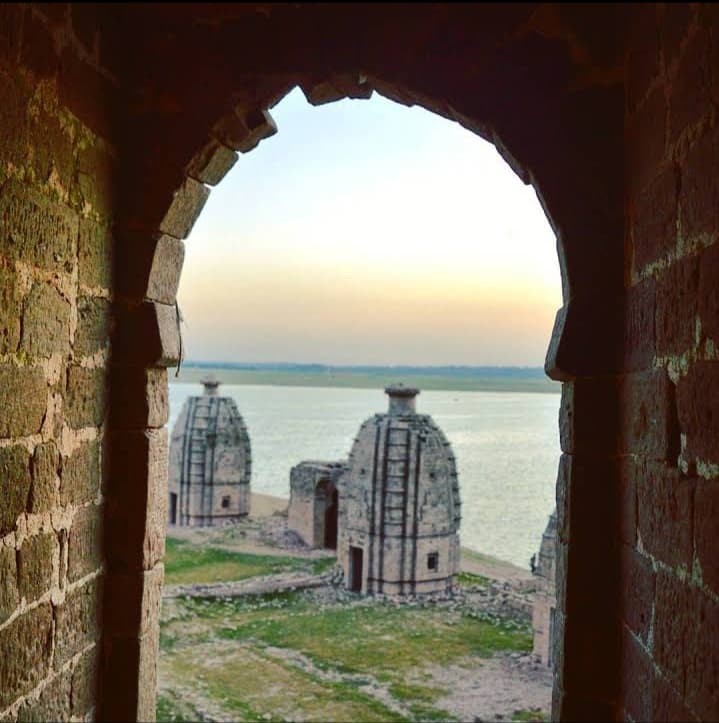
The Bathu Temples, also known as Bathu ki Ladi, are a cluster of ancient Hindu temples located in the Kangra district of Himachal Pradesh, India. Originally submerged by the Pong Dam reservoir in the 1970s, these temples are now only accessible for a few months each year when water levels recede. The main temple is primarily dedicated to Goddess Parvati and Lord Shiva, with some traditions also associating it with Lord Vishnu.

Pataleshwar Caves, Pune
The Pataleshwar Caves are an 8th-century rock-cut Hindu temple complex in Pune, Maharashtra, India, originally excavated during the Rashtrakuta period. Dedicated primarily to Shiva, the temple features a unique monolithic structure with a circular Nandi mandapa and a large pillared mandapa, with its sanctums carved deeper into the ground, giving it the name Pataleshwar, meaning 'Lord of the Underworld'. The site, managed by the Archaeological Survey of India, is a protected monument that has undergone restoration and now includes a surrounding garden and new idols.

Kichakeshwari Temple
The Kichakeshwari Temple in Khiching, Odisha, is a Hindu temple dedicated to Goddess Chamunda, also known as Kali. It served as the family and state deity for the Bhanja rulers of Mayurbhanj, with its original structure dating back to the 7th or 8th century. The temple is renowned for its Kalinga architectural style and intricate carvings, having been significantly reconstructed in 1934.