
Hanuman Temple, Connaught Place
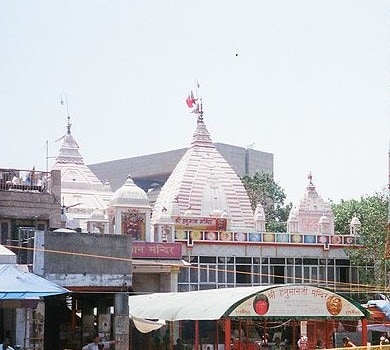
Hanuman Temple in Connaught Place, New Delhi, is an ancient Hindu temple claimed to be one of five from the Mahabharata era in Delhi. It is distinguished by a self-manifest idol of Bala Hanuman and an unusual crescent moon finial on its spire, a feature attributed to its history during the Mughal period. The temple is a significant religious center in the heart of the city, attracting large numbers of devotees, particularly on Tuesdays and Saturdays.
Key Facts
- ›Believed to be one of five ancient temples in Delhi dating back to the Mahabharata period.
- ›Features a unique crescent moon finial on its spire, instead of the traditional Aum or Sun symbol.
- ›Houses a self-manifest idol of Bala Hanuman (Hanuman as a child).
- ›The idol faces south, with devotees able to see only one eye.
- ›Reportedly rebuilt in 1724 by Maharaja Jai Singh, around the same time as the Jantar Mantar.
- ›The temple complex has been expanded to include shrines for other deities like Shiva, Durga, and Santoshi Mata.
Hanuman, Shiva, Parvati, Durga, Lakshmi Narayan, Ganesha, Santoshi Mata, Rama, Lakshmana, Sita, Krishna, Radha
- Ancient Religious Site
- Claimed Historical Connection To the Mahabharata Period
- Unique Architectural Feature
- Significant Pilgrimage Destination
Mughal Empire
Hanuman Jayanti
Marble, Silver
Maharaja Man Singh I, Maharaja Jai Singh, Tulsidas
Paintings of Hanuman In Cardinal Directions, Paintings Depicting Ramayana Story On Ceiling
Yamuna River
About Hanuman Temple, Connaught Place
Hanuman Temple, located in Connaught Place, New Delhi, is an ancient Hindu temple that holds significant historical and religious importance. It is traditionally believed to be one of five temples dating back to the Mahabharata epic period in Delhi. The temple is renowned for its self-manifest idol of Bala Hanuman, depicting the deity as a child, and for a distinctive feature on its spire: a crescent moon, an unusual element for Hindu temples, which is said to have played a role in its preservation during periods of invasion.
History and Legend
The temple's origins are intertwined with the legend of the Pandavas, who are said to have ruled from Indraprastha, the ancient name for Delhi. Mythological accounts suggest that during their exile, Hanuman appeared disguised before Bhima. Following the Pandavas' victory in the Kurukshetra War, it is believed they constructed several temples, including this one dedicated to Hanuman.
Historically, the temple is linked to the Mughal era. It is believed that the renowned saint and poet Tulsidas, author of the Ramacharitamanas and the Hanuman Chalisa, visited this temple. Legend states that Tulsidas, after performing a miracle at the request of a Mughal Emperor, was presented with an Islamic crescent moon finial for the temple's spire. The temple is also reported to have been originally built by Maharaja Man Singh I of Amber during Emperor Akbar's reign and was reconstructed by Maharaja Jai Singh in 1724.
Temple Features and Significance
Entry to the temple is through marble steps leading to a foyer with silver-plated doors engraved with scenes from the Ramayana. The foyer features clerestory windows with paintings of Hanuman, and the walls are inscribed with the Sundar Kand from Tulsidas's Ramayana. The Sanctum Sanctorum houses the idol of Bala Hanuman, which faces south. The idol is depicted with a mace and its right hand crossed over its chest in reverence to the adjacent idols of Rama, Lakshmana, and Sita. Images of Radha and Krishna are also installed nearby.
In recent years, the temple complex has been expanded to include shrines dedicated to other deities, such as Shiva, Parvati, Durga, Lakshmi Narayan, Ganesha, and Santoshi Mata. These additions have enhanced the temple's role as a notable religious center in the heart of Delhi. Tuesdays and Saturdays are considered auspicious days for worship, drawing large crowds, and Hanuman Jayanti is celebrated with great fervor annually.
Source: Wikipedia ↗
Frequently Asked Questions
What is the historical significance of Hanuman Temple, Connaught Place?
The temple is ancient and is claimed to be one of five temples in Delhi from the Mahabharata period. It is believed to have been originally built by Maharaja Man Singh I and reconstructed by Maharaja Jai Singh in 1724. Its historical importance is also linked to the Mughal period, with a legend attributing its survival to a crescent moon finial gifted by an emperor.
What is unusual about the Hanuman idol at this temple?
The idol is of Bala Hanuman, depicting Hanuman as a child. It is a self-manifest idol and faces the southern direction, meaning only one eye is visible to devotees. The idol holds a mace in its left hand and has its right hand crossed over its chest in veneration of the nearby idols of Rama, Lakshmana, and Sita.
What is the significance of the crescent moon on the temple's spire?
The spire features an unusual Islamic crescent moon finial instead of the common Hindu symbols like Aum or the Sun. This feature is particularly noted as significant during the Mughal period and is said to have contributed to the temple not being destroyed by Muslim invaders.
When is the best time to visit Hanuman Temple, Connaught Place?
Tuesdays and Saturdays are considered special days for worship, when large numbers of devotees gather at the temple. Hanuman Jayanti, celebrated annually on the full moon day in the month of Chaitra (March-April), is a major festival with grand celebrations.
Are there other deities worshipped at Hanuman Temple?
Yes, the temple complex has been expanded to include shrines dedicated to other deities. These include a shrine for Shiva, Parvati, and their children, as well as enclosures housing idols of Durga, Lakshmi Narayan, Ganesha, and goddess Santoshi Mata.
Related Temples (Hindu)

Trilokpur Temple
The Trilokpur Temple complex in Himachal Pradesh, India, is a significant Hindu pilgrimage site dedicated to Goddess Durga in her form as Mahamaya Bala Sundri. Legend states its origin in 1570 CE when a sacred stone representing the goddess appeared in a salt bag, leading to the construction of the main temple. The site is known for its amalgam of Indo-Persian architectural styles and attracts millions of devotees annually.

Hari Parbat
Hari Parbat is a significant hill overlooking Srinagar, Jammu and Kashmir, India, renowned for its historical fort and religious sites. It features a Hindu temple dedicated to Goddess Sharika (Parvati), identified with the sacred pebble of local mythology, alongside Muslim shrines and Sikh Gurdwaras.

Gavi Gangadhareshwara Temple
The Gavi Gangadhareshwara Temple is a 16th-century rock-cut temple in Bengaluru, India, dedicated to Lord Shiva. It is renowned for its unique architectural planning that allows sunlight to illuminate the lingam during specific times of the year, drawing large numbers of devotees.