
Longinus the Centurion
October 16·1st century·Roman Empire
Longinus the Centurion is the Roman soldier traditionally credited with piercing the side of Jesus with a lance during the Crucifixion. Initially unnamed in scripture, his legend developed to describe him as a convert to Christianity whose blindness was cured by Jesus's blood. He is venerated as a saint and martyr in various Christian traditions, particularly for his role in the events of the Passion.
Key Facts
- ›The name Longinus first appeared in the apocryphal Gospel of Nicodemus, not the canonical Gospels.
- ›He is traditionally identified as the Roman centurion who pierced Jesus's side with a lance during the Crucifixion.
- ›In later legends, his blindness was cured by contact with Jesus's blood, leading to his conversion.
- ›His relics are said to be preserved in Mantua, Prague, and other locations.
- ›Longinus is venerated as a martyr in the Roman Catholic, Eastern Orthodox, and Armenian Apostolic Churches.
- ›In Brazil, São Longuinho is invoked to find lost objects.
São Longuinho
Finding Lost Objects
Lance, Spear, Holy Lance, Holy Sponge
About Longinus the Centurion
Longinus the Centurion is the name given in tradition to the unnamed Roman soldier who pierced the side of Jesus with a lance during the Crucifixion, an event recorded in the Gospel of John. While the canonical Gospels do not name this soldier, the name Longinus first appeared in the apocryphal Gospel of Nicodemus. This act is significant in Christian tradition as it is said to have created the last of the Five Holy Wounds of Christ.
Origins and Legend
The legend of Longinus developed over centuries. Early traditions, found in pseudepigraphal texts, describe him suffering for his act, sometimes involving a recurring torment by lions. Later traditions transformed him into a Christian convert, with a prominent narrative suggesting he was a Roman centurion whose blindness was miraculously cured by the blood of Christ falling upon his eyes after he pierced his side. This miraculous healing cemented his belief and led to his conversion and veneration.
The spear used in the act is known as the Holy Lance, and the name Longinus became associated with it, particularly in legends of the Holy Grail. While historical accounts of his martyrdom are not definitively established, he is widely venerated as a saint.
Veneration and Legacy
Longinus is venerated as a martyr in the Roman Catholic Church, the Eastern Orthodox Church, and the Armenian Apostolic Church. His feast day is observed on October 16 in the Roman Martyrology and by the Eastern Orthodox Church. His relics are traditionally believed to be preserved in Mantua, Italy, and have also been associated with Prague. In Brazil, Saint Longinus, known as São Longuinho, is invoked as the patron saint for finding lost objects, a tradition stemming from folklore about his keen eyesight.
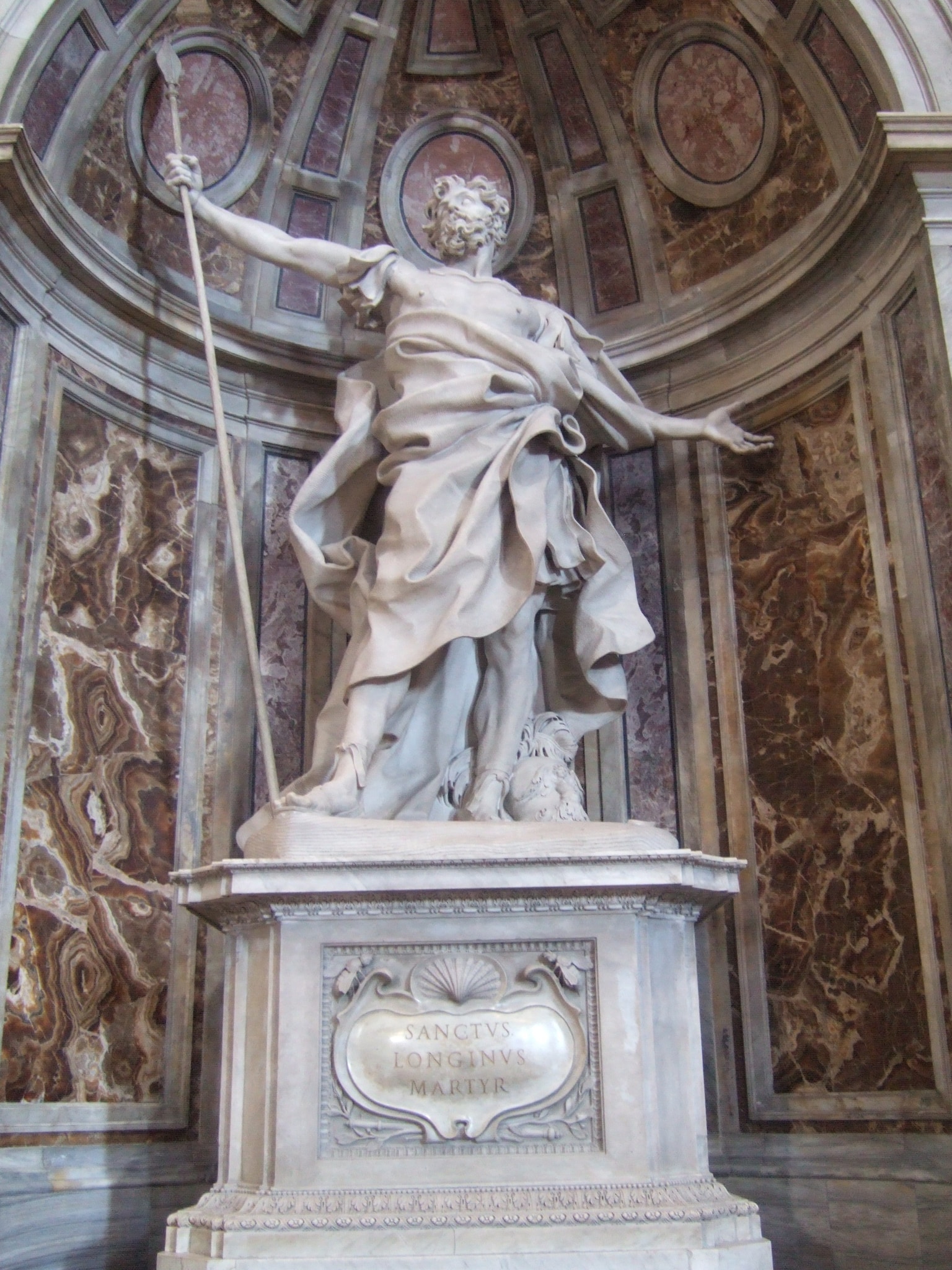
The statue of Saint Longinus sculpted by Gian Lorenzo Bernini is a notable work of art located in Saint Peter's Basilica in the Vatican City, reflecting his enduring presence in Christian art and devotion.
Source: Wikipedia ↗
Frequently Asked Questions
Who was Longinus the Centurion?
Longinus the Centurion is the name given in tradition to the Roman soldier who pierced Jesus's side with a lance during the Crucifixion. He is recognized as a saint and martyr in several Christian denominations.
Where is Longinus mentioned in the Bible?
The soldier who pierced Jesus's side is mentioned in the Gospel of John, but he is not named. The name Longinus first appears in the apocryphal Gospel of Nicodemus.
What is Longinus remembered for?
He is primarily remembered for the act of piercing Jesus's side with a lance, an event that became known as one of the Five Holy Wounds. Later traditions also emphasize his conversion to Christianity after witnessing the miracles surrounding the Crucifixion.
What are the traditions surrounding Longinus's conversion?
Christian legend states that Longinus was a blind Roman centurion whose sight was miraculously restored when Jesus's blood touched his eyes after he pierced his side. This event led to his belief in Jesus and his subsequent conversion.
Where are Longinus's relics located?
Tradition holds that Longinus's body was discovered in Mantua, Italy, along with the Holy Sponge stained with Christ's blood. Portions of his relics are also said to be in Prague and other locations.
Is Longinus considered a martyr?
Yes, Longinus is generally venerated as a martyr in the Roman Catholic, Eastern Orthodox, and Armenian Apostolic Churches, though the specific details of his martyrdom are not always consistently recorded.
What is São Longuinho known for in Brazil?
In Brazil, Saint Longinus, known as São Longuinho, is invoked for his intercession in finding lost objects. This tradition is linked to tales of his short stature allowing him to see under tables at gatherings.
Related Saints
Flavia Domitilla
Flavia Domitilla was a Roman noblewoman of the 1st century AD, a granddaughter of Emperor Vespasian and niece to Emperors Titus and Domitian. She is primarily remembered for her association with her husband, Titus Flavius Clemens, and for the differing accounts of her life and death in historical and Christian traditions, with some traditions identifying her as a martyr.
Olympas
Olympas was a Roman Christian mentioned by Paul of Tarsus in the Epistle to the Romans around 65 AD. He is recognized in the Eastern Orthodox Church as one of the Seventy disciples of Jesus. His significance lies in his inclusion in Pauline greetings, indicating his role within the early Christian community.
Demetrius of Sirmium
Saint Demetrius of Sirmium was a Roman deacon and martyr of the early 4th century. He is remembered for his martyrdom, executed for preserving Christian texts. He is often confused with the Greek saint Demetrius of Thessaloniki.