
George the Confessor
April 19·8th century·Turkey
George the Confessor was an 8th-century Bishop of Antioch in Pisidia, venerated for his steadfast adherence to icon veneration. He is remembered for his refusal to comply with iconoclast councils, leading to his exile, and his later participation in the restoration of icon veneration.
Key Facts
- ›George was the Bishop of Antioch in Pisidia during the 8th century.
- ›He attended the iconoclast Council of Hieria in 754 and refused to ban icon veneration.
- ›Emperor Constantine V exiled George for his iconodule stance.
- ›He later participated in the Second Council of Nicaea in 787, which restored icon veneration.
- ›George was banished again by Emperor Leo V for opposing the resurgence of iconoclasm.
- ›He died in exile in 814 and was named a Confessor of the Faith for his dedication.
George of Antioch
About George the Confessor
George the Confessor, also known as Saint George of Antioch, was a prominent ecclesiastical figure in the 8th century, serving as the Bishop of Antioch in Pisidia. His life is primarily remembered for his courageous and unwavering defense of the veneration of religious icons during a period of significant theological and political upheaval within the Byzantine Empire. He is recognized as a saint in both the Eastern Orthodox and Roman Catholic traditions, with his feast day celebrated on April 19th.
Life and Historical Context
George's spiritual journey began in his youth when he became a monk, distinguishing himself through his piety. This devotion later led to his ordination as bishop of Antioch in Pisidia. His tenure as bishop coincided with the iconoclast controversies, a period marked by imperial decrees against the use and veneration of religious images. In 754, George attended the iconoclast Council of Hieria in Constantinople, an assembly that officially banned the veneration of icons. As an adherent to iconodule principles, George refused to accept the council's rulings and consequently faced exile ordered by Emperor Constantine V.
Despite the challenges, George later returned from exile and played a role in the restoration of icon veneration at the Second Council of Nicaea in 787. However, his commitment to this cause was tested again at the onset of Emperor Leo V's reign, which saw a resurgence of iconoclasm. George once more refused to remove icons from churches within his diocese, leading to his second banishment. He died in exile in 814. For his steadfastness in upholding the Orthodox faith against imperial opposition, George was posthumously honored with the title "Confessor of the Faith."
Source: Wikipedia ↗
Frequently Asked Questions
Who was George the Confessor?
George the Confessor was an 8th-century Bishop of Antioch in Pisidia. He is venerated as a saint in both the Eastern Orthodox and Roman Catholic Churches.
Why is George called a Confessor?
He is named a Confessor of the Faith for his steadfast dedication to Orthodox beliefs, particularly his refusal to abandon the veneration of icons despite imperial persecution and exile.
What was George's role in the iconoclast controversies?
George attended the iconoclast Council of Hieria in 754, where he refused to ban icon veneration. He was later exiled for this stance and then participated in the Second Council of Nicaea in 787, which restored icon veneration.
When did George the Confessor live and die?
He was active in the 8th century and died in exile in 814. His feast day is observed on April 19th.
Related Saints
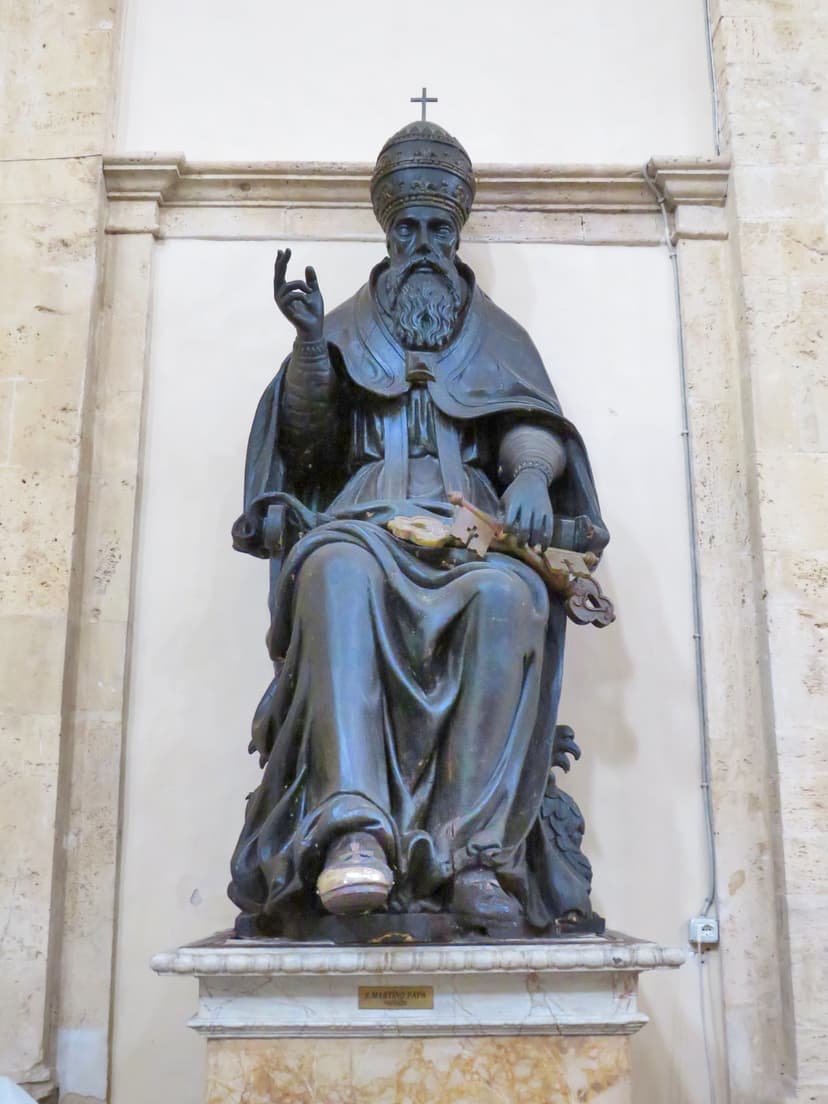
Martin the Confessor
Pope Martin I, also known as Martin the Confessor, served as bishop of Rome from 649 to 653 or 654. He is remembered for his strong opposition to Monothelitism, which led to his arrest and exile by Emperor Constans II. Martin is venerated as a saint by both the Catholic and Eastern Orthodox Churches, and is recognized as the last pope to be considered a martyr.
Pope Martin I
Pope Martin I was the bishop of Rome from 649 to 653 or 654. He is remembered for his staunch opposition to Monothelitism, a theological doctrine concerning Christ's will, which led to his arrest, exile, and death. He is recognized as a saint by both the Catholic and Eastern Orthodox Churches and is the last pope to be acknowledged as a martyr.
Paulinus of Trier
Saint Paulinus of Trier was a bishop of Trier and a staunch supporter of St. Athanasius the Great during the conflict against Arianism. He was exiled by Emperor Constantius II for his opposition to Arianism and died in exile, though his remains were later returned to Trier and interred in a church rededicated in his honor.