
Semeru
Semeru is the highest and most active volcano on the Indonesian island of Java, standing at 3,676 meters. Derived from the Hindu concept of Meru, the world mountain, it is also known as Mahameru, meaning "The Great Mountain." Its spiritual significance is profound, with Indonesian Hindus believing it to be the abode of Shiva.
Key Facts
- ›Semeru is an active stratovolcano located in East Java, Indonesia, standing at 3,676 meters.
- ›Its name originates from the Hindu world mountain Meru or Sumeru, the abode of gods.
- ›The volcano has a long eruptive history, with over 60 eruptive periods recorded since 1818, often involving lava and pyroclastic flows.
- ›Semeru has been in a state of near-constant eruption since 1967.
- ›Local legends describe Semeru being transplanted from India to create Java, with parts breaking off to form other mountains.
- ›Non-native invasive plants and erosion from surrounding vegetable plantations pose ecological threats to the mountain's national park and nearby lakes.
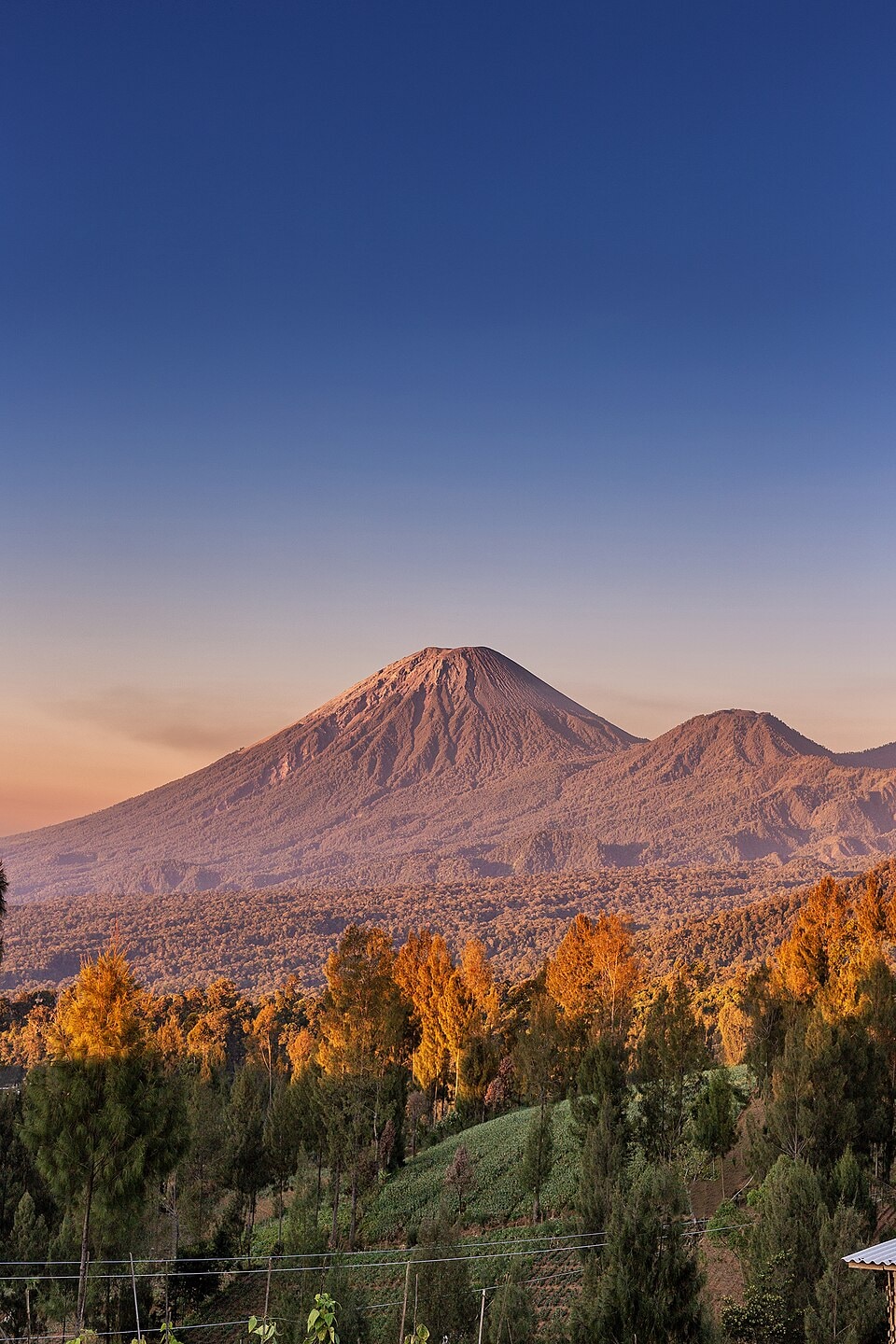
Mahameru
Hinduism, Shivaism
- Central World Mountain In Hinduism
- Abode of Shiva In Java
- Mythological Creation of Java Through Its Transplantation From India
- Origin of Other Mountains Through Fragments Falling Off During Its Relocation
Shiva
About Semeru
Overview
Semeru, also known as Mahameru, meaning "The Great Mountain" in Sanskrit, is the highest and most active volcano on the island of Java, Indonesia. Standing at an elevation of 3,676 meters, it is a significant geological feature located in East Java within a subduction zone where the Indo-Australian Plate meets the Eurasian Plate.
Geological and Eruptive History
This stratovolcano is characterized by its steep ascent from the coastal plains and the presence of maars with crater lakes along its summit line. Semeru was formed south of the overlapping Ajek-ajek and Jambangan calderas and is part of the Tengger Volcanic Complex. Its eruptive history is extensive; since 1818, at least 61 eruptive periods have been recorded, typically involving lava and pyroclastic flows. Notably, Semeru has been in a state of near-constant eruption from 1967 to the present day. Major eruptions, such as those in December 2021 and December 2022, have resulted in fatalities, injuries, displacement of populations, and damage to infrastructure and homes.
Spiritual and Mythological Significance
The name "Semeru" is derived from Meru or Sumeru, the central world mountain in Hindu cosmology and the mythical abode of the gods. In accordance with legend, the mountain was transplanted from India to form the island of Java. Initially placed in the west, its weight caused the island to tip, prompting gods to move it eastward. During this relocation, parts broke off, forming other mountains like Lawu, Wilis, and Kelud, and the shaking top created Penanggungan. Indonesian Hindus hold a deep belief that Semeru is the earthly dwelling place of the god Shiva on Java.
Ecological Concerns
Mount Semeru National Park faces ecological challenges, including the presence of 25 non-native invasive plant species that threaten endemic flora. These plants were introduced during the colonial era and have spread widely. Furthermore, erosion from surrounding vegetable plantations is contributing significant silt to Ranu Pani Lake, a natural feature near the volcano, threatening its eventual disappearance.
Source: Wikipedia ↗
Frequently Asked Questions
What is Semeru's geological makeup and formation?
Semeru is a stratovolcano composed of andesitic eruptive products. It was formed south of the overlapping Ajek-ajek and Jambangan calderas and lies at the southern end of the Tengger Volcanic Complex.
What is the eruptive history of Semeru?
Semeru has an extensive eruptive history, with nearly constant eruptions recorded from 1967 to the present. Since 1818, at least 61 eruptive periods have been documented, frequently involving lava and pyroclastic flows, with most historical eruptions having a Volcanic Explosivity Index of 2 or 3.
What were the impacts of the 2021 eruption of Semeru?
The December 2021 eruption of Semeru caused significant devastation, including 11 km high ash ejections, lava flows, and ash rains impacting areas up to 30 km away. Tragically, at least 57 people died, 104 were injured, and more than 10,000 people were displaced.
What is the mythological significance of Semeru?
The name Semeru is derived from Meru or Sumeru, the central world mountain in Hinduism and the abode of gods. Indonesian Hindus believe Semeru to be the earthly abode of the god Shiva on Java.
Are there any ecological concerns related to Semeru National Park?
Yes, non-native invasive plants have been found in Mount Semeru National Park, threatening endemic flora. Additionally, mud erosion from surrounding vegetable plantations contributes silt to Ranu Pani Lake, threatening its existence.
Related Sacred Mountains

Mount Bromo
Mount Bromo is an active somma volcano located in East Java, Indonesia, and is a significant Hindu pilgrimage site. Named after the Hindu god of creation, Brahma, it is a prominent feature of the Tengger mountains and a major tourist attraction within Bromo Tengger Semeru National Park. The volcano is situated in the "Sea of Sand" (Segara Wedi), a protected nature reserve.

Mount Agung
Mount Agung, known locally as Gunung Agung, is Bali's highest point and an active stratovolcano. It holds deep religious significance for the Balinese people, who believe it to be a replica of Mount Meru, the axis of the universe, and is home to the island's most important temple, Pura Besakih. Its eruptions have historically had devastating impacts, but also hold spiritual meaning for the local population.

Mount Merapi
Mount Merapi, meaning "Fire Mountain" in Javanese, is an exceptionally active stratovolcano in Indonesia, located on the border of Central Java and Yogyakarta. It is one of the most active volcanoes in the country, with a history of regular eruptions since 1548, posing significant risks to the densely populated surrounding areas. Its spiritual significance is deeply intertwined with Javanese culture, where it is believed to be a dwelling place for spirits and part of a sacred axis connecting the peak to the Indian Ocean.