
Mount Murud
Mount Murud, also known as Gunung Murud, is the highest mountain in Sarawak, Malaysia, standing at 2,424 meters. This sandstone peak is significant for its biodiversity and holds spiritual importance, with a church built on its plateau and prayer meetings held regularly. It is considered a sacred mountain where certain activities are prohibited.
Key Facts
- ›Mount Murud is the highest mountain in Sarawak, Malaysia, at 2,424 meters (7,946 ft).
- ›It is a white-yellowish sandstone mountain formed during the Miocene Epoch.
- ›Local legend attributes the mountain's formation to a divine punishment involving stones raining from the sky.
- ›The first recorded successful ascent was by Swedish zoologist Eric Mjöberg in October 1922.
- ›A church was built on a plateau on the mountain in the 1980s, making it a site for prayer meetings.
- ›The mountain is known for its unique biodiversity, including endemic species like Nepenthes murudensis and Ansonia vidua.

Gunung Murud
- Local Legend Describes Its Formation Through Divine Intervention and Geological Events.
- It Is A Site of Religious Pilgrimage and Prayer Meetings.
- Prayer Meetings Are Held Every Two Years By the Mount Murud Prayer Ministry.
- Visitors Participate In Prayer Meetings and Visit the Church On the Mountain's Plateau.
Baya Kalong, Kelawing, Tingang, Lawi, John Coney Moulton, Eric MjöBerg, Agung Bangau
Smoking Is Prohibited., Alcoholic Drinks Are Prohibited.
About Mount Murud
Mount Murud, also known locally as Gunung Murud, stands as the highest peak in Sarawak, Malaysia, reaching an elevation of 2,424 meters (7,946 ft). This prominent sandstone mountain is located in the Limbang Division, straddling the border with Miri Division within the scenic Kelabit Highlands. Its geological formation dates back to the Miocene Epoch, characterized by its white-yellowish sandstone composition and an extended ridgeline running in an ENE-WSW direction.
History and Legend
Local folklore imbues Mount Murud with a dramatic origin story. According to legend, the mountain was formed from a deluge of stones from the sky, a divine punishment for a dispute between two brothers that led to the tragic death of a woman. This narrative highlights the mountain's deep roots in local oral traditions.
The mountain's recorded exploration began with early attempts to climb it. John Coney Moulton, curator of the Sarawak State Museum, made two unsuccessful attempts in 1914 and 1920. The first documented successful ascent was achieved in October 1922 by Swedish zoologist Eric Mjöberg, who spent six days at the summit collecting specimens that contributed significantly to scientific understanding of the region's biodiversity. Botanical collectors followed in later decades, and during the Indonesia-Malaysia confrontation, a Gurkha post was established at its summit.
Spiritual and Ecological Significance
In the 1980s, Mount Murud gained new significance when Agung Bangau, a local man from Ba'kelalan, envisioned building a church there. This vision materialized, and a church was subsequently built on a plateau on the mountain. This site now serves as a focal point for prayer meetings, drawing hundreds of attendees from surrounding villages and visitors from around the world. The mountain is revered as sacred, with strict prohibitions against smoking and the consumption of alcoholic drinks. Prayer meetings are organized bi-annually by the Mount Murud Prayer Ministry.
Mount Murud is also a treasure trove of biodiversity. Expeditions, such as one organized by Universiti Malaysia Sarawak (UNIMAS) in 1995, have identified numerous plant species, including rare orchids and pitcher plants. Notably, the species Nepenthes murudensis is named after the mountain and is believed to be endemic to its summit area. The Murud black slender toad, Ansonia vidua, is another species known only from this mountain. Its summit flora exhibits distinct characteristics, differing from nearby Mount Mulu, despite their relative proximity. The mountain's ecological importance is further underscored by the presence of many bird species also found on Mount Kinabalu and a high commonality of Pteridophyte and orchid species between the two peaks.
Source: Wikipedia ↗
Frequently Asked Questions
What is the elevation of Mount Murud?
Mount Murud stands at an elevation of 2,424 meters (7,946 ft) above sea level, making it the highest mountain in Sarawak.
What is the geological formation of Mount Murud?
Mount Murud is composed of white-yellowish sandstone and was primarily formed during the Miocene Epoch.
Who made the first successful ascent of Mount Murud?
The first successful ascent of Mount Murud was achieved in October 1922 by Eric Mjöberg, a Swedish zoologist and curator of the Sarawak State Museum.
What is the spiritual significance of Mount Murud?
Mount Murud is regarded as a sacred mountain. A church was built on its plateau, and it hosts regular prayer meetings. Smoking and alcoholic drinks are prohibited on the mountain.
Are there any endemic species found on Mount Murud?
Yes, Mount Murud is home to unique biodiversity. The tropical pitcher plant species Nepenthes murudensis is named after the mountain and is thought to be endemic to its summit area, as is the Murud black slender toad, Ansonia vidua.
Related Sacred Mountains

Mount Kinabalu
Mount Kinabalu is the highest peak in Malaysia and Maritime Southeast Asia, located on the island of Borneo. It is renowned for its exceptional biodiversity, housing thousands of plant species and numerous bird and mammal species. The mountain is a significant geological formation and a protected UNESCO World Heritage Site within Kinabalu Park.
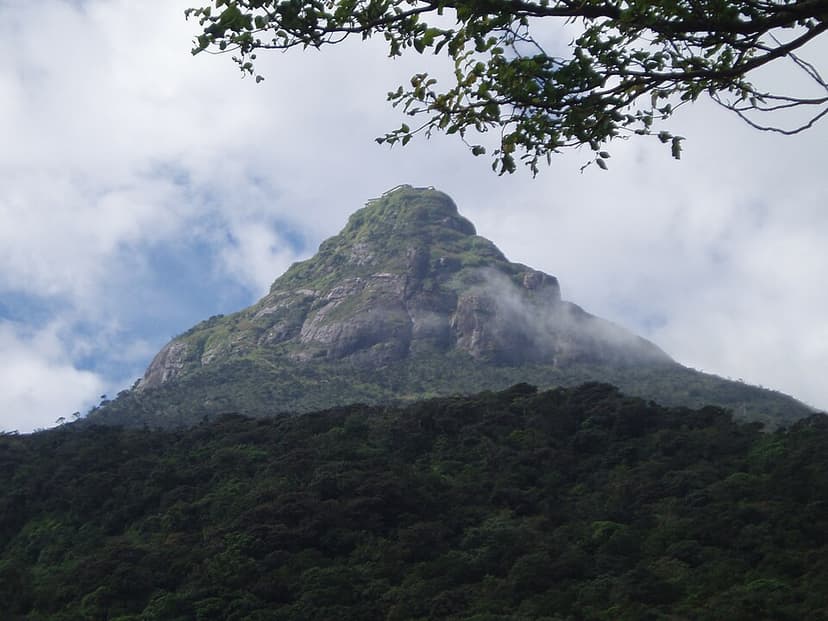
Adam's Peak
Adam's Peak, also known as Sri Pada, is a 2,243-meter-tall conical mountain in central Sri Lanka famed for a sacred footprint-shaped rock formation near its summit. This "sacred footprint" is revered by Buddhists as the Buddha's, by Hindus as Shiva's or Hanuman's, and by some Islamic and Christian traditions as Adam's or St. Thomas the Apostle's, making it a significant pilgrimage site for multiple faiths.

Mount Ararat
Mount Ararat, also known as Mount Ağrı and Masis, is a dormant compound volcano in eastern Turkey, composed of Greater Ararat and Little Ararat. It holds profound religious and cultural significance, particularly for Armenians, who consider it their principal national symbol and a sacred mountain associated with Noah's Ark. Its towering presence has inspired art, literature, and national identity for centuries.