
Mount Ararat
Turkey·Asia
Mount Ararat, also known as Mount Ağrı and Masis, is a dormant compound volcano in eastern Turkey, composed of Greater Ararat and Little Ararat. It holds profound religious and cultural significance, particularly for Armenians, who consider it their principal national symbol and a sacred mountain associated with Noah's Ark. Its towering presence has inspired art, literature, and national identity for centuries.
Key Facts
- ›Mount Ararat is a dormant compound volcano with two main cones: Greater Ararat (5,137 M) and Little Ararat (3,896 M).
- ›It is the highest peak in Turkey and the Armenian highlands, with a massif approximately 35 km wide.
- ›Ararat is considered the principal national symbol of Armenia and is deeply significant in Armenian literature and art.
- ›The mountain is identified with the biblical 'mountains of Ararat' where Noah's Ark is said to have rested, though this is debated.
- ›The first recorded ascent of Mount Ararat was made in 1829 by Friedrich Parrot, Khachatur Abovian, and four others.
- ›The mountain's location forms a near-quadripoint between Turkey, Iran, Armenia, and Azerbaijan's Nakhchivan exclave.

Mount AğRı, Masis, AğRı Dağı, Mets Masis, Sis, P′Ok′R Masis, KūH-E Nūḥ, ἄβος, νίβαρος
Armenian Apostolic Church, Christianity
- Principal National Symbol of Armenia
- Icon For Armenian Nationalism
- Sacred Mountain In Armenian Tradition
- Associated With the Resting Place of Noah's Ark
- Prominent In Armenian Literature and Art
- Patriotic Pilgrimages Organized From Armenia and the Armenian Diaspora.
Noah, Friedrich Parrot, Khachatur Abovian
About Mount Ararat
Mount Ararat, officially known as Mount Ağrı in Turkish and Masis in Armenian, is a majestic, snow-capped, and dormant compound volcano located in eastern Turkey. It is a prominent landmark, comprising two major volcanic cones: Greater Ararat, the highest peak in Turkey and the Armenian highlands at 5,137 meters (16,854 ft), and Little Ararat, which stands at 3,896 meters (12,782 ft). The Ararat massif is a significant geological feature, spanning approximately 35 kilometers at its base.
Religious and Cultural Significance
The mountain holds deep religious and cultural importance, particularly for Armenians, who consider it their principal national symbol and a sacred mountain. It is identified with the biblical "mountains of Ararat" mentioned in the Book of Genesis as the resting place of Noah's Ark, a belief that has shaped its spiritual significance for centuries, despite historical debates about the precise location. Mount Ararat has been a pervasive icon in Armenian literature, art, and national identity, even appearing on the coat of arms of Armenia.
Geographical and Historical Context
Geographically, Mount Ararat is situated in the Eastern Anatolia region of Turkey, near the borders of Iran, Armenia, and the Nakhchivan exclave of Azerbaijan. Historically, its control has shifted between empires, with its summit and slopes being part of the Ottoman-Persian and later Russian territories before becoming part of modern Turkey in the 20th century. The mountain's geological history is marked by volcanic activity, with its formation spanning from the Miocene to the Quaternary periods. The last recorded volcanic eruption occurred in 1840.
Exploration and Ascent
While early attempts to reach Ararat's summit were made in the Middle Ages, the first recorded ascent in modern times was achieved on October 9, 1829, by Friedrich Parrot and Khachatur Abovian, accompanied by four others. The Armenian Apostolic Church historically held reservations about ascents due to religious beliefs concerning the preservation of Noah's Ark, though in contemporary times, climbing Ararat has become a significant goal for patriotic pilgrimages from Armenia and the Armenian diaspora.
Source: Wikipedia ↗
Frequently Asked Questions
What are the different names for Mount Ararat?
Mount Ararat is officially known as Mount Ağrı in Turkish and Masis in Armenian. It has also been referred to by ancient Greek names such as Abos and Nibaros, and the traditional Persian name Kūh-e Nūḥ (Mountain of Noah).
What is the geological nature of Mount Ararat?
Mount Ararat is a polygenic, compound stratovolcano, meaning it is composed of multiple volcanic cones. It is the largest volcanic edifice in its region, formed by dacitic and rhyolitic pyroclastic debris and lavas.
What is the significance of Mount Ararat in Armenian culture?
Mount Ararat is the principal national symbol of Armenia and is considered a sacred mountain by Armenians. It features prominently in Armenian literature and art and is an icon for Armenian nationalism, depicted on the coat of arms of Armenia.
When was the first recorded ascent of Mount Ararat?
The first recorded ascent of Mount Ararat took place on October 9, 1829. The expedition was led by the Baltic German naturalist Friedrich Parrot and included the prominent Armenian writer Khachatur Abovian.
What is the current elevation of Mount Ararat?
While some sources cite 5,165 m (16,946 ft), the more widely accepted elevation for Greater Ararat is 5,137 m (16,854 ft). Its elevation may be slightly lower due to the melting of its ice cap.
Is Mount Ararat an active volcano?
Mount Ararat is considered a dormant volcano. While it has a history of volcanic activity, with the last recorded eruption in 1840, it is not currently considered active.
Related Sacred Mountains
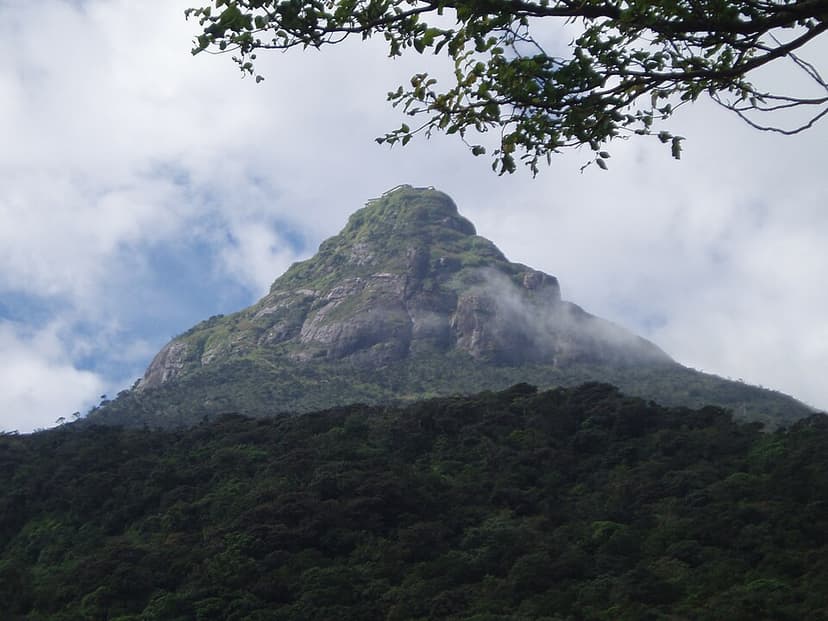
Adam's Peak
Adam's Peak, also known as Sri Pada, is a 2,243-meter-tall conical mountain in central Sri Lanka famed for a sacred footprint-shaped rock formation near its summit. This "sacred footprint" is revered by Buddhists as the Buddha's, by Hindus as Shiva's or Hanuman's, and by some Islamic and Christian traditions as Adam's or St. Thomas the Apostle's, making it a significant pilgrimage site for multiple faiths.

Mount Carmel
Mount Carmel is a coastal mountain range in northern Israel, significant for its rich history as a site of human evolution, ancient civilizations, and diverse religious traditions. Its name, likely meaning "garden-land" or "vineyard of God," reflects its lush vegetation and spiritual importance across Canaanite, Israelite, Christian, Baháʼí, and Druze faiths. The mountain is renowned for its caves, ancient altars, and association with the prophet Elijah, making it a focal point for pilgrimage and historical study.

Mount Murud
Mount Murud, also known as Gunung Murud, is the highest mountain in Sarawak, Malaysia, standing at 2,424 meters. This sandstone peak is significant for its biodiversity and holds spiritual importance, with a church built on its plateau and prayer meetings held regularly. It is considered a sacred mountain where certain activities are prohibited.