
Mount Everest
Tibet Autonomous Region·Asia
Mount Everest, also known as Sagarmāthā in Nepal and Qomolangma in Tibet, is the highest mountain on Earth above sea level, reaching an elevation of 8,848.86 meters. It is a prominent peak in the Mahalangur Himal sub-range of the Himalayas and straddles the border between Nepal and China. The mountain attracts numerous climbers, who face challenges such as altitude sickness, extreme weather, and avalanches, with many expeditions attempting to reach its summit via established routes.
Key Facts
- ›The most recent official measurement of Mount Everest's height, conducted in 2020 by Nepalese and Chinese authorities, determined it to be 8,848.86 meters (29,031 ft 8+1⁄2 in).
- ›Mount Everest is situated in the Mahalangur Himal sub-range of the Himalayas and forms part of the border between Nepal and the Tibet Autonomous Region of China.
- ›Two primary climbing routes exist: the standard southeast ridge route from Nepal and the north ridge route from China.
- ›The mountain's geological composition includes sedimentary and metamorphic rocks, primarily the Qomolangma, North Col, and Rongbuk Formations.
- ›The first documented ascent of Mount Everest was achieved by Sir Edmund Hillary and Tenzing Norgay on May 29, 1953.
- ›As of May 2024, 340 people have died on Mount Everest, with over 200 bodies remaining on the mountain due to hazardous conditions.

SagarmāThā, Qomolangma, Peak Xv, Deodungha, Gauri Shankar, Gaurishankar, Gaurisankar, Chomolungma, ZhūMùLǎNgmǎ FēNg, Shengmu Feng
- Mount Everest Holds Immense Significance For Local Populations, With the Tibetan Name Qomolangma Meaning "Holy Mother" and the Nepali Name SagarmāThā Translating To "Goddess of the Sky."
- the Mountain Is A Major Goal For Mountaineers Worldwide, Representing A Pinnacle of Human Achievement In Extreme Environments.
- Historical Expeditions, Particularly Those By the British In the Early 20th Century, Contributed To the Exploration and Mapping of the Himalayas.
George Mallory, Andrew Irvine, Tenzing Norgay, Edmund Hillary, Wang Fuzhou, Gonpo, Qu Yinhua, Radhanath Sikdar, Bradford Washburn, Erwin Schneider, Andrew Scott Waugh, John Armstrong, James Nicolson, Michael Hennessy
About Mount Everest
Mount Everest, known by the Nepali name Sagarmāthā and the Tibetan name Qomolangma, stands as the Earth's highest mountain above sea level. Located in the Mahalangur Himal sub-range of the Himalayas, its summit marks a section of the border between Nepal and the Tibet Autonomous Region of China. The mountain's most recent official height, determined in 2020, is 8,848.86 meters (29,031 ft 8+1⁄2 in).
Climbing and Challenges
Mount Everest is a significant destination for experienced climbers from around the globe. Two primary routes are used for ascent: the standard route from the southeast in Nepal and the route from the north in China. While the standard route does not present extreme technical climbing difficulties, climbers face severe risks from altitude sickness, harsh weather, high winds, avalanches, and the perilous Khumbu Icefall. Tragically, as of May 2024, 340 individuals have lost their lives on Everest, with over 200 bodies remaining on the mountain due to the insurmountable dangers involved in their recovery.
Climbers typically commence their ascents from base camps situated above 5,000 meters (16,404 ft). The journey from these camps to the summit represents a substantial elevation gain, with the Nepalese side often involving a trek from Lukla, adding approximately 6,000 meters (20,000 ft) of elevation climb.
Historical Ascents and Naming
The earliest recorded attempts to summit Everest were made by British mountaineers from the Tibetan side, as Nepal was not open to foreigners. The 1921 British expedition reached 7,000 meters, and the 1922 expedition marked the first time humans climbed above 8,000 meters. A notable historical mystery surrounds George Mallory and Andrew Irvine, who disappeared on a summit attempt in 1924, leaving open the question of whether they were the first to reach the peak. The first confirmed ascent was achieved on May 29, 1953, by Sir Edmund Hillary of New Zealand and Tenzing Norgay, a Sherpa climber from Nepal, via the southeast ridge.
Mount Everest bears multiple names reflecting its cultural significance. Its Nepali name, Sagarmāthā, translates to "goddess of the sky." The Tibetan name, Qomolangma, means "holy mother." The English name "Mount Everest" was given by the British Surveyor General of India, Andrew Waugh, who proposed naming it after his predecessor, Sir George Everest, despite Sir George's own reservations.
Geological Significance
Geologically, Mount Everest is composed of three distinct rock units: the Qomolangma Formation (summit to Yellow Band), the North Col Formation (middle section), and the Rongbuk Formation (base). These formations consist of marine sedimentary and metamorphic rocks, including Ordovician limestone containing fossilized marine life, indicating the mountain's formation from ancient oceanic sediments uplifted by continental collision. The International Union of Geological Sciences has recognized the Ordovician Rocks of Mount Everest as a geological heritage site for their fossiliferous marine limestone.
Measurement and Comparisons
Determining Everest's exact height has been a subject of numerous surveys over centuries. Early British surveys in the 19th century led to an 1856 announcement of 8,840 meters (29,002 ft). Subsequent measurements, including those in 1954, 1975, 1999, and 2005, yielded slightly different figures, leading to debates between China and Nepal regarding whether to measure the rock height or the snow and ice covering. The 2020 joint survey settled on 8,848.86 meters. While Everest is the highest mountain above sea level, Mauna Kea in Hawaii is taller from its base on the ocean floor, and Chimborazo in Ecuador is farthest from the Earth's center due to the planet's equatorial bulge.
Source: Wikipedia ↗
Frequently Asked Questions
What is the official height of Mount Everest?
The most recently measured and jointly recognized official height of Mount Everest is 8,848.86 meters (29,031.7 feet) above sea level, as announced in 2020 by Nepal and China.
What are the different names for Mount Everest?
Mount Everest is known locally as Sagarmāthā in Nepal, meaning "goddess of the sky," and Qomolangma in Tibet, meaning "holy mother." It was historically referred to as Peak XV by British surveyors before being named after Sir George Everest.
What are the main climbing routes for Mount Everest?
The two main climbing routes are the southeast ridge from Nepal, often considered the standard route, and the north ridge from China. Both routes begin from base camps located at high altitudes.
What are the primary dangers faced by climbers on Mount Everest?
Climbers on Mount Everest face significant risks including altitude sickness, unpredictable and extreme weather conditions, strong winds, and hazards such as avalanches and the treacherous Khumbu Icefall.
When was Mount Everest first successfully climbed?
The first documented ascent of Mount Everest was achieved on May 29, 1953, by Sir Edmund Hillary of New Zealand and Tenzing Norgay, a Sherpa climber from Nepal, via the southeast ridge route.
What is the geological formation of Mount Everest?
Mount Everest is composed of three main rock units: the Qomolangma Formation at the summit, the North Col Formation in the middle section, and the Rongbuk Formation at the base. These are primarily sedimentary and metamorphic rocks, with marine limestone found near the summit.
Related Sacred Mountains
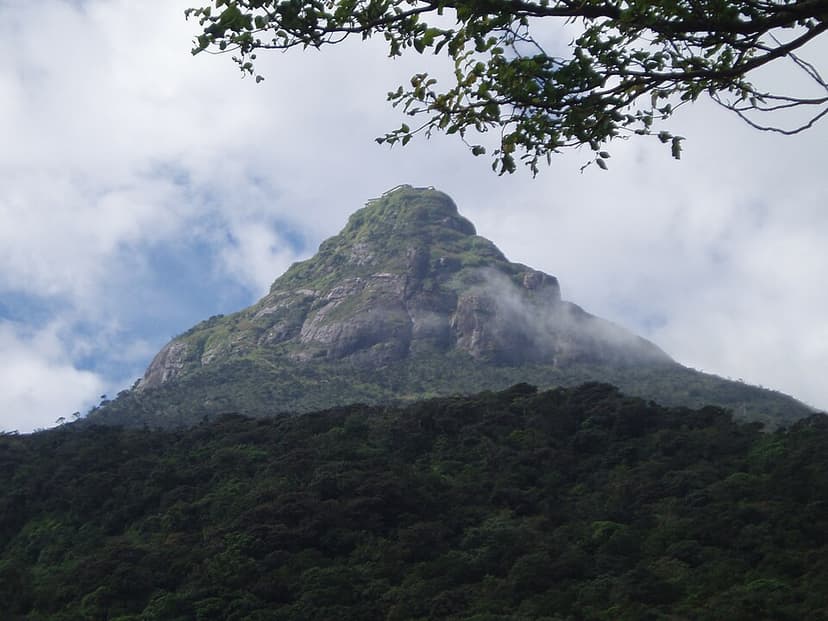
Adam's Peak
Adam's Peak, also known as Sri Pada, is a 2,243-meter-tall conical mountain in central Sri Lanka famed for a sacred footprint-shaped rock formation near its summit. This "sacred footprint" is revered by Buddhists as the Buddha's, by Hindus as Shiva's or Hanuman's, and by some Islamic and Christian traditions as Adam's or St. Thomas the Apostle's, making it a significant pilgrimage site for multiple faiths.
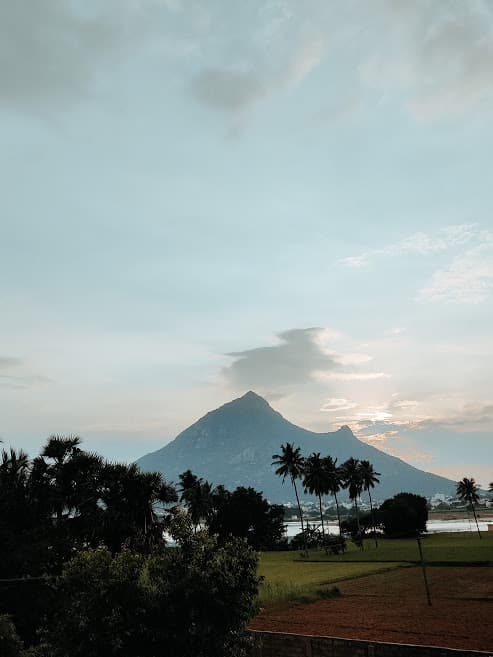
Arunachala
Arunachala is a sacred hill and one of the five main Shaiva holy places in South India, located in Tamil Nadu. It is revered as a manifestation of Lord Shiva and is the site of the Arunachalesvara Temple. The hill holds immense spiritual significance, particularly for devotees of Ramana Maharshi, and is a focal point for annual religious festivals and pilgrimage.

Ba Vì mountain range
The Ba Vì mountain range, also known as Tản Viên Sơn, is a significant soil-limestone mountain range in northern Vietnam, revered in Vietnamese folk religion as "the lord of mountains". While not the highest in the country, its most famous peak, Tản Viên Peak, is central to the mythology of the mountain god Tản Viên Sơn Thánh. The range is also a protected area, Ba Vì National Park, known for its primary forests and biodiversity.