
Werne
Werne an der Lippe is a town in North Rhine-Westphalia, Germany, with a history stretching back to the 9th century. Originally established as a parish by Bishop Liudger under Charlemagne, it grew into a fortified settlement and a member of the Hanseatic League. Despite periods of conflict, plague, and administrative changes, Werne has evolved into a modern town with a significant population and a diverse industrial base, while retaining elements of its historical past.
Key Facts
- ›Founded as a parish by Bishop Liudger on orders of Charlemagne.
- ›First documented in 834 as a village around a chapel.
- ›Became a member of the Hanseatic League in 1470.
- ›Received town privileges in 1385 after fortifications began.
- ›Experienced significant population loss due to the Black Death in 1636-1637.
- ›Experienced industrial development with the discovery of brine springs and coal mining.
- Fortifications
- Monastery Erected By the Order of Friars Minor Capuchin
- Werne Baths Established From A Brine Thermal Spring
- Zeche Werne
- Graduation Tower In the City Park
Werne An Der Lippe, WäEn
Liudger, Charlemagne
- Establishment As A Parish By Bishop Liudger
- Formation of A Village Around A Chapel
- Establishment of A Customs Agency
- Formation of the 'Werner Bund' Alliance
- Receiving Town Privileges
- Burned To the Ground By Adolph I, Duke of Cleves
- Full Fortification Commenced
- Occupation, Looting, and Torching During the Thirty Years' War
- Black Death Outbreak
- Peace of Westphalia
- Erection of A Monastery By the Order of Friars Minor Capuchin
- Coming Under Prussian Administration
- Attached To the Grand Duchy of Berg
- Restored To Prussia
- Granting of Administrative Independence
- Discovery of Brine Thermal Spring
- Opening of the Werne Baths
- Commencement of Coal Mine Operations
- Opening of the MüNster-Werne-Dortmund Railway Line
- Significant Citizen Deaths and Disappearances During World War Ii
- Accommodation of Refugees During World War Ii
- Urban Renewal Project Commencement
- Opening of Pedestrian Zone
- Municipal Reorganization, Incorporation of Stockum
- Closure of Werne Coal Mine
- Dropping of 'A. D. Lippe' Suffix
- Opening of Karl Pollender City Museum
- Reopening of the City Library
- Reopening of the Natural Brine Bath
- Building of A Graduation Tower
- Closure of the Old Brine Bath and Opening of A New Building
About Werne
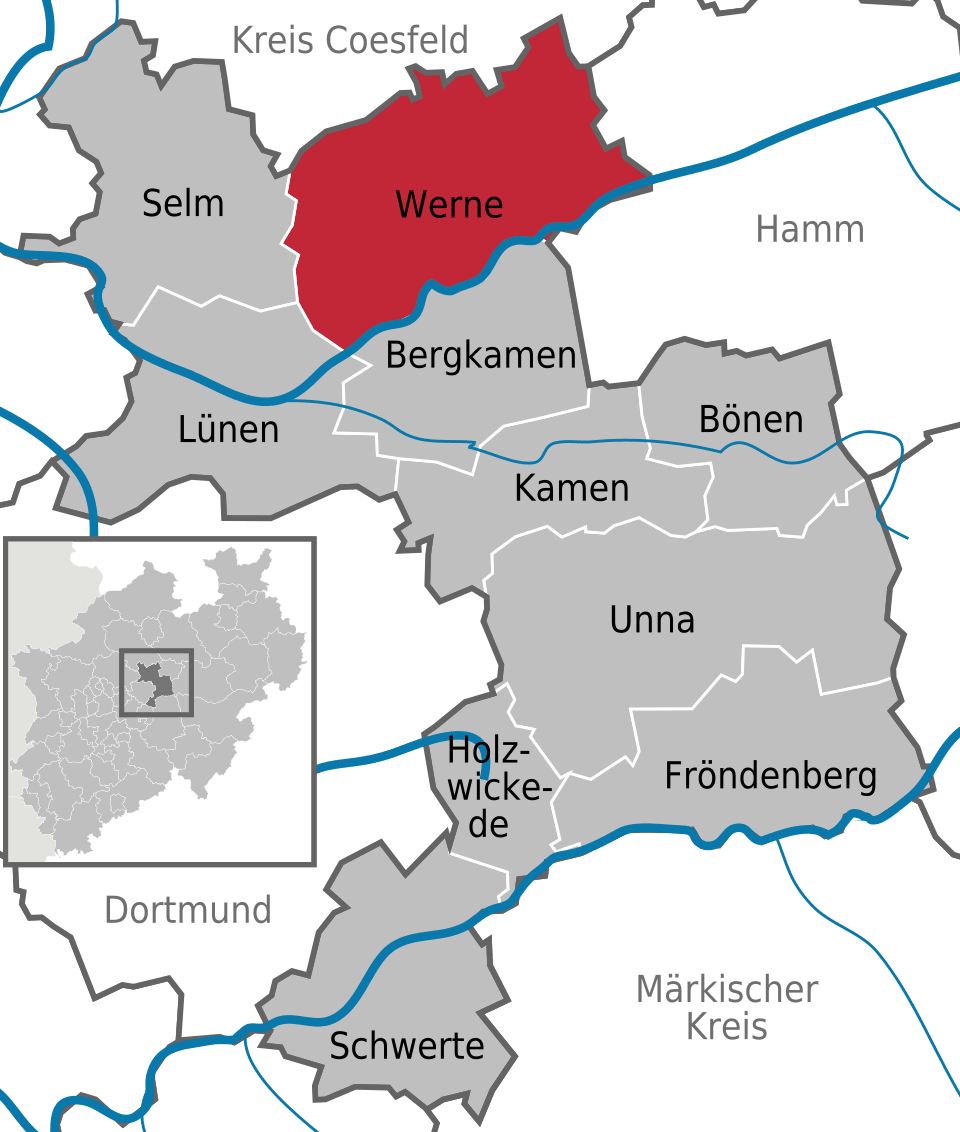
Werne an der Lippe is a town situated in the Unna district of North Rhine-Westphalia, Germany, located on the southern edge of the Münsterland region near the industrial Ruhrgebiet. Its history is deeply rooted, with its origins as a parish established by Bishop Liudger under the directives of Charlemagne following the conclusion of the Saxon Wars. The earliest documented evidence of Werne dates back to 834, referring to a village that had already developed around a chapel.
Throughout the Middle Ages, Werne grew in importance as a trading settlement. It became a site for a customs agency between the years 1192 and 1195 and was part of a crucial alliance in 1253 to safeguard trading rights over the Lippe river. By 1470, Werne had achieved the status of a member of the Hanseatic League, signifying its prominence in medieval commerce. The town also underwent significant fortification efforts, beginning with a trench around the church in 1302 and evolving into a protective structure for the entire settlement by 1383, prior to receiving town privileges in 1385. Despite these defenses, Werne experienced destructive events, including being burned to the ground in 1400 and suffering during the Thirty Years' War. The devastating Black Death also impacted the town severely in 1636 and 1637, claiming a substantial portion of its population.
The modern era brought further transformations to Werne. After coming under Prussian administration in 1803, it experienced shifts in governance before being incorporated into Prussia's Province of Westphalia. The discovery of a brine thermal spring in the late 19th century led to the establishment of the Werne Baths and later, coal mining operations which continued until 1975. Industrialization and infrastructure development, including the opening of a railway line in 1928, shaped the town's growth. Werne also played a role during World War II, experiencing casualties and hosting refugees. Post-war development included comprehensive urban renewal projects, the construction of new public buildings, and administrative reorganizations, such as the incorporation of the municipality of Stockum in 1975. Today, Werne is a town with a population of over 30,000, a diverse economy featuring major employers like Amazon, and various cultural and educational institutions, while also preserving historical sites such as the Karl Pollender town museum.
Source: Wikipedia ↗
Frequently Asked Questions
When was Werne first established?
Werne was first established as a parish by Bishop Liudger on orders of Charlemagne. The earliest preserved document, dating from 834, indicates that a village had already formed around a chapel by this time.
What was Werne's role in medieval trade?
Werne was strategically important for trade, with a customs agency established between 1192 and 1195. In 1253, it formed an alliance to defend trading rights related to a bridge over the Lippe river, and by 1470, it became a member of the Hanseatic League.
What challenges did Werne face historically?
Werne faced several historical challenges, including being burned to the ground in 1400, suffering occupation and looting during the Thirty Years' War, and experiencing a devastating outbreak of the Black Death in 1636-1637. The town also endured significant loss of life and displacement during World War II.
When did Werne become part of Prussia?
Werne came under the administration of Prussia in 1803 when the Prince-Bishopric of Münster was dissolved. It was subsequently attached to the Grand Duchy of Berg by Napoleon in 1806 before being restored to Prussia by the Congress of Vienna.
What is the current population of Werne?
As of 2024, the population of Werne was 30,202.
Related Monasteries

Leuven
Leuven, also known as Louvain, is the capital and largest city of the province of Flemish Brabant in Belgium, renowned as a historic university city since 1425. It has been a significant center for trade, cloth manufacture, art, and knowledge, hosting influential humanists, scholars, and artists. The city has faced considerable damage in both World Wars but has rebuilt and continues to be a hub for research, innovation, and culture, as well as the global headquarters for Anheuser-Busch Inbev.

Avignon
Avignon, also known as 'La Cité des Papes' (The City of the Popes), is a historic city in southern France renowned for its papal history and well-preserved medieval architecture. Between 1309 and 1377, it served as the residence for seven successive popes, significantly shaping its urban development and cultural landscape. The city's historic center, including the Palais des Papes and its ramparts, is a UNESCO World Heritage Site, drawing millions of visitors annually for its architectural grandeur and vibrant arts scene, particularly the annual Festival d'Avignon.

Brixen
Brixen, also known as Bressanone, is a historic town and municipality in South Tyrol, northern Italy, situated at the confluence of the Eisack and Rienz rivers. It is the third-largest city and oldest town in the province, known for its German-speaking majority and rich history dating back to the Upper Paleolithic. The town boasts significant religious and secular architecture, including its cathedral and the Renaissance Bishop's Palace, and is a center for culture and tourism, particularly for its nearby ski resort, Plose.