
Vogelsang Charterhouse
Vogelsang Charterhouse was a Carthusian monastery located near Jülich, Germany, founded in 1478. It was dedicated to the compassion of Mary and, despite facing periods of destruction and economic hardship, experienced a golden age of prosperity in the late 17th century. The charterhouse was secularised in 1802, with its lands and buildings subsequently sold and largely demolished.
Key Facts
- ›Founded in 1478 at the instigation of Hermann von Brakel, Chancellor of the Duchy of Jülich.
- ›Dedicated to the compassion of Mary (compassio Beatae Mariae).
- ›Construction of the monastic church was completed in 1527.
- ›Suffered significant plundering and destruction during the War of the Jülich Succession (1609/10).
- ›Experienced a golden age of prosperity in the second half of the 17th century.
- ›Secularised in 1802 and its buildings were mostly demolished.
Baroque
Monastic Church, Refurbished Buildings In Baroque Manner
- Kartause Zum Vogelsang Bei JüLich
- Domus Compassionis Beatae Mariae In Cantavio Prope Iuliacum
Hermann Von Brakel, Johannes Justus of Landsberg, Theodor Monheim, Antonius Basel, Carl Unkraut
War of the JüLich Succession, Thirty Years' War, French Revolutionary Occupation, Secularisation, World War Ii
About Vogelsang Charterhouse
Vogelsang Charterhouse, also known in German as Kartause zum Vogelsang bei Jülich and in Latin as Domus compassionis Beatae Mariae in Cantavio prope Iuliacum, was a Carthusian monastery situated near the town of Jülich in what is now North Rhine-Westphalia, Germany. Founded in 1478, the charterhouse was dedicated to the compassion of Mary. Its establishment was initiated by Hermann von Brakel, the chancellor of the Duchy of Jülich, who invited the community of Roermond Charterhouse to create a daughter house on land provided by Duke William IV of Jülich and Berg.
Construction and Development
The construction of the monastery, intended for the typical Carthusian community of twelve monks, spanned nearly fifty years, concluding with the completion of the monastic church in 1527. Despite periods of economic uncertainty, the charterhouse received further endowments and enjoyed the favor of local rulers. During the Reformation, the prior Johannes Justus of Landsberg played a significant role in advocating for spiritual renewal within the Catholic Church, becoming a notable figure in the Counter-Reformation through his publications.
Challenges and Prosperity
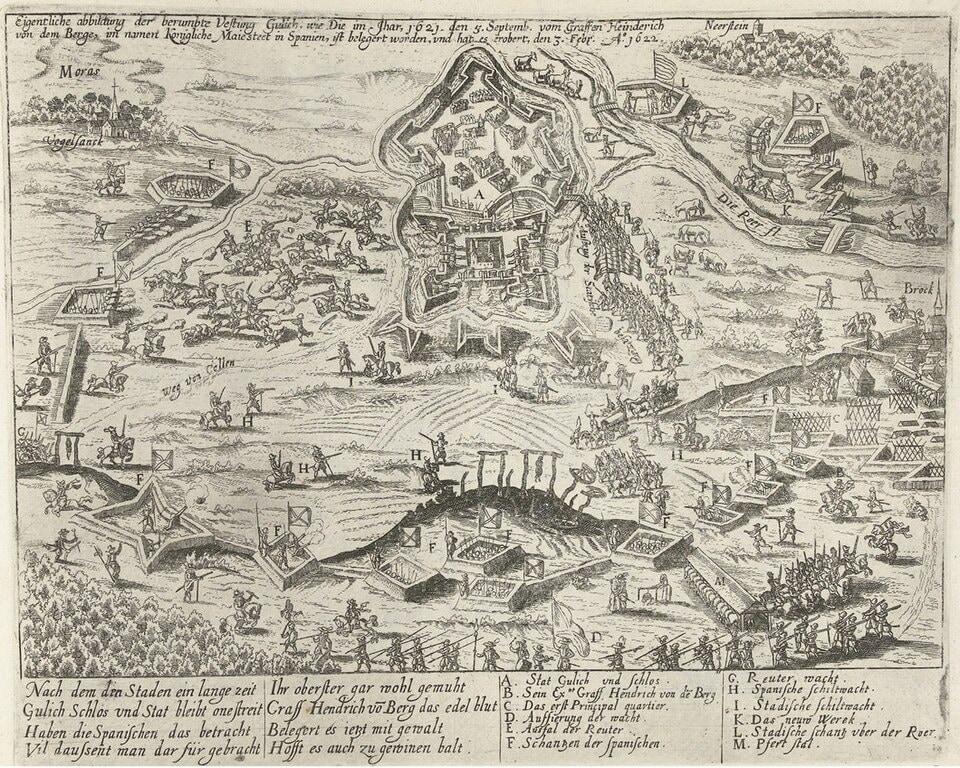
Vogelsang Charterhouse faced considerable peril during the War of the Jülich Succession (1609/10), lying exposed on open ground and suffering extensive plundering and destruction. However, it sustained little damage during the Thirty Years' War and gradually recovered from poverty, moving towards stable economic circumstances. The latter half of the 17th century marked a golden age of prosperity under priors Theodor Monheim and Antonius Basel, facilitated by effective forestry management. This era saw the acquisition of valuable liturgical vessels and significant capital investment, leading to the refurbishment of the buildings and the decoration of the church in the Baroque style starting in 1696.
Dissolution and Legacy
The charterhouse's operational continuity was disrupted in 1794 when French revolutionary troops conquered territories on the left bank of the Lower Rhine. Although some monks returned, ongoing legal measures made the strict Carthusian discipline increasingly difficult to maintain. The monastery was officially closed down in August 1802 as part of the mediatisation of Germany, and the monks were forbidden to wear their habits. The former monks largely transitioned to pastoral duties. The lands and buildings were sold and predominantly demolished. Further destruction occurred during World War II, and the few remaining vestiges of Vogelsang Charterhouse are now in private ownership.
Source: Wikipedia ↗
Frequently Asked Questions
When was Vogelsang Charterhouse founded?
Vogelsang Charterhouse was founded in 1478. The construction of its monastic church, designed for the usual Carthusian community of 12 monks, took nearly 50 years and was completed in 1527.
What religious order was associated with Vogelsang Charterhouse?
Vogelsang Charterhouse was a Carthusian monastery. The community was established by monks from Roermond Charterhouse, invited to set up a daughter house.
What historical events impacted Vogelsang Charterhouse?
The monastery was significantly plundered and destroyed during the War of the Jülich Succession in 1609-1610. Later, during the French revolutionary occupation in 1794, some monks had to flee, and continuing the order's discipline became increasingly difficult.
What happened to Vogelsang Charterhouse after its secularisation?
Following its closure in August 1802, the lands and buildings of Vogelsang Charterhouse were sold and mostly demolished. Further destruction occurred during World War II, and the few remaining parts are now in private ownership.
Who was Johannes Justus of Landsberg?
Johannes Justus of Landsberg, from Cologne Charterhouse, served as prior of Vogelsang Charterhouse during the Reformation. He was a significant figure in the Counter-Reformation due to his many publications advocating for spiritual renewal without adopting Lutheran teachings.
Related Monasteries

Astheim Charterhouse
Astheim Charterhouse, also known as Marienbrück Charterhouse, was a Carthusian monastery founded in 1409 near Volkach, Bavaria. Established by Erkinger von Seinsheim, it served as a family burial site for centuries and was settled by monks from Cologne Charterhouse. Dissolved in 1803 during the secularization of Bavaria, its surviving structures now house the archives of Volkach and the Kartausenmuseum Astheim, dedicated to Christian graphic art.

Ilmbach Charterhouse
Ilmbach Charterhouse, also known as Mariengarten Charterhouse, was a former Carthusian monastery located in Prichsenstadt, Bavaria, Germany. Founded in 1453, it endured destruction during the Peasants' War and was dissolved in 1803 during the secularization of Bavaria. Today, only its 17th-century sandstone entrance gateway remains, relocated to a farm near Bamberg.

Xanten Charterhouse
Xanten Charterhouse was a former Carthusian monastery established in 1417, initially near Wesel before relocating to Xanten in 1628. It operated until 1802 when it was suppressed during Napoleonic secularization. Today, the former monastery buildings serve dual purposes, housing the town library in the upper levels and a bar and restaurant on the ground floor.