
Virgin Mary (El-Sourian) Coptic Orthodox Monastery
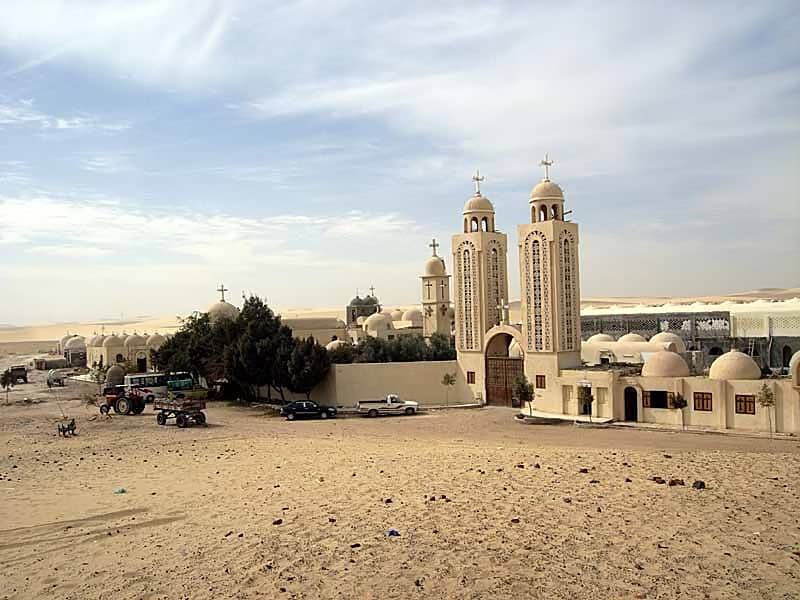
The Virgin Mary (El-Sourian) Coptic Orthodox Monastery, commonly known as the Syrian Monastery, is located in Egypt's Wadi El Natrun. Founded in the 6th century AD by monks rejecting the Julianist heresy, it later became a significant center for Syriac Orthodox monks from the 8th to the 14th century, earning its current name. The monastery is renowned for its rich library of Syriac manuscripts, its ancient wall paintings, and unique architectural features like the Door of Prophecies.
Key Facts
- ›Founded in the 6th century AD by monks who opposed the Julianist heresy.
- ›Known as the Syrian Monastery due to its use by Syriac Orthodox monks for several centuries.
- ›Possesses a significant library containing around 250 Syriac manuscripts, some dating back to the 5th century.
- ›Features the 'Door of Prophecies,' an ancient door with symbolic diagrams illustrating Christian history.
- ›Houses several churches, including the Church of the Holy Virgin and the Chapel of the Forty-Nine Martyrs, with layered wall paintings from the 7th to 13th centuries.
- ›Enclosed by a large wall dating to the late 9th century, with a height of 9.5 to 11.5 meters.

Coptic, Syriac
Door of Prophecies, Extensive Library of Syriac Manuscripts, Ancient Wall Paintings, Miraculous Tree of Saint Ephrem
Monastery of Saint Mary of the Syrians, Monastery of Saint Mary Deipara, Syriac Monastery, Dayr Al-SuryāN
Pope Gabriel Vii, Pope Shenouda Iii, Moses of Nisibis, Saint Ephrem
- Rejection of Julianist Heresy Leading To Its Establishment
- Purchase By Syriac Merchants and Conversion For Syriac Monks
- Destruction and Rebuilding After Bedouin Attacks
- Moses of Nisibis's Journey To Baghdad For Tax Exemption and Acquisition of Manuscripts
- Decimation By Plague In the 14th Century
- Restoration Efforts By the Patriarch of Antioch Towards the End of the 15th Century
About Virgin Mary (El-Sourian) Coptic Orthodox Monastery
The Virgin Mary (El-Sourian) Coptic Orthodox Monastery, more commonly referred to as the Syrian Monastery, is a significant religious site located in the Wadi El Natrun, a desert region in Egypt's Beheira Governorate. Situated a short distance from the Monastery of Saint Pishoy, this monastery is dedicated to the Virgin Mary and has a history intertwined with theological disputes and the movement of monastic communities.
Foundation and Early History
While the precise founding date remains uncertain, historical consensus places the establishment of the Monastery of Saint Mary of the Syrians in the 6th century AD. Its origin is closely linked to the Julianist heresy, a theological movement that spread in Egypt. Monks who rejected this heresy, particularly concerning the incorruptibility of Christ's body, sought to establish separate communities. These new foundations often retained the names of existing monasteries but were distinguished by adding 'Theotokos' (Mother of God) to affirm Orthodox doctrine. Thus, the Syrian Monastery was initially established by monks from Saint Pishoy who opposed the Julianists, and was then known as the Monastery of the Holy Virgin Theotokos.
Syriac Influence and Later History
Towards the beginning of the 8th century AD, the monastery underwent a significant transformation when it was purchased by wealthy Syriac merchants from Tikrit. They converted the monastery for use by monks of the Syriac Orthodox Church, renaming it the Monastery of the Holy Virgin of the Syrians. This period marked the beginning of its association with Syrian monks, which persisted for several centuries and led to its modern name, the Syrian Monastery (Dayr al-Suryān).
During its history, the monastery, like others in Scetes, faced numerous attacks from desert Bedouin and Berber groups. A particularly devastating attack in 817 AD necessitated its rebuilding in 850 AD by monks Matthew and Abraham. A pivotal moment occurred in the 10th century when a monk named Moses of Nisibis traveled to Baghdad to secure tax exemptions for monasteries and subsequently returned with 250 precious Syriac manuscripts. This acquisition greatly enriched the monastery's library, establishing it as an important center for Syriac scholarship and a repository of artistic treasures.
Architectural and Artistic Significance
The monastery is enclosed by a substantial wall, erected in the late 9th century, with impressive heights ranging from 9.5 to 11.5 meters. Within its walls are five churches, dedicated to various saints and martyrs, including the Virgin Mary, the Forty-Nine Martyrs, Saints Honnos and Marutha, and Saint John the Dwarf. A distinctive architectural feature is the 'Door of Prophecies,' a large door adorned with symbolic diagrams that represent the history and future of the Christian faith from the perspective of 10th-century monks. Extensive efforts have been made to uncover and conserve the monastery's wall paintings, which reveal layers of art dating from the 7th to the 13th centuries, offering valuable insights into the evolution of Coptic wall painting.
Legacy
Despite periods of decline, such as decimation by plague in the 14th century and a lack of Syrian clergy in the 12th century, the monastery continued to be inhabited by both Syrian and Egyptian monks. Its library's manuscripts have been a focus of scholarly research, providing access to ancient texts of classical Greek authors. Notable figures who have served from or been associated with the monastery include Pope Gabriel VII and Pope Shenouda III, underscoring its continuing importance within the Coptic Orthodox Church.
Source: Wikipedia ↗
Frequently Asked Questions
When was the Virgin Mary (El-Sourian) Coptic Orthodox Monastery founded?
The exact date of the monastery's foundation is unknown, but most sources indicate it was established in the 6th century AD. Its founding is linked to a theological dispute within the Orthodox Church concerning the nature of Christ's body.
Why is it called the Syrian Monastery?
It is primarily known as the Syrian Monastery because it was used by monks of the Syriac Orthodox Church from the 8th to the 14th century. This was after wealthy Syriac merchants purchased the monastery and converted it for their use.
What is significant about the monastery's library?
The monastery's library is famous for its collection of approximately 250 Syriac manuscripts, many of which are ancient. These texts have been crucial for Western scholars studying classical Greek philosophy and science, as they represent some of the oldest surviving copies of these works.
Are there any unique architectural features at the monastery?
Yes, a notable feature is the 'Door of Prophecies,' which is a large door adorned with symbolic diagrams. These depict the past and future of the Christian faith as understood by monks in the tenth century.
What is the current status of the monastery?
The Virgin Mary (El-Sourian) Coptic Orthodox Monastery is an active monastery within the Coptic Orthodox Church. It continues to be a site for religious practice and is notable for its ongoing projects to conserve its historical wall paintings.
What are the wall paintings like at the monastery?
The monastery features layered wall paintings in its churches, particularly in the Church of the Holy Virgin and the Chapel of the Forty-Nine Martyrs. These paintings, uncovered between the 7th and 13th centuries, offer valuable insights into the development of Coptic wall painting.
Related Monasteries
St. Fana Coptic Orthodox Monastery
The Monastery of Saint Fana is a Coptic Orthodox monastery located in the Western Desert of Egypt, near Minya Governorate. It is named after the 4th-century hermit Saint Fana and is sometimes referred to as the Monastery of Abu Fanah or Monastery of the Cross. Historically, it was a significant monastic center, reportedly housing around 1,000 monks in pre-Islamic times, though its numbers dwindled significantly by the 14th-15th centuries.

St. Macarius Coptic Orthodox Monastery
The Monastery of Saint Macarius the Great, located in Wadi El Natrun, Egypt, is a Coptic Orthodox monastery with a history stretching back to the 4th century AD. Attributed to Saint Macarius the Great, it is one of the oldest continually inhabited monastic communities in the world. The monastery is significant for its historical architecture, religious relics, and its role in the development of Christian monasticism.

St. Menas Coptic Orthodox Monastery
The Monastery of Saint Mina is a significant Coptic Orthodox monastery located in the Western Desert near Alexandria, Egypt. It is dedicated to Saint Menas, a martyr revered as the 'Wonders' Maker'. The modern monastery, established in 1959, is situated near the extensive ruins of the ancient pilgrimage city of Abu Mena, which flourished from the late 4th century until its destruction in the 7th century.