
Torgau
Torgau is a historic town in Saxony, Germany, situated on the Elbe River. It gained international recognition as the site of the first meeting between American and Soviet forces at the end of World War II on April 25, 1945. Historically, Torgau served as a significant electoral residence for the Electors of Saxony and was a focal point during the Protestant Reformation, with key documents like the Torgauer Artikel being drafted there.
Key Facts
- ›Site of the historic meeting between U.S. and Soviet armies on April 25, 1945, known as 'Elbe Day'.
- ›Hartenfels Castle, a large, preserved early Renaissance castle, is a dominant landmark.
- ›The court chapel in Hartenfels Castle, consecrated by Martin Luther in 1544, is one of the world's oldest newly constructed Protestant churches.
- ›Torgau was a center for the Protestant Reformation, with significant events and writings occurring in the town.
- ›The town was passed to Prussia in 1815 after the Congress of Vienna.
- ›Known for its historic town center and the monument commemorating the Elbe meeting.

Early Renaissance, Late Gothic
- Hartenfels Castle
- Court Chapel Consecrated By Martin Luther
- Monument For the Meeting of Russian and American Troops On the Elbe
- Historic Town Center
- Brewery Museum
- Brown Bears In the Castle Moat
Turguo
Martin Luther, Melanchthon, Bugenhagen, Jonas, Frederick Iii, Elector of Saxony, Katharina Von Bora, Conrad PflüGer, Konrad Krebs, Nikolaus Gromann, Andreas Karlstadt, Heinrich SchüTz, Leopold Josef Graf Daun, King Friedrich the Great
- Treaty of Leipzig Partition of the Wettin Inheritance
- Town Council Closed All Cloisters
- Citizens Stormed the Franciscan Monastery
- Expulsion of Karlstadt's Followers
- Composition of the Torgauer Artikel
- Writing of the Formula of Concord
- First German Opera, Heinrich SchüTz's Dafne, Presented
- Battle of Torgau
- Meeting of U.S. and Soviet Armies On the Elbe
- Establishment of Nkvd Special Camps Nos. 8 and 10 in Fort Zinna and Seydlitz Barracks
About Torgau
Torgau is a historic town located in northwestern Saxony, Germany, situated on the banks of the Elbe River. It is primarily recognized internationally for its pivotal role at the close of World War II, when American and Soviet forces met there on April 25, 1945, an event commemorated as 'Elbe Day'. Historically, Torgau was a significant center of power and culture, notably serving as an electoral residence for the Dukes and Electors of Saxony.
Historical Significance and Reformation
The settlement has roots in a Slavonic outpost named Turguo, later falling under the Holy Roman Empire. By the 10th century, a stone castle was constructed, around which the town grew. Torgau became part of the Electorate of Saxony and, following the partition of the Wettin inheritance in 1485, it became a residence for the Ernestine line. Hartenfels Castle, the largest preserved early Renaissance castle in Germany, was built and expanded during this period.
During the Protestant Reformation, Torgau was a focal point of significant religious developments. The town council initiated reforms by closing cloisters in 1523, and citizens actively participated in the movement. Important Lutheran documents, including the Torgauer Artikel, a draft of the Augsburg Confession, were composed in Torgau in 1530. The Lutheran Formula of Concord was also written in the town in 1576. The court chapel within Hartenfels Castle, consecrated by Martin Luther himself on October 5, 1544, is recognized as the second oldest newly constructed Protestant church globally.
World War II and Post-War Era
In the latter stages of World War II, Torgau marked a crucial junction for the Allied forces. The meeting of the U.S. First Army and the Soviet First Ukrainian Front on the Elbe near Torgau symbolized the division of Germany and the eventual end of hostilities in Europe. Following the war, Torgau also became the site of Soviet NKVD special camps and later served as a penitentiary under East German rule. The Memorial Site Torgau continues to research and present the history of these prisons and the victims of political despotism.
Architectural and Cultural Heritage
Beyond its historical and religious importance, Torgau boasts a rich architectural heritage. Hartenfels Castle remains a dominant feature, with its chapel showcasing a blend of late Gothic and early Renaissance styles. The town's historic center has been restored, and it features various sights including a brewery museum and a monument dedicated to the Elbe meeting. Notably, brown bears are still kept in the moat of Hartenfels Castle, a unique tradition.
Source: Wikipedia ↗
Frequently Asked Questions
What is Torgau most famous for internationally?
Torgau is internationally best known as the location where American and Soviet armies first met near the end of World War II on April 25, 1945. This event is remembered as 'Elbe Day'.
What is the significance of Hartenfels Castle?
Hartenfels Castle is a major landmark in Torgau and is considered the largest completely preserved castle of the early Renaissance in Germany. Its court chapel, consecrated by Martin Luther, holds historical importance as one of the oldest Protestant churches.
What role did Torgau play in the Protestant Reformation?
Torgau was a significant town during the Reformation. The town council closed cloisters in 1523, and citizens were involved in iconoclasm. Important Lutheran documents like the Torgauer Artikel and the Formula of Concord were composed or written there.
When did Torgau become part of Prussia?
Following the Congress of Vienna, Torgau was passed to Prussia in 1815.
Are there any notable religious structures in Torgau?
Yes, the court chapel in Hartenfels Castle is notable. Consecrated by Martin Luther in 1544, it is recognized as the second oldest newly constructed Protestant church in the world.
Related Monasteries
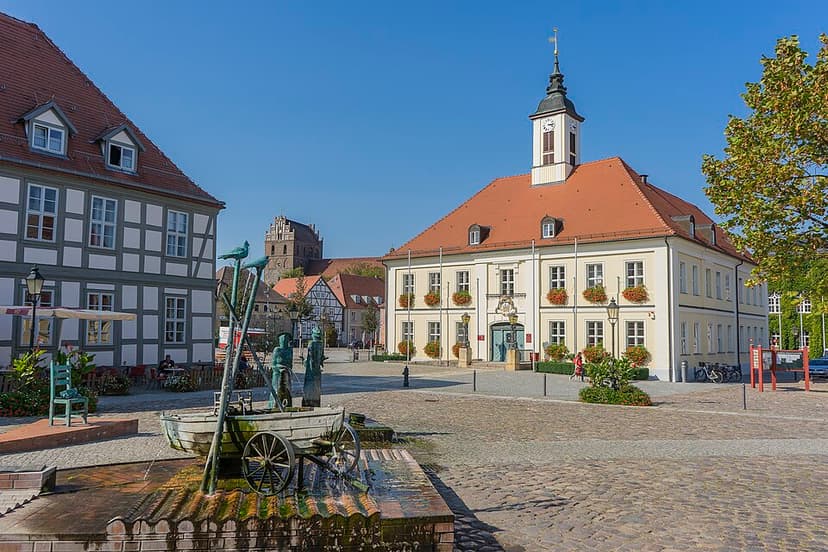
Angermünde
Angermünde is a historic town in the Uckermark region of Brandenburg, Germany, with a population of around 14,000. Originally an abbreviation of Tangermünde, it developed into an administrative sub-center known for its Protestant churches, schools, and a recently revitalized historic marketplace. Once a hub for enamel production, the town now heavily relies on tourism, leveraging its location amidst game-filled forests and numerous lakes.

Arnsberg
Arnsberg is a town in North Rhine-Westphalia, Germany, historically significant as the seat of the Counts of Arnsberg and later a possession of the Electorate of Cologne. Situated in the Ruhr river valley and surrounded by forests, it retains remnants of its past, including Arnsberg Castle. The town has undergone significant administrative mergers, most notably in 1975, to form its current structure, and has experienced periods of destruction, particularly during World War II.

Attendorn
Attendorn is a historic Hanseatic town in North Rhine-Westphalia, Germany, situated in the southern Sauerland region. Its origins trace back to prehistoric times, with significant settlement in the Middle Ages, evidenced by its strategic location at the crossroads of ancient trade routes. The town's prosperity was driven by its guilds, particularly wool and linen weavers, and its role as a political and ecclesiastical bulwark for the Archbishopric of Cologne. Attendorn is nationally recognized for the Atta Cave and Lake Bigge, and it officially adopted the title "Hanseatic town" in 2012.