
Snagov Monastery
Snagov Monastery, also known as Vlad Țepeș Monastery, is a significant medieval Orthodox site in southern Romania, located on an island in Lake Snagov. Originally a Thracian settlement, it likely dates to the late 14th century and was supported by various rulers, including Vlad the Impaler, who is believed to be buried there. The monastery served as a center for Orthodox spirituality, culture, and printing, notably under Abbot Anthim the Iberian.
Key Facts
- ›First documented in 1408, likely a late foundation of Mircea the Elder.
- ›Rumored burial site of Vlad the Impaler, who is documented to have had a prison and defense walls built on the island.
- ›The current church was built by Neagoe Basarab in 1521 after an earlier building was destroyed.
- ›Served as an important printing center, with Abbot Anthim the Iberian producing books in multiple languages.
- ›Its strategic island location made it a place of refuge and exile.
- ›The church has two patron saints: Saint Voivode Neagoe Basarab and Saint Anthim the Iberian.

Byzantine, Romanian Decorative Elements
- Island Location On Lake Snagov
- Burial Slab of Vlad the Impaler
- Printing Press Established By Constantin BrâNcoveanu
- Balcony Supported By 16 Pillars
- Bell Tower
Vlad țEpeș Monastery
Mircea the Elder, Vlad țEpeș, Neagoe Basarab, Mircea Ciobanul, Petru șChiopul, Matei Basarab, Constantin BrâNcoveanu, Anthim the Iberian, Alexandru Odobescu, Nicolae Iorga, Dinu Rosetti
- First Documented In 1408
- Vlad țEpeș Ordered the Construction of A Prison, Defense Walls, and A Bridge Around 1456
- Current Church Built By Neagoe Basarab In 1521
- Walls Painted By Dobromir the Young In 1563
- Printing Press Established By Matei Basarab In 1643
- Anthim the Iberian Served As Abbot From 1694 To 1705
- Convent of Nuns Abolished In 1810
- Bridge Connecting Island To Mainland Burned In 1821
- Leaders of the 1848 Revolution Detained On the Island
- Archaeological Research In 1933
- Church Damaged By Earthquakes In 1977 and 1986
- Repairs Between 1998 and 2000
- Modern Pedestrian Walkway Built In 2009
About Snagov Monastery
Snagov Monastery, also known as Vlad Țepeș Monastery, is a significant medieval Orthodox spiritual and cultural center situated in southern Romania. Located on an island within Lake Snagov, the site is believed to have foundations tracing back to an old Thracian settlement. The monastery's first documented mention dates to 1408, and it is considered a late endowment of Mircea the Elder. Throughout its history, it has been rebuilt and supported by various rulers, including Vlad Țepeș, Neagoe Basarab, and Mircea Ciobanul.
Historical Significance and Structure
The monastery's strategic island location has historically made it a place of refuge and exile. Vlad Țepeș is strongly associated with the site, with legends and some historical opinions suggesting he is buried within its precincts; a tomb slab bearing his name exists in front of the altar, though its contents are debated. The current church, built by Neagoe Basarab in 1521 after an earlier structure was destroyed by an earthquake, showcases Byzantine architecture with Romanian decorative elements, featuring exposed brickwork and a notable balcony.
Cultural and Spiritual Hub
Beyond its historical and military associations, Snagov Monastery was a vital center for Orthodox spirituality and culture. Under the support of Matei Basarab, a printing press was established in 1643. The monastery gained particular renown during the tenure of Abbot Anthim the Iberian (1694-1705), who utilized the printing press to produce religious texts in multiple languages, extending the monastery's cultural influence to Greece, Asia Minor, and Egypt. Despite periods of damage and restoration, including repairs after earthquakes in the late 20th century, the church, bell tower, and a fountain remain as key surviving structures from its rich past.
Source: Wikipedia ↗
Frequently Asked Questions
Where is Snagov Monastery located?
Snagov Monastery is located in southern Romania, in Ilfov County, on an island in the northern part of Lake Snagov. It is near the commune of Snagov and the village of Siliștea Snagovului.
When was Snagov Monastery first documented?
The monastery is first documented in 1408. Some historical accounts suggest an even earlier mention in the second half of the 14th century.
Is Vlad the Impaler buried at Snagov Monastery?
Local legends and the opinions of some specialists suggest that Vlad the Impaler is buried at Snagov Monastery. His funeral slab is located in front of the altar, although research by archaeologist Dinu Rosetti in the 1930s found the tomb to be empty.
What is the architectural style of the church?
The church at Snagov Monastery is built in a Byzantine style, incorporating Romanian decorative elements. It features exposed brickwork on the exterior, a balcony supported by pillars, a nave, and an altar.
What is the significance of Snagov Monastery as a cultural center?
Snagov Monastery was a significant cultural center, notably housing a printing press established by ruler Constantin Brâncoveanu. Under Abbot Anthim the Iberian, it printed religious books in various languages, contributing to its fame.
What remains of the original monastery buildings?
Currently, only the church, the bell tower, and a fountain are still standing on the island. Other buildings are either recently constructed or are old ruins.
Related Monasteries
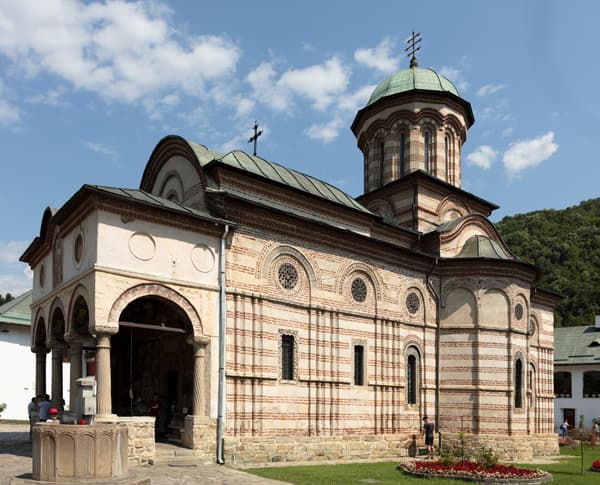
Cozia Monastery
Cozia Monastery is a significant medieval monastic complex in Romania, founded by Voivode Mircea the Elder in the late 14th century. It played a crucial role in the spiritual, cultural, and political history of Wallachia for over six centuries, serving as a prominent Orthodox center, a royal necropolis, and a model for subsequent religious architecture. The monastery is renowned for its Byzantine-influenced architecture, well-preserved frescoes, and its enduring importance as a pilgrimage site and symbol of national heritage.

Horezu Monastery
Horezu Monastery, founded in 1690 by Prince Constantin Brâncoveanu, is a masterpiece of the Romanian "Brâncovenesc style." Renowned for its architectural purity, balance, and rich sculpted and painted details, it represents a peak of cultural development in Wallachia during a period of geopolitical instability. The monastery is recognized as a UNESCO World Heritage Site.

Brebu Monastery
Brebu Monastery is a significant 17th-century Romanian Orthodox monastic complex, noted for its architectural preservation and importance in Romanian art of the period. Construction began in 1640 under Matei Basarab, and the monastery is situated in Prahova County, Romania, nestled in the foothills of the Bucegi and Grohotiş Mountains. It stands as one of the few medieval Romanian monuments largely preserved in its original form.