
Simon the Tanner
Coptic Orthodox·Egypt·Active (Cathedral)·10th century
Simon the Tanner is a Coptic Orthodox saint venerated for his association with the miraculous moving of the Mokattam Mountain in Cairo during the 10th century. According to tradition, his faith was instrumental in fulfilling a challenge posed by the Fatimid Caliph al-Muizz Lideenillah, saving the Coptic Christian community. His relics were discovered in 20th-century restorations, providing tangible links to this significant event in Coptic history.
Key Facts
- ›Associated with the miracle of moving the Mokattam Mountain in Cairo.
- ›Lived in the 10th century during the rule of Caliph al-Muizz Lideenillah.
- ›Was a tanner by profession, also known as a shoemaker and craftsman.
- ›His skeleton, with intact hair, was discovered during church restorations in 1991.
- ›The Coptic Orthodox Church commemorates the miracle with three extra days of fasting before the Nativity Fast.
- ›A clay pot believed to be used by Simon to carry water to the poor was found and is preserved.

- Virgin Mary and St. Simon the Tanner Cathedral, Cairo
- Monastery of Saint Simon, Aswan
- the Story of the Moving of the Mokattam Mountain
Simon the Shoemaker, Fiethouav SimōN PivakšAr; PišOm, Sama'An Al-Dabagh
Pope Abraham, Caliph Al-Muizz Lideenillah, Yaqub Ibn Killis
Miracle of Moving the Mokattam Mountain, Discovery of Saint Simon's Relics
About Simon the Tanner
Simon the Tanner, also known by various epithets such as Simon the Shoemaker, is a revered Coptic Orthodox saint from 10th-century Egypt. His fame rests primarily on his pivotal role in the traditional account of the miraculous moving of the Mokattam Mountain in Cairo. This event is said to have occurred during the reign of the Fatimid Caliph al-Muizz Lideenillah, under whom religious debates were common.
Life and the Miracle
Simon was a craftsman, working as a tanner and shoemaker, professions common among Coptic Christians of his era. The narrative of the moving mountain recounts how the caliph, incited by a Jewish debater named Yaqub ibn Killis, challenged the Coptic Patriarch Abraham to prove his faith by moving the mountain, threatening the lives of all Copts if he failed. After a period of prayer and penance, Patriarch Abraham received a vision of the Virgin Mary, who directed him to a one-eyed man in the market – Simon the Tanner. Simon, who had famously blinded himself in one eye in adherence to a biblical passage about avoiding sin, instructed the patriarch on how to perform the miracle. The mountain was reportedly moved upon the patriarch’s prayer, leading to the caliph’s recognition of the correctness of the Christian faith. Some accounts suggest this event led to the caliph's conversion.
Discovery of Relics and Commemoration
In modern times, between 1989 and 1991, extensive searches for Simon the Tanner's relics led to a significant discovery. His skeleton was found buried about a meter below the surface in the Coptic Orthodox Church of the Holy Virgin at Babylon El-Darag during its restoration. Notably, the hair on the back of his skull was found to be intact, a detail that aligned with a painting found in a nearby church depicting a bald-headed tanner carrying water jars. A clay pot, believed to be over 1000 years old and used by Simon to carry water to the poor, was also discovered and is now housed in the new Church of Saint Simon on Mokattam, Cairo. In commemoration of the miracle, the Coptic Orthodox Church observes three extra days of fasting each year before the beginning of the Nativity Fast.
Source: Wikipedia ↗
Frequently Asked Questions
Who was Simon the Tanner?
Simon the Tanner was a Coptic Orthodox saint who lived in the 10th century. He is primarily known for his association with the miraculous moving of the Mokattam Mountain in Cairo, a story central to Coptic tradition.
What is the story of the moving of the Mokattam Mountain?
According to tradition, Caliph al-Muizz demanded that Pope Abraham prove the truth of Christianity by moving the Mokattam Mountain. Guided by a vision of the Virgin Mary, Pope Abraham found Simon the Tanner, who instructed him on how to perform the miracle, which involved crying out 'O Lord, have mercy' three times and making the sign of the cross.
When did Simon the Tanner live?
Simon the Tanner lived towards the end of the 10th century, a period when many Coptic Christians in Egypt were engaged in various handicrafts.
Where were Simon the Tanner's relics discovered?
Simon the Tanner's skeleton was discovered in 1991 during the restoration of the Coptic Orthodox Church of the Holy Virgin at Babylon El-Darag in Old Cairo.
What is the significance of Simon the Tanner in the Coptic Orthodox Church?
Simon the Tanner is venerated as a saint for his role in the miraculous event of moving the Mokattam Mountain. In commemoration, the Coptic Orthodox Church observes three extra days of fasting before the Nativity Fast.
Are there any places dedicated to Saint Simon the Tanner?
Yes, there is the Virgin Mary and St. Simon the Tanner Cathedral in Cairo, located near the Zabbaleen village. There is also a Monastery of Saint Simon in Aswan, although its direct connection to the saint is less clear.
Related Monasteries

St. Anthony Coptic Orthodox Monastery
The Monastery of Saint Anthony is a prominent Coptic Orthodox monastery located in the Eastern Desert of Egypt, considered one of the most significant institutions in Coptic monasticism. Established by followers of Anthony the Great, it has influenced many Coptic institutions and promoted monasticism generally. The modern monastery functions as a self-contained village and is a popular destination for religious retreats and cultural excursions.
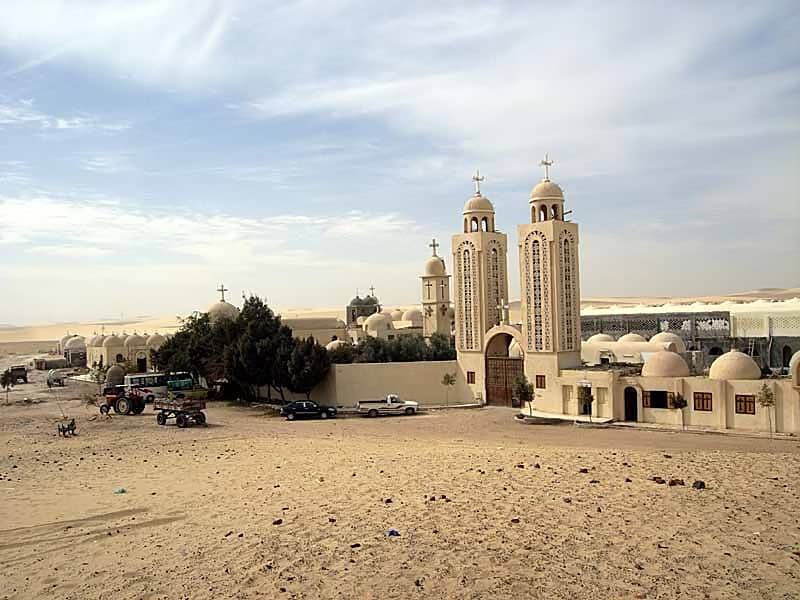
St. Fana Coptic Orthodox Monastery
The Monastery of Saint Fana is a Coptic Orthodox monastery located in the Western Desert of Egypt, near Minya Governorate. It is named after the 4th-century hermit Saint Fana and is sometimes referred to as the Monastery of Abu Fanah or Monastery of the Cross. Historically, it was a significant monastic center, reportedly housing around 1,000 monks in pre-Islamic times, though its numbers dwindled significantly by the 14th-15th centuries.

St. Macarius Coptic Orthodox Monastery
The Monastery of Saint Macarius the Great, located in Wadi El Natrun, Egypt, is a Coptic Orthodox monastery with a history stretching back to the 4th century AD. Attributed to Saint Macarius the Great, it is one of the oldest continually inhabited monastic communities in the world. The monastery is significant for its historical architecture, religious relics, and its role in the development of Christian monasticism.