
Serafimo-Diveevsky Monastery
The Serafimo-Diveevsky Monastery, also known as Saint Seraphim-Diveyevo Monastery, is a significant convent located in Diveyevo, Russia. It gained prominence due to its association with Saint Seraphim of Sarov, who served as Elder for its nuns and whose relics are now housed there. The monastery is also recognized for possessing the only contemporary portrait of Saint Seraphim.
Key Facts
- ›The monastery is a convent for nuns located in Diveyevo settlement, Russia.
- ›It is closely associated with Saint Seraphim of Sarov, who acted as Elder for its nuns.
- ›The monastery houses the relics of Saint Seraphim of Sarov, which were rediscovered after the fall of communism.
- ›It is home to the 'Diveyevo Portrait,' the only known portrait of Saint Seraphim painted during his lifetime.
- ›The monastery's construction began with the Church of our Lady of Kazan in 1773-1780.

- Church of Our Lady of Kazan
- Church of the Nativity of Christ
- Church of the Nativity of Theotokos
- Trinity Cathedral
- Transfiguration Cathedral
- the 'Diveyevo Portrait' of Saint Seraphim of Sarov
- Saint Seraphim-Diveyevo Monastery
- Holy Trinity-Saint Seraphim-Diveyevo Monastery
Saint Seraphim of Sarov, Alexandra Melgunova
- Construction of the Church of Our Lady of Kazan
- Blessing of Construction For Two Adjoining Churches By Saint Seraphim
- Construction of the Trinity Cathedral
- Construction of the Office of the Hegumenia and Associated Churches
- Construction of the Transfiguration Cathedral
- Significant Restoration Works Celebrating the 250th Anniversary of Saint Seraphim
About Serafimo-Diveevsky Monastery
The Serafimo-Diveevsky Monastery, also known by variations such as Saint Seraphim-Diveyevo Monastery and Holy Trinity-Saint Seraphim-Diveyevo Monastery, is a prominent convent situated in the Diveyevo settlement within Russia's Nizhny Novgorod Oblast. Its location, approximately 185 km from Nizhny Novgorod and 12 km from Sarov, places it in a region considered to be of great spiritual importance, with other notable cloisters like Sarov Monastery and Sanaksar Monastery in its proximity.
History and Significance
The monastery's fame is significantly tied to Saint Seraphim of Sarov, a revered monk from the nearby Sarov Monastery. He served as the spiritual Elder, or Staretz, for the nuns of this convent, although he visited only once during his lifetime. A pivotal moment in the monastery's modern history was the recovery and solemn transfer of Saint Seraphim's relics to the convent after the fall of communism. These relics, once feared lost, were found in a museum of atheism in Saint Petersburg and now reside at the monastery, which bears his name.
Another unique artifact associated with the monastery is the "Diveyevo Portrait," the sole portrait of Saint Seraphim painted by a contemporary. During periods of Communist persecution, this portrait was smuggled out of Russia and is presently housed at the Novo-Diveyevo Convent in Nanuet, New York.
Architectural Development
The monastic complex began with the construction of the Church of Our Lady of Kazan (Kazanskaya), which was built between 1773 and 1780. Following this, Saint Seraphim blessed the construction of two additional churches adjacent to the Kazanskaya: the Church of the Nativity of Christ, completed in 1829, and the Church of the Nativity of Theotokos, finished in 1830. A grander structure, the Trinity Cathedral, complete with a bell tower, was erected between 1865 and 1875. The late 19th century saw the addition of the Office of the Hegumenia (Abbess) with its Mary Magdalen House Church and the Alexander Nevsky Trapeza Church.
More recently, the Transfiguration Cathedral was constructed from 1907 to 1916. Significant restoration efforts were undertaken in 2003-2004, coinciding with celebrations for the 250th anniversary of Saint Seraphim's birth, further preserving and enhancing the monastery's historical structures.
Source: Wikipedia ↗
Frequently Asked Questions
What is the Serafimo-Diveevsky Monastery famous for?
The Serafimo-Diveevsky Monastery is famous for its association with Saint Seraphim of Sarov, who served as the Elder for its nuns. It is also known for housing his relics and the unique 'Diveyevo Portrait,' the only contemporary depiction of the saint.
Where is the Serafimo-Diveevsky Monastery located?
The monastery is situated in the Diveyevo settlement, near Sarov (12 km) and the city of Nizhny Novgorod (185 km), within the Nizhny Novgorod Oblast of Russia.
When was the Serafimo-Diveevsky Monastery founded?
The monastery's earliest documented structure, the Church of Our Lady of Kazan, was built between 1773 and 1780, marking the beginning of its establishment.
What is the significance of Saint Seraphim of Sarov to the monastery?
Saint Seraphim of Sarov was a monk at the nearby Sarov Monastery and served as the spiritual Elder for the nuns of the Serafimo-Diveevsky Monastery. His relics are a central feature of the convent, and the monastery is named in his honor.
Are there any notable artworks associated with Serafimo-Diveevsky Monastery?
Yes, the monastery is famous for possessing the 'Diveyevo Portrait,' which is the only portrait of Saint Seraphim of Sarov painted by a contemporary. This portrait is currently kept at the Novo-Diveyevo Convent in Nanuet, New York.
Related Monasteries
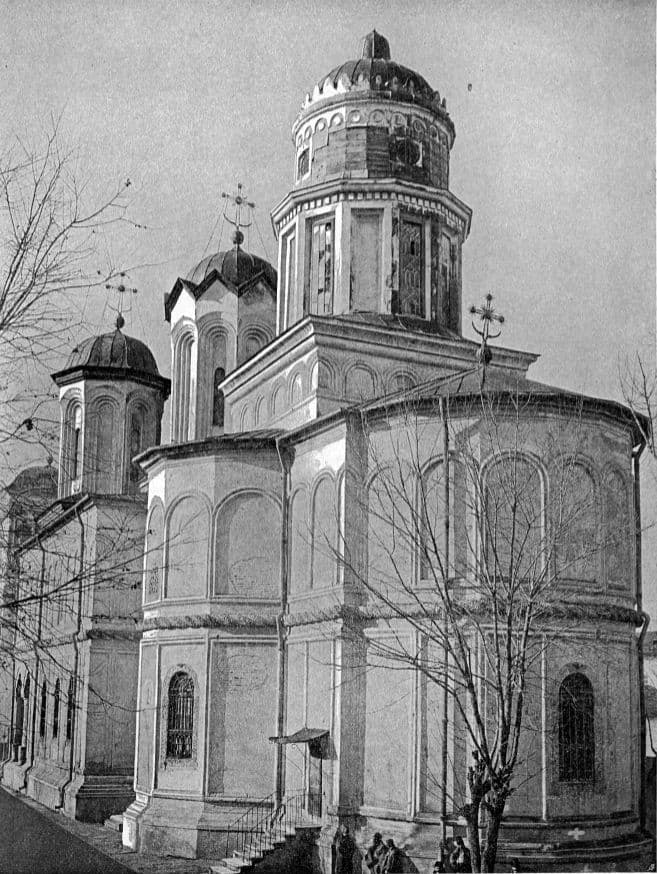
Văcărești Monastery
Văcărești Monastery was a significant religious and architectural complex in Bucharest, Romania, founded by ruler Nicholas Mavrocordatos between 1716 and 1736. It served as a royal residence, a center for culture with a notable library and printing press, and later as a prison before its complete demolition in 1986-1987 under Nicolae Ceaușescu's regime. The monastery was built in the Brâncovenesc style with influences of Mountainside Baroque and was dedicated to the Holy Trinity.

Alexander Nevsky Lavra
The Alexander Nevsky Lavra, officially Saint Alexander Nevsky Monastery, is a prominent Eastern Orthodox monastery in Saint Petersburg, Russia. Founded by Peter the Great in 1710, it was intended to commemorate the victory of Alexander Nevsky, though the chosen site was not the actual battlefield. The monastery holds significant religious and historical importance, serving as a burial place for many famous Russians and housing the relics of its namesake saint.

Epiphany Monastery
Epiphany Monastery, also known as Bogoyavlensky Monastyr, is the oldest male Orthodox monastery in Moscow, located in the Kitai gorod district near the Kremlin. Traditionally founded around 1296 by Prince Daniel of Moscow, it has a long history marked by royal patronage, significant fires, and periods of both prosperity and closure. The monastery's surviving Epiphany Cathedral is a notable example of Muscovite Baroque architecture.