
Sawtry Abbey
Sawtry Abbey was a Cistercian monastery founded in 1147 by Simon II de Senlis. Located in Cambridgeshire, England, it was the only Cistercian abbey in the county. Despite facing financial difficulties and disputes with neighboring monasteries in its early centuries, it was eventually dissolved in 1536, with its buildings largely demolished thereafter.
Key Facts
- ›Founded in 1147 by Simon II de Senlis, Earl of Northampton.
- ›It was the sole Cistercian abbey in Cambridgeshire.
- ›Experienced financial struggles and disputes with nearby abbeys during the 14th century.
- ›Dissolved in 1536 and its structures were subsequently demolished.
- ›Excavations between 1907 and 1913 revealed the abbey's layout.
- ›The site is scheduled and its earthworks are well preserved.
- Cruciform Church With Short Transepts and Choir
- South-Facing Cloisters
- Infirmary Or Abbot's Lodging To the East of the Cloisters
- Guest House South-West of the Cloister
- Well-Preserved Earthworks
Simon Ii De Senlis, Earl Waltheof, Judith, William the Conqueror, William Angell
- Founded In 1147
- Disputes Over Tithes and Land During the 13th Century
- Dissolution of the Monasteries In 1536
About Sawtry Abbey
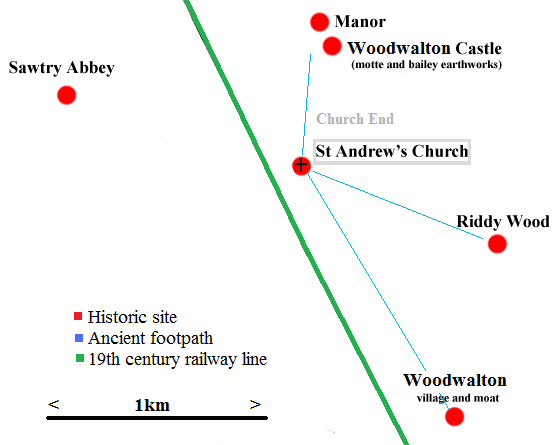
Sawtry Abbey was a Cistercian monastery situated in Cambridgeshire, England, between the villages of Sawtry and Woodwalton. Its establishment in 1147 marked it as the sole Cistercian abbey within the county.
Founding and Early History
The abbey was founded by Simon II de Senlis, Earl of Northampton. A contingent of monks from Wardon Abbey in Bedfordshire joined to form the new community. During the 13th century, Sawtry Abbey experienced frequent disputes concerning tithes and land with the abbots of nearby Ramsey and Thorney abbeys.
Later Centuries and Dissolution
Throughout the 14th century, records indicate that the abbot of Sawtry was often in debt, though the precise reasons remain unclear. Few documents detailing the abbey's history survive from this period. Its annual worth was less than £200. At the Dissolution of the Monasteries, Sawtry Abbey was disbanded before December 1536. Of the monks and conversi present, only the abbot, William Angell, was granted a pension of £10.
Post-Dissolution and Excavations
Following its dissolution, the abbey's church, conventual buildings, gate-house, bell tower, and even the old parish church of Sawtry Judith were demolished. Material from the site was quarried as late as the 19th century. Extensive excavations conducted between 1907 and 1913 successfully recovered much of the abbey's layout, revealing a cruciform church with short transepts and choir. The cloisters were located to the south, with an infirmary or Abbot's lodging to their east, and a guest house situated southwest of the cloister. The site's earthworks have been resurveyed and are considered well preserved, leading to its scheduling in 1954.
Source: Wikipedia ↗
Frequently Asked Questions
When was Sawtry Abbey founded?
Sawtry Abbey was founded in 1147. It was established by Simon II de Senlis, Earl of Northampton.
What religious order was Sawtry Abbey part of?
Sawtry Abbey was a Cistercian monastery. It was the only Cistercian abbey in the county of Cambridgeshire.
What happened to Sawtry Abbey after its dissolution?
Following its dissolution in 1536, the church, conventual buildings, gate-house, bell tower, and even the old parish church of Sawtry Judith were demolished. Stone was removed from the site as late as the 19th century.
Can the remains of Sawtry Abbey be seen today?
While the buildings were largely demolished, excavations between 1907 and 1913 recovered the layout of the abbey, and the earthworks are described as well preserved. The site has been scheduled since 1954.
Were there any notable figures buried at Sawtry Abbey?
Several notable figures were buried at Sawtry Abbey, including Isobel of Huntingdon, David Earl of Huntingdon, Matilda of Chester, Beatrice de Teyden, Margaret of Huntingdon, and Lady Margaret Fraser Keith.
Related Monasteries
Aldgate Priory
Holy Trinity Priory, also known as Christchurch Aldgate, was an Augustinian priory founded around 1108 by Queen Matilda of Scotland near Aldgate in London. It held significant ties to English royalty, with several queens maintaining a close relationship with the priory and some royal children buried there. The priory was a center of learning in the 12th century and played a role in civic life, with its prior serving as an Alderman of London. It was dissolved in 1532 and its buildings have since been largely lost, with only remnants surviving.

Ankerwycke Priory
Ankerwycke Priory was a small and relatively poor Benedictine nunnery established around 1160 in Buckinghamshire, England. Dedicated to St. Mary Magdalene, it held lands across several counties. Dissolved in 1536, its revenues were transferred to Bisham Abbey, and the priory site later saw the construction of a manor house. Today, only a small section of ruins remains, situated in Berkshire.

Arthington Priory
Arthington Priory was an English monastery for nuns of the Cluniac congregation, located in Arthington, West Yorkshire, and founded in the mid-12th century. It was one of only two Cluniac nunneries in England. The priory experienced periods of disciplinary issues among its nuns and prioresses, as documented by Archbishop William Greenfield's visits and injunctions. Following the Dissolution of the Monasteries under Henry VIII, the priory was surrendered in 1540, and its lands were eventually granted to Archbishop Thomas Cranmer. Today, little remains of the original priory structures, with a residence known as Arthington Hall built on the site around 1585, and the priory church potentially occupied by a farmhouse named The Nunnery.