
Riesa
Riesa, historically known as Ryzawa in Upper Sorbian, is a town situated on the Elbe River in Saxony, Germany. Its origins trace back to a Slavic name that first appeared in written records in 1119. The town experienced significant growth during the 20th century due to industrialization, particularly in steel production and pasta manufacturing, though its population declined after German reunification. Riesa is also recognized for its modern sporting facilities, including the SACHSENarena, and a distinctive oak trunk sculpture.
Key Facts
- ›The name Riesa is derived from the Slavic 'Riezowe', first documented in 1119.
- ›It was the site of the world's first 110 kV power line installation in 1912.
- ›The town's population saw a significant decline after German reunification due to the closure of local steel works.
- ›Riesa is known for its pasta production at Teigwaren Riesa GmbH and historically for 'Riesaer Zündhölzer' matches.
- ›It hosts the SACHSENarena, a venue for major sporting and cultural events, including darts and sumo wrestling championships.
- ›The town features an imposing 25-meter-tall cast-iron sculpture of an oak trunk named Elbquelle.

Elbquelle Sculpture, St. Marien Minster, Trinitatis Church, Sachsenarena
Ryzawa
JöRg Immendorff, Adolph Von Carlowitz, Johannes MüLler, Rolf Moebius, Dieter Noll, Lothar Kurbjuweit, JüRgen Schmieder, Monika Zehrt, Olaf Jentzsch, Heiko Peschke, Ulf Kirsten, RüDiger Heinze, Heike GeißLer, Maximilian Arnold, Walter Fritzsch, Wolfgang Lischke, Peter Kotte, Harald Czudaj, Ralf Hauptmann
- First Documented Mention of the Name 'Rezoa' In 1119.
- Installation of the World's First 110 Kv Power Line Between Riesa and Lauchhammer In 1912.
- Served As Headquarters For the Soviet Union's 9th Tank Division In the 1980s.
- Hosted the Far-Right Party Afd's Federal Party Conference On January 11, 2025, Which Was Met With Large Protests.
About Riesa
Riesa is a town in the Meißen district of Saxony, Germany, situated on the banks of the Elbe River. Its history is marked by a Slavic origin, with its name first appearing in written records in 1119. The town experienced significant industrial growth in the 20th century, becoming known for steel production and manufacturing, though this led to population decline after German reunification in 1989.
Historical Context
The name Riesa derives from the Slavic 'Riezowe', romanized as 'Rezoa' in a document from Pope Callixtus II in 1119. The town's development was spurred by industrialization, notably the installation of the world's first 110 kV power line connecting it to Lauchhammer in 1912. During the 1980s, Riesa was a significant military location, serving as the headquarters for the 9th Tank Division of the Group of Soviet Forces in Germany. The post-reunification period saw economic challenges, with the closure of local steel works leading to a substantial population decrease.
Sights and Culture
Among Riesa's notable landmarks is the 'Elbquelle' sculpture, a 25-meter-tall cast-iron oak trunk erected in 1999, often called the 'Rusty Oak' by locals. The town also features historical religious sites, including the minster St. Marien, built in 1261 as an addition to a Benedictine Abbey, and the Trinitatis Church, completed in 1897. Culturally, Riesa is recognized for its pasta production by Teigwaren Riesa GmbH and historically for its matches, 'Riesaer Zündhölzer'.
Modern Significance
Riesa is a hub for sports and events, primarily through the SACHSENarena, a large hall that has hosted international competitions such as the European and World Sumo Wrestling Championships and the International Darts Open. The town also has a football club, BSG Stahl Riesa. In recent years, Riesa gained attention for hosting political events, including a federal party conference in January 2025 that drew significant public protest.
Source: Wikipedia ↗
Frequently Asked Questions
What is the historical origin of the name Riesa?
The name Riesa originates from the Slavic name 'Riezowe'. This name, romanized as 'Rezoa', first appeared in official documents in October 1119, indicating its long historical roots.
What industrial developments are associated with Riesa's history?
Riesa grew significantly due to industrialization starting in the 20th century. It was a center for steel production and the manufacturing of matches ('Riesaer Zündhölzer'). The town is also locally known for its pasta production, carried out by Teigwaren Riesa GmbH.
What major sporting events has Riesa hosted?
Riesa is known for its SACHSENarena, a large hall that has hosted significant sporting events. These include the European Sumo Wrestling Championship in 2003 and the World Sumo Wrestling Championship in 2004. Since 2015, it has also been the home of the International Darts Open.
What is the 'Elbquelle' sculpture?
Elbquelle, meaning 'source of the Elbe', is a notable sculpture in Riesa. It is a 25-meter-tall, 234-tonne cast-iron sculpture of an oak trunk, created by Jörg Immendorff and erected in 1999. Locals often refer to it as 'Rusty Oak'.
What was Riesa's significance during the Cold War?
During the 1980s, Riesa served as the headquarters for the 9th Tank Division of the Group of Soviet Forces in Germany. This placed it in a strategically important position within the Soviet military presence in East Germany.
Related Monasteries
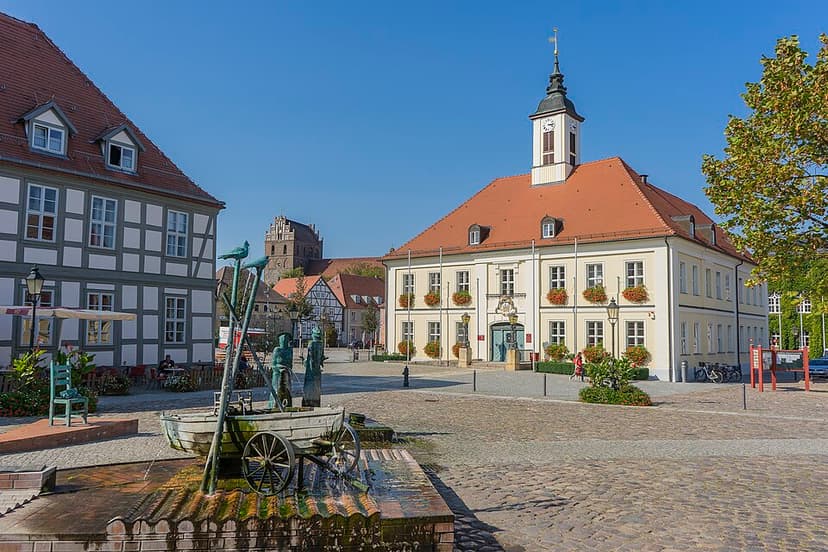
Angermünde
Angermünde is a historic town in the Uckermark region of Brandenburg, Germany, with a population of around 14,000. Originally an abbreviation of Tangermünde, it developed into an administrative sub-center known for its Protestant churches, schools, and a recently revitalized historic marketplace. Once a hub for enamel production, the town now heavily relies on tourism, leveraging its location amidst game-filled forests and numerous lakes.

Arnsberg
Arnsberg is a town in North Rhine-Westphalia, Germany, historically significant as the seat of the Counts of Arnsberg and later a possession of the Electorate of Cologne. Situated in the Ruhr river valley and surrounded by forests, it retains remnants of its past, including Arnsberg Castle. The town has undergone significant administrative mergers, most notably in 1975, to form its current structure, and has experienced periods of destruction, particularly during World War II.

Attendorn
Attendorn is a historic Hanseatic town in North Rhine-Westphalia, Germany, situated in the southern Sauerland region. Its origins trace back to prehistoric times, with significant settlement in the Middle Ages, evidenced by its strategic location at the crossroads of ancient trade routes. The town's prosperity was driven by its guilds, particularly wool and linen weavers, and its role as a political and ecclesiastical bulwark for the Archbishopric of Cologne. Attendorn is nationally recognized for the Atta Cave and Lake Bigge, and it officially adopted the title "Hanseatic town" in 2012.