
Nicula Monastery
Nicula Monastery is a significant pilgrimage site in Transylvania, Romania, with a history spanning centuries. Originally an Eastern Orthodox monastery, it became Greek-Catholic before being confiscated and transferred to the Romanian Orthodox Church in 1948. The monastery is renowned for its icon of the Virgin Mary, which is said to have shed tears in 1699, an event that cemented its status as a pilgrimage destination.
Key Facts
- ›Established with an unconfirmed tradition dating to the 14th century.
- ›First documentary mention in 1552 as an Eastern Orthodox site.
- ›Became Greek-Catholic at the end of the 18th century and dedicated to Saint Nicholas.
- ›Housed a famous icon painted in 1681 by Luca of Iclod, which reportedly shed tears in 1699.
- ›Confiscated and transferred to the Romanian Orthodox Church in 1948.
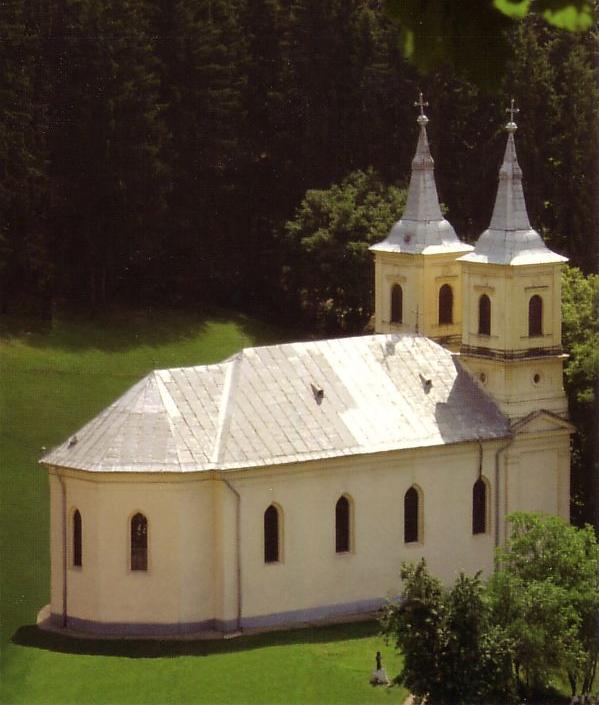
- ›Features a stone church built between 1875 and 1879, with two spires added in 1905.
Baroque, Neoclassical
Icon of the Virgin Mary, Wooden Church, Stone Church, Iconostasis, Bell, Guesthouse For Pilgrims
Luca of Iclod, Sigismund Kornis, Pope Clement Xiii, Pope Pius Xi
- Icon Shedding Tears
- Greek-Catholic Church Outlawed and Monastery Confiscated
About Nicula Monastery
Nicula Monastery is an esteemed pilgrimage site situated in the village of Nicula, Cluj County, in the northern Transylvania region of Romania. While tradition suggests its founding in the 14th century, the earliest documented mention dates to 1552, when it operated as an Eastern Orthodox monastery. The monastery's history is marked by shifts in religious affiliation; it became Greek-Catholic following the church's establishment at the end of the 18th century and was dedicated to Saint Nicholas. A significant restructuring occurred during this period, evidenced by the construction of a wooden church, iconostasis, and bell in the late 17th century.
The Miraculous Icon and Pilgrimage
A pivotal element in the monastery's spiritual significance is the icon painted in 1681 by artisan Luca of Iclod. This icon gained widespread renown when, between February 15 and March 12, 1699, it reportedly "shed tears," an event documented by Austrian officers. This miraculous occurrence cemented Nicula Monastery's status as a major Greek-Catholic pilgrimage destination. The icon was later moved to various noble residences before eventually reaching Cluj. Pope Clement XIII granted plenary indulgence to Greek-Catholic pilgrims visiting the monastery during Marian feasts in 1767, further underscoring its importance.
Later Developments and Current Status
The monastery saw further architectural development with the construction of its stone church between 1875 and 1879, funded by the Gherla Diocese, and the addition of two prominent spires in 1905. In 1928, Pope Pius XI officially designated the monastic sanctuary as a Marian Sanctuary. The monastery has also been a center for icon painting, contributing to the spread of glass painting techniques originating from Central Europe. In 1948, with the outlawing of the Greek-Catholic Church by the communist regime, Nicula Monastery was confiscated and transferred to the Romanian Orthodox Church, under whose administration it continues to operate as an active monastic community and pilgrimage site today. The original wooden church burned down in 1973, and an 18th-century replacement was brought to the site.
Source: Wikipedia ↗
Frequently Asked Questions
When was Nicula Monastery founded?
An unconfirmed tradition suggests that Nicula Monastery was established in the 14th century. The earliest documentary evidence of its existence dates to 1552.
What is the religious affiliation of Nicula Monastery?
Nicula Monastery was originally an Eastern Orthodox site. It later became Greek-Catholic at the end of the 18th century. In 1948, it was confiscated and transferred to the Romanian Orthodox Church, which currently owns and uses it.
What is the significance of the icon at Nicula Monastery?
The monastery's church housed a famous icon painted in 1681 by Luca of Iclod. According to reports, this icon shed tears between February 15 and March 12, 1699, an event that significantly contributed to the monastery's importance as a pilgrimage center.
What notable architectural features does Nicula Monastery have?
The monastery features a stone church constructed between 1875 and 1879, which was built next to an earlier wooden church. Two spires, each 25 meters high, were added to the stone church in 1905.
Is Nicula Monastery open to the public?
Nicula Monastery is an important pilgrimage center and is accessible to the public. The text mentions facilities for pilgrims, indicating public visitation is a key aspect of its function.
Related Monasteries

Antim Monastery
The Antim Monastery is a Romanian Orthodox church in Bucharest, built between 1713 and 1715 by Saint Anthim the Iberian. It served as a significant religious center and was later restored in the 1960s. The monastery complex includes a museum dedicated to Saint Anthim and has a complex history, including its involvement in the 1941 pogrom and its preservation during the communist era through relocation.

Baia de Aramă Monastery
Baia de Aramă Monastery is a significant religious site in Romania, established in the late 17th century. It is renowned for its well-preserved fresco decorations, characteristic of the Romanian artistic period between the Carpathians and the Danube. Following a period of disuse, the monastery was re-established as a nunnery in 2008 and continues to be an active spiritual center and a valuable monument of medieval art.

Bârnova Monastery
Bârnova Monastery is a Romanian Orthodox monastery located in Bârnova, within the Iași metropolitan area of Moldavia, Romania. It was established in 1628 by Miron Barnovschi-Movilă, a Moldavian Voivode, and is recognized on the National Register of Historic Monuments. The monastery's courtyard hosts the oldest tree in Iași County, a 675-year-old hybrid lime tree, predating the first mention of Iași as an urban settlement.