
Le Barroux Abbey
Le Barroux Abbey, officially known as Sainte-Madeleine du Barroux Abbey, is a traditionalist Benedictine monastery established in 1978 in Le Barroux, Vaucluse, France. It was founded by Dom Gérard Calvet to preserve the traditional Benedictine monastic life and liturgy of the Catholic Church, particularly the pre-1970 Roman Missal. The abbey gained canonical status and was elevated to an abbey in 1989, later joining the Benedictine Confederation in 2008, and is known for its spiritual retreats and online streaming of its Divine Office.
Key Facts
- ›Founded in 1978 by Dom Gérard Calvet.
- ›Celebrates liturgy according to the pre-1970 Roman Missal (Tridentine Mass).
- ›Reconciled with the Holy See in 1988, retaining the traditional liturgy.
- ›Has a female branch, the Abbey of Notre-Dame-de-L'Annonciation, founded in 1979.
- ›Produces olive oil, lavender, wine, and bread.
- ›Streams its Divine Office daily online.

Olive Oil Mill, Bakery Producing Wine and Bread, On-Site Hotel For Guests, Daily Streaming of Divine Office
Sainte-Madeleine Du Barroux Abbey
Dom GéRard Calvet, Dom Louis-Marie De Geyer D’Orth, Archbishop Marcel Lefebvre, Pope John Paul Ii, Cardinal éDouard Gagnon, Cardinal Ratzinger
- Founding of the Community In 1978
- Break With the Lefebvrist Movement and Reconciliation With the Holy See In 1988
- Conferral of Canonical Status and Elevation To Abbey Rank In 1989
- Consecration of the Abbey In 1989
- Visit By Cardinal Ratzinger In 1995
- Founding of Monastery of Sainte-Marie De La Garde By Monks In 2002
- Resignation of Dom Gerard Calvet As Abbot In 2003
- Death of Dom Gerard Calvet In 2008
- Inclusion In the Benedictine Confederation In 2008
- Independent Foundation In Villatalla, Italy In 2008
About Le Barroux Abbey
Le Barroux Abbey, formally known as Sainte-Madeleine du Barroux Abbey, is a traditionalist Benedictine monastery located in the commune of Le Barroux in the Vaucluse department of southeastern France. It was established in 1978 by Dom Gérard Calvet, with the current abbot being Dom Louis-Marie de Geyer d’Orth. The abbey was founded with the explicit purpose of preserving the traditional monastic life and liturgical practices of Benedictine monks, particularly the celebration of the Roman Missal as it was used before the liturgical reforms following the Second Vatican Council. This commitment to tradition led the community to seek reconciliation with the Holy See, which was achieved in 1988, allowing them to continue using the pre-conciliar liturgy under specific provisions.
History and Development
The community began as a small group of monks led by Dom Gérard Calvet, seeking to maintain the traditional Benedictine way of life in the Chapel of St. Mary Magdalene. Shaken by the changes occurring within the Catholic Church, Calvet envisioned the abbey as a haven for this traditional observance. In 1979, a corresponding female branch, the Abbey of Notre-Dame-de-l'Annonciation, was founded. The community grew, numbering 53 monks by 1986. Initially aligned with the Lefebvrist movement, the monks eventually broke ties following the Écône consecrations and subsequent excommunications. Their reconciliation with the Holy See in 1988, facilitated by Pope John Paul II's motu proprio Ecclesia Dei, allowed them to continue their specific liturgical practice. The monastery received canonical status on June 18, 1989, and was elevated to the rank of an Abbey on July 2, with Dom Gerard Calvet appointed as its first Abbot. The Abbey was consecrated on October 2, 1989. Notable visitors have included Cardinal Ratzinger in 1995. Over the years, some monks have departed to found other communities, including the Monastery of Sainte-Marie de la Garde in 2002 and an independent foundation in Villatalla, Italy, in 2008. Dom Gerard resigned as Abbot in 2003, succeeded by Dom Louis-Marie. In 2008, Le Barroux Abbey officially became part of the Benedictine Confederation of the Order of St. Benedict.
Community Life and Activities
The community at Le Barroux Abbey engages in various self-sustaining activities. They operate a mill for producing olive oil and maintain a bakery that produces wine and bread. The wine is also produced in collaboration with local winemakers, adhering to traditional methods. The monks provide spiritual guidance and offer retreats for visitors. To foster a connection with the wider faithful, the monastery streams its daily Divine Office online, with recordings available on their website and through a dedicated phone application, allowing individuals to participate in their liturgical life remotely.
Notable Figures
Dom Gérard Calvet is the founder of Le Barroux Abbey and served as its first Abbot. Dom Louis-Marie de Geyer d’Orth is the current abbot. The abbey's history is also marked by significant figures in the Catholic Church, including Archbishop Marcel Lefebvre, Pope John Paul II, Cardinal Édouard Gagnon, and Cardinal Ratzinger, who visited the monastery.
Current Status
As of May 2014, the Abbey comprised 57 members, including priests, a deacon, brothers, students, and novices, with an average age of 44. The monastery continues its active spiritual life, production activities, and outreach through online streaming.
Source: Wikipedia ↗
Frequently Asked Questions
When was Le Barroux Abbey founded?
Le Barroux Abbey was founded in 1978 by Dom Gérard Calvet. A group of men initially formed a small community before establishing the abbey.
What makes the liturgy at Le Barroux Abbey traditional?
The liturgy is celebrated according to the pre-1970 Roman Missal, also known as the Tridentine Mass. This was a key reason for the monastery's foundation, to continue traditional practices.
What is the relationship between Le Barroux Abbey and the Holy See?
The monks were reconciled with the Holy See in 1988 after a period of negotiation, allowing them to use the pre-conciliar liturgy. The monastery gained canonical status in 1989 and later became part of the Benedictine Confederation.
What products does the abbey community create?
The monastic community has its own mill for olive oil production. They also produce lavender, wine, and bread through their own bakery. The wine is produced jointly with local winemakers.
Can visitors experience the monastic life at Le Barroux Abbey?
The monks offer spiritual retreats and individual spiritual guidance. The Abbey also has a hotel to accommodate guests, and the Divine Office is streamed online for those wishing to connect remotely.
Related Monasteries
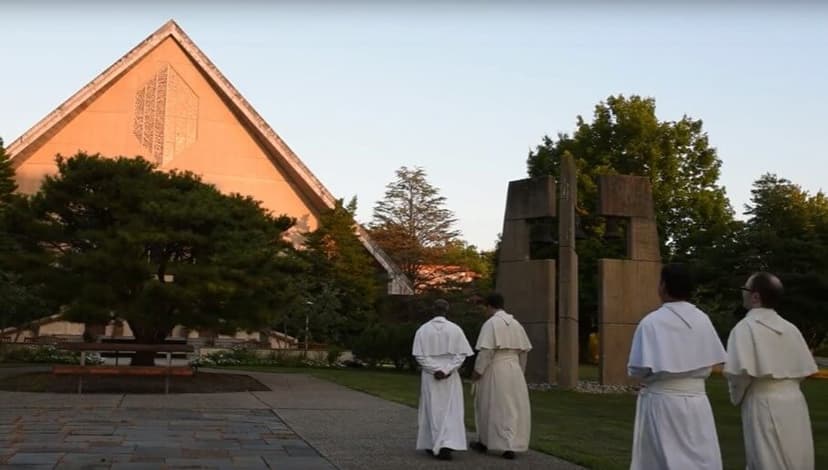
Daylesford Abbey
Daylesford Abbey is a Catholic monastery of the Norbertine order, located in Chester County, Pennsylvania. Founded in the 1950s to expand the Norbertine presence on the East Coast, it was established on the Cassatt Estate and later moved to its present 88-acre site in Paoli. The abbey is known for its solemn liturgies, adherence to the Rule of St. Augustine, and its ministries in education and social services, including a prominent role in supporting the homeless.

Louvain-la-Neuve
Louvain-la-Neuve is a planned town in Belgium, established to house the French-speaking Université catholique de Louvain (UCLouvain) following linguistic disputes in the 1960s. Designed with a focus on pedestrian accessibility, its city center is built on a concrete slab with vehicular traffic routed underground. While initially conceived as an academic hub, it has diversified with cultural and commercial amenities, aiming for a balanced community beyond its student population.

Monastery of the Holy Spirit
The Monastery of the Holy Spirit, officially the Monastery of Our Lady of the Holy Spirit, is a Trappist monastery located near Conyers, Georgia, within the Arabia Mountain National Heritage Area. Founded in 1944 by monks from the Abbey of Gethsemani, it is characterized by its commitment to prayer, self-sustainment through various businesses, and its role as a spiritual center offering retreats and spiritual direction. The monastery is home to an active community of monks and is open to visitors.