
Konevsky Monastery
Konevsky Monastery is a Russian Orthodox monastery situated on Konevets Island in Lake Ladoga, established around 1393 by St. Arseny Konevsky. Known for its missionary work and once considered a twin to the Valaam Monastery, it experienced periods of displacement and restoration throughout its history. The monastery features a notable 19th-century cathedral and bell tower, and after damage and evacuation during wartime, it was revived in the late 20th century and is now a popular site for tourists and pilgrims.
Key Facts
- ›Founded around 1393 by St. Arseny Konevsky.
- ›Located on Konevets Island in Lake Ladoga, Leningrad Oblast, Russia.
- ›Known for its missionary activities among pagan Karelians.
- ›Experienced displacement due to wars and floods, with its location changing multiple times.
- ›Features a large cathedral built between 1800–09 and a 35-meter bell tower completed in 1812.
- ›Revived by the Russian Orthodox Church in 1990 after a period of housing a military unit.

Russian Orthodox
- Kon’-Kamen’
- Church of the Nativity of the Theotokos
- Miraculous Image of Mother of God From Mount Athos
- 19th-Century Cathedral With Five Blue Domes
- Three-Storey Belltower
- Konevsky Psalter
- рождество-богородичный коневский монастырь
- Konevitsan JumalansynnyttäJäN SyntymäN Luostari
St. Arseny Konevsky
Ingrian War, Great Northern War, Finnish War, Russian Revolution of 1917, Winter War, Continuation War, Soviet Period, Revival By Russian Orthodox Church In 1990
About Konevsky Monastery
Konevsky Monastery is a significant Russian Orthodox monastic community located on Konevets Island in the western part of Lake Ladoga, within the Leningrad Oblast of the Russian Federation. Often likened to the Valaam Monastery due to their shared island locations on Lake Ladoga, Konevsky Monastery has a rich history stretching back to the late 14th century.
Medieval Origins and Early History
The island itself, known historically as Konevitsa or Kononsaari, was considered a sacred site by the indigenous Finnish tribes, who revered a massive boulder named Kon’-Kamen’ (Steed-Stone). It was in this spiritually charged environment that St. Arseny Konevsky founded the monastery around 1393, with the express purpose of converting the local pagan Karelians to Christianity. The monastery's early existence was marked by a need for resilience, as its location was altered multiple times to safeguard against floods. A pivotal moment occurred in 1428 when St. Arseny established the Church of the Nativity of the Theotokos, which became the repository for the monastery's most sacred relic: a miraculous icon of the Mother of God brought from Mount Athos.
Periods of Conflict and Revival
Like its island counterpart, Valaam Monastery, Konevsky Monastery was recognized for its missionary endeavors. The monastery faced considerable challenges, including capture by the Swedes during the Ingrian War, which necessitated the monks' retreat to Novgorod. Following Russia's retaking of the territory after the Great Northern War, the monks were permitted to return and re-establish their holdings. In 1812, after the Finnish War, the monastery became administratively part of the Grand Duchy of Finland. The 19th century marked a golden age, with extensive building projects, including a grand cathedral (1800–09) and a prominent bell tower (1810–12), funded by the monastery's growing fame and patronage from notable visitors, including figures like Alexandre Dumas and Fyodor Tyutchev.
20th Century Transformations and Modern Status
The tumultuous 20th century brought further upheaval. After the Russian Revolution, the monastery came under the jurisdiction of the Finnish Orthodox Church. During the Winter War and Continuation War, the monastery's buildings sustained damage, and the monks were evacuated, taking precious icons and manuscripts to safety. The monastery site later housed a military unit during the Soviet era. However, the spirit of Konevsky Monastery endured. In 1990, it became one of the first monasteries in the region to be revived by the Russian Orthodox Church. By the early 21st century, the monastery had largely been restored and had re-emerged as a significant center for both pilgrims and tourists, drawing visitors to its historic island setting.
Source: Wikipedia ↗
Frequently Asked Questions
When was Konevsky Monastery founded?
Konevsky Monastery was founded around 1393 by St. Arseny Konevsky. He aimed to convert the pagan Karelians to Christianity.
Where is Konevsky Monastery located?
The monastery is situated on Konevets Island, which is in the western part of Lake Ladoga in the Leningrad Oblast of the Russian Federation.
What is the significance of Kon’-Kamen’ to the monastery?
Kon’-Kamen’, also known as Hevoskivi, is a large boulder on the island in the shape of a horse's skull. This sacred stone was revered by the local Finnish tribes and gives its name to the island and, by extension, the monastery.
Has the monastery always been in its current location?
No, the location of the monastery was changed several times in its early history to avoid floods. The Church of the Nativity of the Theotokos, housing the monastery's main shrine, was founded by St. Arseny in 1428.
What happened to the monastery during the 20th century?
Following the Russian Revolution, the monastery passed to independent Finland and suffered damage during the Winter War and Continuation War. Monks were evacuated, taking the holy icon with them. After the war, the monks joined the New Valamo Monastery, and the site housed a military unit before being revived in 1990.
Is Konevsky Monastery open to visitors?
Yes, by 2004, Konevsky Monastery had been mostly restored and hosts a large number of tourists and pilgrims, indicating it is accessible to the public.
Related Monasteries

Sanaksar Monastery
The Sanaksar Monastery of the Nativity of the Mother of God is a Russian Orthodox monastery located in the Republic of Mordovia. Founded in 1659, it was returned to the Russian Orthodox Church in 1991. The monastery is notable for enshrining the relics of Admiral Fyodor Ushakov, who is considered the patron of the Russian Navy and strategic bombers.
Conception Convent
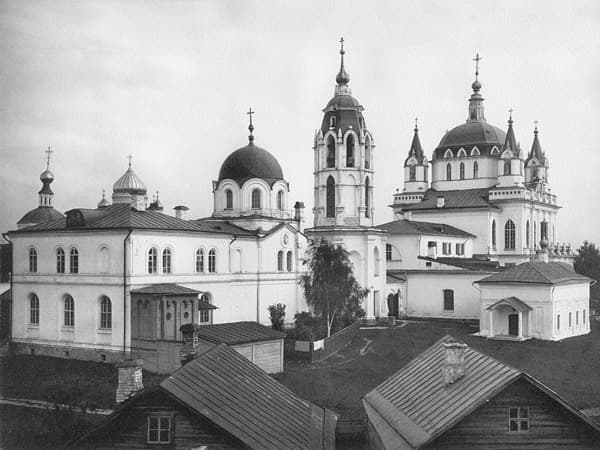
The Conception Convent, also known as the Zachatyevsky Monastery, is a Russian Orthodox convent located on the Moskva River in Moscow. Originally believed to occupy the site of the oldest nunnery in Moscow, it was reestablished in 1995 after being closed by the Bolsheviks in 1918 and undergoing significant damage and repurposing during the Soviet era. Its reconstruction has seen the rebuilding of its katholikon in a Russian Revival style.

Savvino-Storozhevsky Monastery
The Savvino-Storozhevsky Monastery is a significant Russian Orthodox monastery located in Zvenigorod, west of Moscow. Founded in 1398 by Prince Yuri of Zvenigorod at the request of Saint Savva, it served as a spiritual center and a defensive outpost. The monastery later became a favored suburban residence for Tsar Alexis and continued to be visited by Russian royalty for blessings before coronations, solidifying its importance as a major religious and historical landmark.