
Hovhannavank
Christian·Armenia·Active monastery with historical structures·4th century
Hovhannavank is a medieval Armenian monastery situated on the edge of the Kasagh River canyon in the Aragatsotn Province. Its origins trace back to the 4th century with the foundation of a basilica by St. Gregory the Enlightener, later expanded significantly in the 13th century by Prince Vache I Vachutian and his son Kurt I Vachutian. The monastery served as a vital educational and theological center for centuries, known for its scriptorium and rich lapidary inscriptions, and its Cathedral features a unique umbrella-shaped dome.
Key Facts
- ›The oldest part is a 4th-century single-nave basilica founded by St. Gregory the Enlightener.
- ›The main Cathedral was constructed between 1216 and 1221.
- ›Features a unique umbrella-shaped dome, characteristic of some Armenian churches.
- ›Served as an important educational and theological center with a scriptorium from the 12th to 17th centuries.
- ›Suffered damage from earthquakes in 1918 and 1679, with subsequent reconstructions.
- ›Known for its rich lapidary inscriptions, including those from the Zakarid brothers.

Armenian Medieval, Basilica
- Single Nave Basilica of St. Karapet
- Cathedral With Cruciform Floor Plan
- Unique Umbrella-Shaped Dome
- Narthex With Central Rotunda
- Rich Lapidary Inscriptions
- Carved Scenes From the Parable of the Wise and Foolish Virgins
Yovhannavank
St. Gregory the Enlightener, Prince Vache I Vachutian Amberdtsi, Kurt I Vachutian, Zakaria Kanakertsi, Konstandin I, Katholicos of Armenia, Zakaria and Ivane
- Baptism of Armenia Into Christianity
- Renovations and Construction Phases In the 13th Century
- Destruction of Dome and Southern Wall By Earthquake In 1918
- Collapse of Structures and Decline After 1679 Earthquake
About Hovhannavank
Hovhannavank, also known as Yovhannavank, is a significant medieval Armenian monastery situated on the dramatic edge of the Kasagh River canyon in the Aragatsotn Province of Armenia. Its history is deeply intertwined with the early Christianization of Armenia, with its oldest surviving structure being a single-nave basilica founded in the 4th century by St. Gregory the Enlightener. This foundational church, dedicated to St. Karapet (John the Baptist), has undergone numerous renovations over the centuries.
History and Architecture
The monastery flourished notably during the High and Late Middle Ages, serving as the center of the episcopal diocese of Amberd province. The architectural centerpiece, the Cathedral, was constructed between 1216 and 1221, endowed by Prince Vache I Vachutian. This Cathedral is characterized by its cruciform floor plan and a distinctive umbrella-shaped roof on its dome, a unique feature in Armenian ecclesiastical architecture. In 1250, Vache I's son, Kurt I Vachutian, added a narthex (zhamatun) to the western side of the Cathedral, further enhancing the complex.
From the 12th to the 17th centuries, Hovhannavank was a renowned educational and theological hub for Eastern Armenia. It housed a scriptorium where valuable manuscripts were meticulously written and illuminated, contributing to the preservation and dissemination of knowledge. The monastery's walls are adorned with numerous lapidary inscriptions, including significant texts from the Zakarid brothers, detailing their patronage and the political context of the era. The complex has endured natural calamities, with earthquakes in 1679 and 1918 causing damage that necessitated subsequent reconstructions, particularly in the 1990s for the Cathedral's dome and southern wall.
Source: Wikipedia ↗
Frequently Asked Questions
When was Hovhannavank founded?
The oldest part of Hovhannavank, the basilica of St. Karapet, was founded at the beginning of the fourth century by St. Gregory the Enlightener. The main Cathedral was built much later, between 1216 and 1221.
Who were the main benefactors of Hovhannavank?
The centerpiece, the Cathedral, was built through the donation of Prince Vache I Vachutian Amberdtsi. His son, Kurt I Vachutian, later built the narthex (zhamatun or gavit) next to the Cathedral.
What is architecturally unique about Hovhannavank?
The Cathedral of Hovhannavank possesses a unique umbrella-shaped roof on its dome, a feature distinctive to some Armenian churches. The narthex also features a central rotunda supported by twelve columns.
What was the historical significance of Hovhannavank?
Between the 12th and 17th centuries, Hovhannavank was a prominent educational and theological center in Eastern Armenia, housing a scriptorium where manuscripts were created and illuminated. It also served as the center of the episcopal diocese of Amberd province.
Has Hovhannavank been affected by natural disasters?
Yes, the monastery has been impacted by earthquakes. In 1918, the dome and southern wall were destroyed by an earthquake, and in 1679, earlier structures collapsed, leading to a period of decline.
What notable inscriptions can be found at Hovhannavank?
Hovhannavank's walls are covered with rich lapidary inscriptions. Notable ones include text attributed to the Zakarids from around 1200 AD, detailing their offering to the Holy Forerunner, and inscriptions left by Konstandin I, Katholicos of Armenia.
Related Monasteries

Geghard
Geghard is a medieval monastery in Armenia, partially carved out of a mountain and surrounded by cliffs, recognized as a UNESCO World Heritage Site. Originally founded in the 4th century as Ayrivank (Monastery of the Cave), it gained its current name, Geghardavank (Monastery of the Spear), from a relic of the spear that wounded Christ. The complex features a unique blend of rock-cut churches, elaborate walled structures, and numerous khachkars, making it a significant historical and pilgrimage site.

Etchmiadzin Cathedral
Etchmiadzin Cathedral, located in Vagharshapat, Armenia, is the mother church of the Armenian Apostolic Church and is widely considered the oldest cathedral in the world. Founded between 301 and 303 AD by Saint Gregory the Illuminator, it was built on the site of a pagan temple, symbolizing Armenia's adoption of Christianity as a state religion. The cathedral has undergone numerous reconstructions and renovations throughout its history, most notably a significant rebuilding in 483/4 AD by Vahan Mamikonian, and has remained the administrative headquarters of the Armenian Church since its restoration as a catholicosate in 1441.
Ligugé Abbey
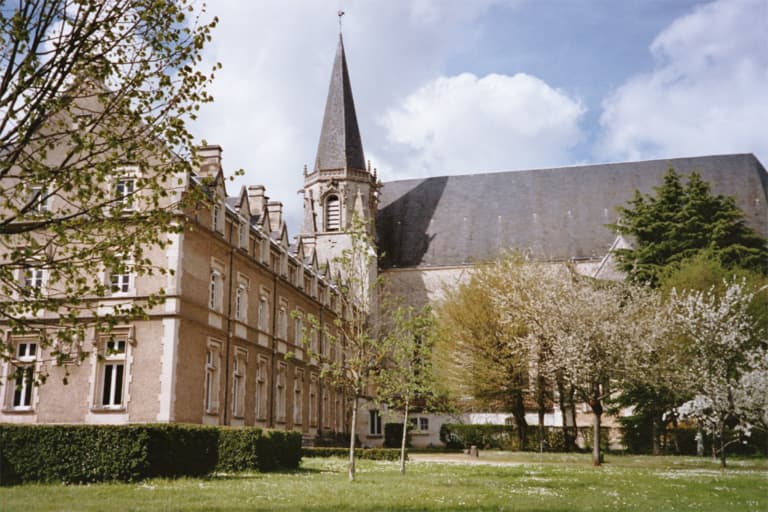
Ligugé Abbey, officially the Abbey of St. Martin of Ligugé, is a Benedictine monastery in France recognized as the oldest in western Europe, initially founded in 361. Despite destruction during the French Revolution, monastic life was restored in 1853, and it now belongs to the Solesmes Congregation. The abbey is known for its historical significance, its connection to Saint Martin of Tours, and its role in preserving monastic traditions.