
Hall in Tirol
Austria·Active town·13th century
Hall in Tirol is a historic town in Austria, primarily known for its significant salt mining industry which began in the 13th century. This economic foundation led to its development as a major trading center and earned it town rights in 1303. The town experienced a significant period of growth in the 15th and 16th centuries, becoming a crucial center within the Habsburg Empire, during which many of its prominent churches and monasteries were constructed, contributing to its status as having the largest intact old town in western Austria.
Key Facts
- ›First mentioned in a 1232 deed as a saltern near Thaur castle.
- ›The town's name, derived from the Celtic word for salt, dates back to 1256.
- ›Became a town in 1303, developing into a leading market and trading place in northern Tyrol.
- ›The Tyrolian mint was moved to Hall in 1477, and it produced the first large European silver coin, the Guldengroschen, in 1486.
- ›In the 15th and 16th centuries, Hall was one of the most important towns in the Habsburg Empire.
- ›The salt mine closed in 1967, and the town was known as Solbad Hall from 1938 to 1974.

- Largest Intact Old Town In Western Austria
- Hall Mint Museum In Burg Hasegg
- Reconstruction of the World's First Automated Coining Machine
Solbad Hall
Blasius Ammon, Christoph Grienberger, Hippolytus Guarinonius, Clotilde Kainerstorfer, Otto Stolz, Werner Pirchner, Ingrid Felipe, Claudia Giner, Klaus Dibiasi, Andreas Felder, Ernst Vettori, Michael Streiter, Christoph Bieler, Andreas Schrott, Andreas Linger, Wolfgang Linger, Peter Penz, Georg Fischler, Janine Flock, Dominik Baumann, David Gleirscher
- First Mentioned As A Saltern In 1232.
- Salt Mine At Absam Laid Out In 1272.
- Became A Town In 1303.
- Suffered A Major Fire In 1447.
- Tyrolian Mint Moved To Hall In 1477.
- Produced the First Guldengroschen In 1486.
- Introduced the World's First Automated Coining Machine In the 16th Century.
- Heavy Bombardment During World War Ii Targeting the Train Station.
- Salt Mine Closed In 1967.
About Hall in Tirol
Hall in Tirol: A Historic Tyrolean Town
Hall in Tirol is a town in Austria's Innsbruck-Land district, situated in the Inn valley approximately 5 kilometers east of the state capital, Innsbruck. Its history is deeply intertwined with the extraction and trade of salt, earning it the distinction of having the largest intact old town in western Austria.
History and Significance
The origins of Hall in Tirol trace back to at least 1232 when it was first mentioned as a saltern, a facility for salt production, near Thaur castle. The town's name itself, dating from 1256, is derived from a Celtic word for salt, underscoring its fundamental economic driver. The salt mine at Absam, north of the town, became the primary industry from the 13th century. The establishment of the first adit in 1272 and the subsequent channeling of brine to Hall for evaporation solidified its importance.
This salt industry fueled Hall's rise as a significant trading hub, with exports reaching as far as Switzerland and the Black Forest. In 1303, Hall was granted town rights, further enhancing its status as a leading market and trading center in northern Tyrol. Its prosperity was disrupted by a major fire in 1447 that destroyed large parts of the upper town. However, Hall's significance grew with the relocation of the Tyrolian mint from Meran in 1477. This led to the production of the Guldengroschen, the first large silver coin in Europe, in 1486, and later, the introduction of the world's first automated coining machine in the 16th century.
During the 15th and 16th centuries, Hall was a crucial center within the Habsburg Empire, a period marked by the construction of many churches and monasteries that still define the town's appearance. Despite suffering bombardment during World War II that destroyed its train station, Hall's old town remained largely unscathed. The salt mine ceased operations in 1967, and the town, which was briefly known as Solbad Hall from 1938 to 1974, continues to preserve its rich historical legacy.
Source: Wikipedia ↗
Frequently Asked Questions
When was Hall in Tirol first mentioned?
Hall in Tirol was first mentioned in a deed in 1232. At that time, it was identified as a saltern (saltworks) located near Thaur castle.
What was the primary industry in Hall in Tirol's early history?
The primary industry in Hall in Tirol and its surrounding areas was salt mining, stemming from the salt mine at Absam in the Hall Valley. This industry was crucial from the 13th century onwards.
When did Hall in Tirol officially become a town?
Hall in Tirol was granted town rights in 1303. This status, along with its trading activities, established it as a leading market in northern Tyrol.
What significant event occurred in Hall in Tirol in 1477?
In 1477, Hall in Tirol gained the right of coinage when the Tyrolian mint was relocated to the town from Meran. This marked an important development in its economic and minting history.
What is Hall in Tirol's current status?
Hall in Tirol is a functioning town in Austria, known for its well-preserved old town and historical significance. While the salt mine is closed, it remains an important cultural and historical center.
Related Monasteries

Graz Friary
Graz Friary is a Franciscan monastery located in the center of Graz, Austria, first mentioned in 1239. It is still owned and operated by the Franciscan order. The complex includes a church with Gothic cloisters surrounding a public garden, and a fortified tower that is a prominent city landmark.

Neukloster Abbey
Neukloster Abbey was a Cistercian monastery located in Wiener Neustadt, Lower Austria. Founded in the 13th century, it was an exception to the Cistercian tradition of establishing monasteries in remote areas, being situated near the imperial residence. The abbey served as a burial site for members of the imperial family and later transitioned into a priory of Heiligenkreuz Abbey in 1881.
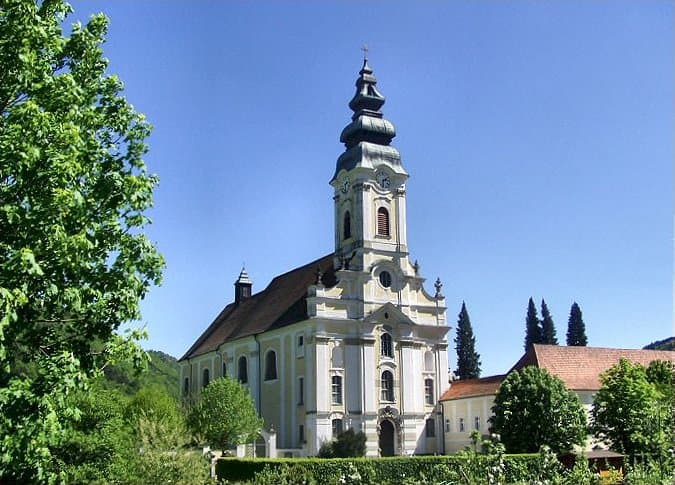
Engelszell Abbey
Engelszell Abbey, originally founded as a Cistercian monastery in 1293, later became the last Trappist monastery in Austria. Despite periods of decline, dissolution, and confiscation, it was re-established by Trappist monks in 1925 and gained recognition for its Trappist beer production. In May 2023, the community was suppressed due to a dwindling number of monks.