
Drenča Monastery
Serbian Orthodox·Serbia·Cultural monument (restored)·14th century
Drenča Monastery, also known as Dušmanica Monastery, is a significant Serbian Orthodox religious site located near Aleksandrovac. Founded between 1379 and 1382 by nobleman monk Dorothej and his son, it is dedicated to the Presentation of the Virgin Mary and exemplifies the Morava architectural school. Despite being demolished by the Ottomans in 1454, the monastery has undergone extensive restoration and is now a protected cultural monument of great importance in Serbia.
Key Facts
- ›Founded between 1379 and 1382 by monk Dorothej and Patriarch Danilo (III).
- ›Dedicated to the Presentation of the Virgin Mary.
- ›Belongs to the Morava architectural school, characterized by its trefoil base and decorative use of slag and brick.
- ›Demolished by the Ottomans in 1454.
- ›Underwent complete restoration of its church between 2003 and 2006.
- ›Recognized as a cultural monument of great importance by the Republic of Serbia.

Morava Architectural School
- Triconconal Base Church Design
- Decorative Use of Slag and Brick
- Remains of Original Monastery Accommodation
- Carved Stone Decoration With Human, Zoomorphic, Geometric, and Floral Motifs
DušManica Monastery
Dorotej, Patriarch Danilo
Demolished By the Ottomans In 1454, Restoration of the Monastery Church
About Drenča Monastery
Drenča Monastery, also referred to as Dušmanica Monastery, is an important historical and religious site situated in modern-day Serbia, near Aleksandrovac. It falls under the jurisdiction of the Eparchy of Kruševac of the Serbian Orthodox Church.
History and Significance
The monastery's construction took place between 1379 and 1382, commissioned by the nobleman monk Dorothej, who had previously served Prince Lazar (1371–1389), and his son, who would later become Patriarch Danilo (III). Dorothej endowed the monastery with substantial estates, including a court with a church at Naupara. The monastery church, dedicated to the Presentation of the Virgin Mary, is a significant early monument representative of the Morava architectural school. Its historical importance was tragically cut short when it was demolished by the Ottoman Empire in 1454. Extensive research and conservation efforts have been undertaken at the ruins over several decades, culminating in the complete restoration of the monastery church by the Institute for the Protection of Cultural Monuments from Kraljevo between 2003 and 2006. Today, Drenča Monastery is recognized and protected by the Republic of Serbia as a cultural monument of great importance.
Architecture
The architectural design of Drenča Monastery's church is a notable example of the Morava school. It features a trefoil (three-lobed) base, combined with an inscribed cross, and is distinguished by its decorative construction using slag and brick. The church has a three-part altar space and free-standing columns supporting an elegant dome. Unique to the Morava architectural school, the vaulting in the prothesis and diaconicon sections, with their cross vaults, is thought to echo solutions found on Mount Athos. The exterior of the apses are polygonal, while the interior is semi-elliptical. The carved stone decoration of the window sills is particularly characteristic, featuring unusually composed human figures, zoomorphic, geometric, and floral motifs, along with intertwined rope designs, which were originally painted. The ravages of time have unfortunately destroyed the original frescoes. Approximately 25 meters west of the church, the remains of the original monastery accommodation, measuring 18.5 by 10.5 meters, have been discovered, providing further insight into the monastery's past layout.
Source: Wikipedia ↗
Frequently Asked Questions
When was Drenča Monastery founded?
Drenča Monastery was built between 1379 and 1382. This period places its construction in the late 14th century.
Who founded Drenča Monastery?
The monastery was founded by the nobleman monk Dorothej, a former nobleman of Prince Lazar, and his son, who later became Patriarch Danilo (III).
What is the architectural style of Drenča Monastery?
Drenča Monastery's church is a prime example of the Morava architectural school. It features a trefoil base combined with an inscribed cross and is richly decorated with slag and brick.
What happened to Drenča Monastery historically?
The monastery was demolished by the Ottomans in 1454. Significant restoration work has been carried out in recent decades to preserve and reconstruct the site.
Is Drenča Monastery still active?
While the historical monastery was demolished, the church has been completely restored, and the site is now under the protection of the Republic of Serbia as a cultural monument. It belongs to the Eparchy of Kruševac of the Serbian Orthodox Church.
Related Monasteries
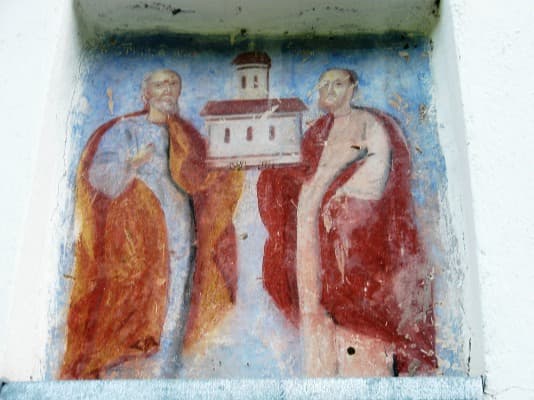
Church of Sts. Peter and Paul
The Church of Sts. Peter and Paul, also known as the Cave Church, is a Serbian Orthodox cave-church situated on Mount Kopaonik in southern Serbia. Constructed in the 14th century by King Milutin, it is dedicated to Saints Peter and Paul and forms part of the Monastery of St. Archangel Gabriel.

Gornjak
Gornjak Monastery is a 14th-century Serbian Orthodox monastery situated in the Gornjačka gorge, Serbia. Founded in 1379 by King Lazar of Serbia, it served monks led by Gregory of Sinai and has endured multiple destructions and rebuildings. The monastery is notable for its church dedicated to the Entrance of the Theotokos and the nearby hermitage caves associated with Gregory of Sinai.
Gornjak Monastery
Gornjak Monastery is a 14th-century Serbian Orthodox monastery situated in the Gornjacka gorge, near Petrovac, Serbia. Founded in 1379 by King Lazar of Serbia, it was established for monks serving under Gregory of Sinai and completed in 1380. The monastery has a history of destruction and rebuilding, most recently its church was reconstructed starting in 1953 on its original foundations.