
Christgarten Charterhouse
Carthusian (initially), Protestant (later)·Germany·Ruins (primarily) / Active Parish Church (choir)·14th century
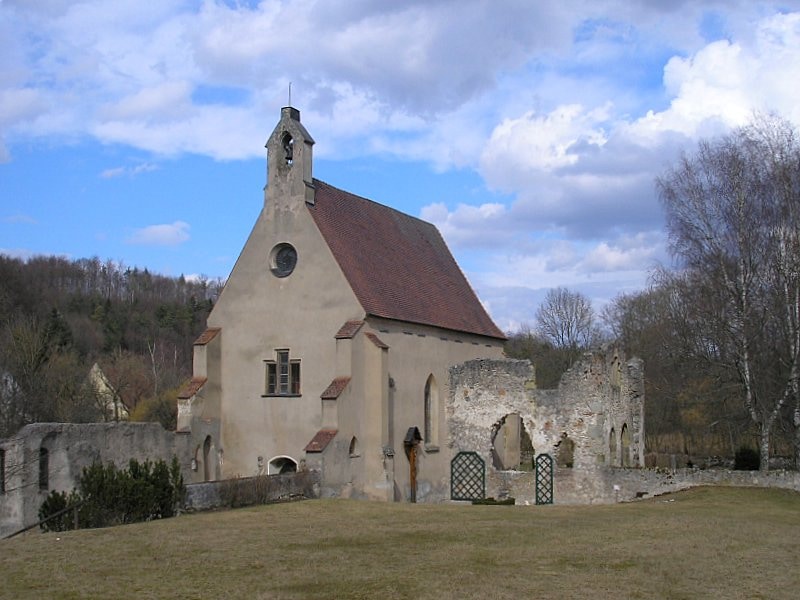
Christgarten Charterhouse was a former Carthusian monastery located near Ederheim in Bavaria, Germany. Founded in 1383 by Counts Ludwig and Friedrich von Oettingen and dedicated to Saint Peter, it transitioned to Protestantism during the Reformation. Although the monastery itself was not dissolved until after the Thirty Years' War in 1649, its buildings were subsequently demolished, leaving only the choir of the monastic church for use as a Protestant parish church.
Key Facts
- ›Founded in 1383 by Counts Ludwig and Friedrich von Oettingen.
- ›Dedicated to Saint Peter.
- ›Became Protestant during the Reformation, with monks serving as ministers.
- ›Dissolved in 1649, after the Thirty Years' War.
- ›Most of the monastic buildings were demolished in subsequent centuries.
- ›The choir of the former monastic church remains and serves as a Protestant parish church.
Scheuffelin Altar, Choir of the Monastic Church
Kloster Christgarten
Ludwig Von Oettingen, Friedrich Von Oettingen
Reformation, Dissolution After the Thirty Years' War
About Christgarten Charterhouse
Christgarten Charterhouse, known in German as Kloster Christgarten, was a significant former Carthusian monastery situated near Ederheim in Bavaria, Germany. Its history is intrinsically linked to the Oettingen family and the religious shifts of the Reformation.
Founding and Early History
The monastery was established in 1383 by Counts Ludwig and Friedrich von Oettingen. It was dedicated to Saint Peter, a common practice for monastic foundations. Life within the charterhouse followed the strict Carthusian rule, emphasizing contemplation and communal living within a monastic framework.
The Reformation and Dissolution
A pivotal period in Christgarten's history began in 1525 when the counts of Oettingen embraced the Reformation. This led to a transformation within the charterhouse; by 1558, Carthusian monks from Christgarten were called upon to serve as Protestant ministers. The prior of Hürnheim, located near Ederheim, also converted to Protestantism and subsequently ministered to Christgarten in a Reformist spirit. Despite these changes, the charterhouse was not formally dissolved until 1649, following the conclusion of the Thirty Years' War.
Legacy and Remaining Structures
Following its dissolution, the monastery faced decline. The bell tower was demolished in 1656, and further buildings were removed in the 18th and 19th centuries. The most significant remnant of the monastic church is its choir, which was adapted and continues to serve as the Protestant parish church for the local community. The renowned "Scheuffelin altar" from the monastery was preserved and transferred to the Alte Pinakothek in Munich, standing as a testament to the charterhouse's artistic heritage.
Source: Wikipedia ↗
Frequently Asked Questions
When was Christgarten Charterhouse founded?
Christgarten Charterhouse was founded in the year 1383. The founding was initiated by Counts Ludwig and Friedrich von Oettingen.
What religious tradition did Christgarten Charterhouse follow?
Initially a Carthusian monastery, Christgarten Charterhouse embraced the Reformation. From 1525, the counts of Oettingen supported the Reformation, and by 1558, monks from Christgarten were serving as Protestant ministers.
What remains of Christgarten Charterhouse today?
After its dissolution in 1649 and subsequent demolitions, only the choir of the monastic church remains. This choir is now used as the Protestant parish church for the local community.
Who founded Christgarten Charterhouse?
Christgarten Charterhouse was founded by Counts Ludwig and Friedrich von Oettingen. They established the monastery in 1383.
Related Monasteries

Ahrensbök Charterhouse
Ahrensbök Charterhouse was a Carthusian monastery established in 1397 in Ahrensbök, Holstein, Germany. Although secularized during the Reformation in 1584 and its buildings largely demolished, the monastery church, St. Mary's Church (Marienkirche), still stands as a significant surviving structure. The materials from the demolished charterhouse were later used to construct a castle, Schloss Hoppenbrook, which itself was eventually demolished.

Cologne Charterhouse
Cologne Charterhouse was a significant Carthusian monastery founded in 1334 and developed into the largest charterhouse in Germany. Despite periods of prosperity and intellectual activity, it faced dissolution by French Revolutionary troops in 1794, followed by destruction in World War II. The present complex is largely a post-war reconstruction, with its church now serving a Protestant congregation.

Eisenach Charterhouse
Eisenach Charterhouse, officially Domus Vallis Sanctae Elisabeth, was a Carthusian monastery founded in 1378 and suppressed in 1525 in Eisenach, Germany. Supported by local rulers, it flourished in the 14th and 15th centuries, producing notable scholars. The monastery was dissolved during the Reformation, its buildings later repurposed for various secular uses including an orphanage, textile mill, and prison, with its former gardens evolving into a landscape park.