
Cernica Monastery
Cernica Monastery is a Romanian Orthodox monastic complex situated on the shore of Lake Cernica, near Bucharest, in Ilfov County. Established in 1608, it has served as a significant center for monastic education and houses three churches and three chapels. The monastery is also notable as the resting place for numerous Romanian personalities and is recognized as a historic monument.
Key Facts
- ›Founded in 1608 by Cernica Știrbei and his wife Chiajna.
- ›Features three churches: Saint Nicholas, Saint George, and Saint Lazarus.
- ›Contains three chapels: the Dormition of the Mother of God, Saint John, and the Entrance into the Church.
- ›Served as a monastic education center.
- ›The cemetery is the burial site for many notable Romanian figures.
- ›Listed as a historic monument.

Neoclassical, Romanian Decorative Elements, Traditional Ecclesiastical
Lake Cernica Shoreline Setting, Monastic Cemetery, Three Churches, Three Chapels
MăNăStirea Cernica
Cernica șTirbei, Chiajna, Archimandrite Timotei, Dan BrașOveanu, Archimandrite George, Tudor Arghezi
- Damage During the 1802 Earthquake
- Repairs Between 1809 and 1815
- Damage From the 1838 Earthquake
- Fire In 1923
- Restoration In 1925
- Rebuilding of Saint George Church Between 1962 and 1964
- Consolidation After the 1977 Vrancea Earthquake
About Cernica Monastery
Cernica Monastery is a significant Romanian Orthodox monastic complex situated on the picturesque shore of Lake Cernica. Located in Ilfov County, just outside the bustling capital of Bucharest, it is administratively part of Pantelimon town. Established in 1608 during the reign of Radu Șerban, the monastery was founded by Cernica Știrbei, a prominent figure who served as the great vornic of Michael the Brave, and his wife, Chiajna. Since its inception, Cernica Monastery has been recognized as a vital center for monastic education within Romania.
History and Architecture
The monastic complex is distinguished by its array of sacred structures, comprising three churches and three chapels. The main church, dedicated to Saint Nicholas, has a history marked by significant events, including damage sustained during the 1802 earthquake, necessitating repairs between 1809 and 1815. Further extensive restoration was undertaken in 1925, following structural issues caused by another earthquake in 1838 and a fire in 1923. The Church of Saint George, originally built in the 18th century, underwent complete rebuilding between 1962 and 1964 and received further consolidation after damage from the 1977 Vrancea earthquake. A smaller Church of Saint Lazarus was constructed in 1804 within the monastery's cemetery by Archimandrite George. The monastery also includes three chapels: "The Dormition of the Mother of God," built in 1790; "Saint John," constructed in 1842; and "The Entrance into the Church."
The architectural style of Cernica Monastery is characterized by monumental churches featuring trilobed plans, lateral apses, and prominent domes. Structures like the Church of Saint Nicholas and the Church of Saint George are built with robust masonry columns supporting the vaults, reflecting a traditional ecclesiastical architectural style. The main church is built in a Neoclassical style incorporating Romanian decorative elements. The Church of Saint Lazarus, in particular, is noted for its rich external decorations, exemplifying the harmonious blend of functionality and spiritual aesthetics characteristic of Orthodox Christian architecture.
Cultural Significance and Legacy
Cernica Monastery holds a special place in Romanian cultural history. Between 1900 and 1904, the acclaimed poet Tudor Arghezi resided at the monastery as a monk. Furthermore, the monastery's cemetery serves as the final resting place for a remarkable number of influential Romanian personalities from various fields. These include the painter Ion Țuculescu, Metropolitan Nifon, theologian Dumitru Stăniloae, writer Gala Galaction, orientalist Athanase Negoiță, sociologist Ernest Bernea, pianist Johnny Răducanu, singer Zavaidoc, actress Stela Popescu, director Geo Saizescu, translator Stelian Gruia, academician Emilian Popescu, broadcaster Marioara Murărescu, and politician Pan Halippa. Cernica Monastery is officially listed as a historic monument, underscoring its importance to Romania's heritage.
Source: Wikipedia ↗
Frequently Asked Questions
When was Cernica Monastery founded?
Cernica Monastery was established in 1608. It was founded during the reign of Radu Șerban by Cernica Știrbei and his wife, Chiajna.
What are the main churches within Cernica Monastery?
The monastery complex includes three main churches. These are the Church of Saint Nicholas, the Church of Saint George, and the smaller Church of Saint Lazarus, which is located in the monastery's cemetery.
Which notable individuals are buried at Cernica Monastery?
The cemetery at Cernica Monastery is the final resting place for many prominent Romanian personalities. This includes artists like painter Ion Țuculescu, theologians such as Dumitru Stăniloae, and writers like Gala Galaction.
What architectural styles are present at Cernica Monastery?
The architecture of the monastery features monumental churches with trilobed plans and prominent domes. The main church is built in a Neoclassical style with Romanian decorative elements. The Church of Saint Lazarus is noted for its rich external decorations, exemplifying traditional monastic architectural style.
Has Cernica Monastery undergone significant repairs or restorations?
Yes, the monastery has experienced several repairs and restorations. The Church of Saint Nicholas was repaired after the 1802 earthquake and underwent major restoration in 1925. The Church of Saint George was rebuilt between 1962 and 1964 and consolidated again after the 1977 earthquake.
Related Monasteries

Bârnova Monastery
Bârnova Monastery is a Romanian Orthodox monastery located in Bârnova, within the Iași metropolitan area of Moldavia, Romania. It was established in 1628 by Miron Barnovschi-Movilă, a Moldavian Voivode, and is recognized on the National Register of Historic Monuments. The monastery's courtyard hosts the oldest tree in Iași County, a 675-year-old hybrid lime tree, predating the first mention of Iași as an urban settlement.
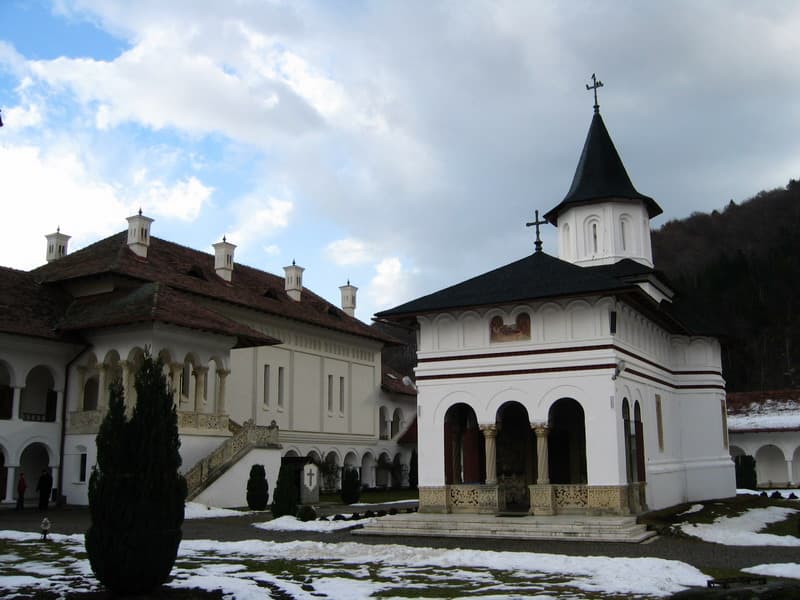
Sâmbăta de Sus Monastery
Sâmbăta de Sus Monastery, also known as Brâncoveanu Monastery, is a Romanian Orthodox monastery in Transylvania, Romania. Founded by Prince Constantin Brâncoveanu around 1696, it served as a spiritual and cultural center, aiming to bolster Orthodox presence against Catholic influence. Despite facing suppression and destruction in the 18th century, it was restored in the 20th century and remains a significant historical and religious site.

Căldărușani Monastery
Căldărușani Monastery is a Romanian Orthodox monastery founded in 1638 by Wallachian ruler Matei Basarab. Situated by Căldărușani Lake in Gruiu, Ilfov County, Romania, it is recognized as a historic monument and has been a vital center for Orthodox spirituality and Romanian culture. The monastery is known for its significant art collection, scriptorium, and its role in developing the Romanian literary language, attracting prominent figures like painter Nicolae Grigorescu.