
Beinwil Abbey
Beinwil Abbey, originally a Benedictine monastery founded around 1100, experienced periods of conflict, dissolution, and revival. Despite being dissolved in the 16th century and later re-established, it faced further dissolution during the Kulturkampf. In recent times, it transitioned from an ecumenical center to an Orthodox monastery, though its canonical affiliation has been questioned.
Key Facts
- ›Founded around 1100 by local nobility.
- ›First mentioned in historical records in 1147.
- ›Burnt down in 1445 due to territorial conflicts.
- ›Formally dissolved in 1554 and later resettled to Mariastein Abbey in 1648.
- ›Dissolved again in 1874 during the Kulturkampf.
- ›Became an Orthodox monastery in 2019.
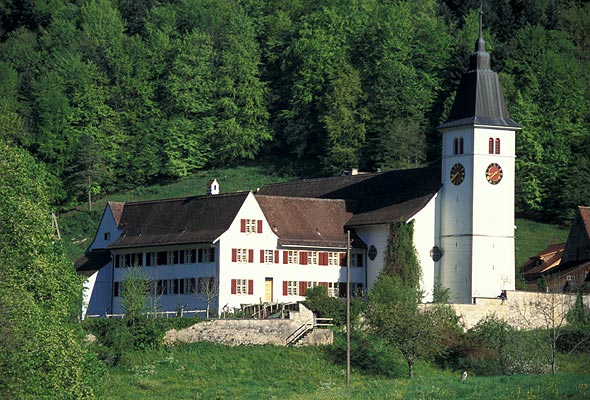
- Restored Abbey Church Dedicated To Saint Vincent of Saragossa
- High Altar Dated About 1700 From Bellwald
- Crypt Used For Liturgical Services By the Orthodox Monastery
Kloster Beinwil
- Burnt Down In 1445
- Formally Dissolved In 1554
- Resettled To Mariastein Abbey In 1648
- Dissolved In 1874 During the Kulturkampf
- Destroyed By Fire In 1978
- Became An Orthodox Monastery In 2019
- Canonical Affiliation Questioned In March 2025
About Beinwil Abbey
Beinwil Abbey, known historically as Kloster Beinwil, is a monastic site located in Beinwil, within the Canton of Solothurn, Switzerland. Originally established as a Benedictine monastery around the turn of the 12th century, likely by local nobility, its early history is marked by its first mention in records from 1147. The abbey experienced significant upheaval, including being burnt down in 1445 following conflicts over territorial claims involving the Counts of Thierstein.
By the 16th century, the monastic community had dwindled, leading to its formal dissolution in 1554. While a small community persisted, under the care of Einsiedeln Abbey and later Rheinau Abbey, efforts to revive it were hampered by its remote location. In 1648, the community was relocated to the newly founded Mariastein Abbey. The abbey site saw a revival in the late 18th century, with its church and premises rebuilt, but it was dissolved again in 1874 during the Kulturkampf, forcing its community into exile.
In contemporary times, the abbey church, dedicated to Saint Vincent of Saragossa, has undergone restoration after being destroyed by fire in 1978. Until 2019, it served as an ecumenical conference and retreat center. Since January 2019, Beinwil Abbey has operated as an Orthodox monastery. The local Catholic parish continues to utilize the abbey church, while the Orthodox monks use the crypt for their services. Approximately 12 rooms are available for visitors. However, in March 2025, a statement from the Russian-Orthodox priests' convention of Zürich raised questions regarding the monastery's canonical affiliation.
Source: Wikipedia ↗
Frequently Asked Questions
When was Beinwil Abbey founded?
Beinwil Abbey was founded around the year 1100. It is first mentioned in historical records from 1147, suggesting it was established by the local nobility.
What religious tradition does Beinwil Abbey belong to?
Beinwil Abbey was originally a Benedictine monastery. Since 2019, it has been an Orthodox monastery, although questions have been raised about its canonical affiliation.
What is the current status of Beinwil Abbey?
The abbey church has been restored and is used by the local Catholic parish. The former monastic premises now house an Orthodox monastery. It also offers short-term stays for visitors.
Has Beinwil Abbey always been an active monastery?
Beinwil Abbey has faced several periods of dissolution, notably in 1554 and 1874. While a small community remained at times, its active monastic life has been interrupted. It became an Orthodox monastery in 2019.
Is Beinwil Abbey open to the public?
The abbey church is used by the local Catholic parish and is accessible. The former monastic site, now an Orthodox monastery, offers about 12 rooms for short-term visitor stays. It also attracted a significant number of visitors in 2023.
Related Monasteries

Khutyn Monastery
Khutyn Monastery of Saviour's Transfiguration and of St. Varlaam is an important Orthodox Christian shrine located on the Volkhov River near Novgorod. Founded in 1192 by Varlaam, a former Novgorodian boyar, it became a significant center of religious life in the medieval Novgorod Republic. The monastery has undergone several architectural transformations, including the construction of a notable Muscovite-style church in the early 16th century, and has a history of housing notable figures and experiencing shifts in its operational status, including periods as a lunatic asylum and a vacation home before its restoration to the church in 1993.

Privina Glava Monastery
Privina Glava Monastery is a Serb Orthodox monastery situated on Fruška Gora mountain in Vojvodina, northern Serbia. While legend attributes its founding to a 12th-century feudal lord named Priba/Priva, historical records first mention the monastery in the mid-16th century. It is recognized as a Monument of Culture of Exceptional Importance and is protected by the state.

New Valamo Monastery
New Valamo Monastery, established in its current location in Heinävesi, Finland, in 1940, is the successor to the historic Valamo Monastery founded in 1717 on Lake Ladoga. It serves as a vital center for Orthodox religious life and culture in Finland, continuing its monastic traditions while also functioning as a significant tourist destination. The monastery is known for its communal spiritual life, its economic activities including a prominent distillery, and its role in preserving Orthodox heritage.