
Krun
Mandaeanism·Mythology·Mesopotamian (Iraq, Iran)·Lord of the underworld
Krun, also known as Akrun, is a significant Mandaean lord of the underworld, described as dwelling in the deepest parts of creation and supporting the physical world. He is recognized as the greatest among the five underworld lords and is symbolically represented by a lion on Mandaean talismans.
Key Facts
- ›Krun is a Mandaean lord of the underworld.
- ›He is considered the greatest of the five Mandaean lords of the underworld.
- ›Krun is represented by the image of a lion on the skandola talisman.
- ›His epithet is 'the great mountain of flesh' (ṭura rba ḏ-bisra).
- ›Mandaean communities preserve ancient Babylonian traditions of astrology.
- ›A feature on Pluto was informally named 'Krun Macula' in his honor.
Akrun
Underworld, Support of the Physical World
Supports the Entirety of the Physical World
Ginza Rabba
Shdum, Hag, Gaf, Zartai-Zartanai
- the Skandola Talisman, Bearing Krun's Image As A Lion, Is Used To Seal the Graves of the Newly Dead.
Lion
About Krun
Who is Krun?
Krun, also known as Akrun, is a prominent figure in Mandaean mythology, holding the title of a "lord of the underworld." According to Mandaean cosmology, Krun occupies the deepest regions of existence and is understood to be the entity that sustains the entire physical world. He is considered the foremost among the five Mandaean lords of the underworld.
Mandaean Cosmology and Significance
The Mandaean sacred text, the Ginza Rabba, specifically the 5th book of its right half, identifies Krun as the greatest of the five underworld lords. The other four lords mentioned are Shdum, Hag, Gaf, and Zartai-Zartanai. Krun's symbolic representation is that of a lion, an image that appears on the skandola talisman. This talisman is a significant ritual object used in Mandaean funerary practices, specifically for sealing the graves of those who have recently died.
Epithets and Astronomical Connections
Krun is most frequently associated with the epithet "ṭura rba ḏ-bisra," which translates from Classical Mandaic to "the great mountain of flesh." This descriptive title likely alludes to his immense power and foundational role in the Mandaean conception of the cosmos.
In a more modern context, Krun gained a connection to astronomy. The Mandaean community, with its roots in ancient Babylonian traditions of astrology, was recognized when a dark region on the dwarf planet Pluto was informally named "Krun Macula" by NASA scientists. This was part of a broader effort to incorporate names from diverse cultures into celestial cartography, although the feature was later renamed Safronov Regio.
Source: Wikipedia ↗
Frequently Asked Questions
Who is Krun in Mandaean mythology?
Krun is a Mandaean lord of the underworld, considered the most powerful of the five such entities. In Mandaean cosmology, he resides in the deepest parts of creation and is depicted as supporting the entire physical world.
What is Krun's symbolic representation?
Krun is symbolically represented by the image of a lion. This imagery is found on the skandola talisman, which is used by Mandaeans to seal the graves of the newly deceased.
What is Krun's epithet?
The epithet most frequently associated with Krun is ṭura rba ḏ-bisra, which translates from Classical Mandaic to 'the great mountain of flesh'.
Is there any astronomical connection to Krun?
Yes, a dark region on the dwarf planet Pluto was informally named 'Krun Macula' by NASA scientists. This naming was part of an effort to recognize the Mandaean community's contributions and heritage.
Which Mandaean text mentions Krun?
Krun is mentioned in the 5th book of the right half of the Great Treasure (Ginza Rabba), which is the most sacred text of the Mandaeans. This text lists him as the greatest of the five underworld lords.
Related Demons
Azi Dahaka/Dahak
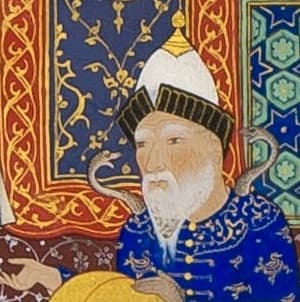
Aži Dahāka, also known as Zahhāk, is a prominent figure of evil in Iranian mythology and Zoroastrian tradition, often depicted as a monstrous serpent or dragon. He is notable for his role as a tyrannical king who ruled for a thousand years, feeding human brains to two snakes that grew from his shoulders, and for his eventual defeat and imprisonment by the hero Fereydun.
Bali Raj
Mahabali, also known as Bali, is a prominent daitya king in Hinduism, recognized as one of the Chiranjivi, or immortals. He is celebrated for his benevolent rule and generosity, famously tricked by Vishnu's Vamana avatar, which led to his banishment to Sutala Loka. His legend forms a central part of the annual Onam festival in Kerala, marking his symbolic return to his kingdom.

Div-e Sepid
Div-e Sepid, meaning "White Div," is a formidable chieftain of the demons of Mazandaran in the Persian epic Shahnameh. He is renowned for his immense physical strength, mastery of sorcery, and necromancy, famously battling the hero Rostam. Div-e Sepid is notable for his defeat of King Kay Kavus and his army, and his subsequent demise at the hands of Rostam, whose victory is symbolically depicted by wearing the Div's head as a helmet.