
Choronzon
Enochian magic / Thelema·Occultism / Demonology·Western Europe·Demon
Choronzon is a demon originating in 16th-century occult writings by Edward Kelley and John Dee, central to their Enochian magic system. He later became a significant figure in Aleister Crowley's 20th-century mystical system of Thelema, where he is known as the "dweller in the abyss" and represents the final obstacle to enlightenment for an adept.
Key Facts
- ›Choronzon originated in the occult system of Enochian magic developed by Edward Kelley and John Dee.
- ›In Aleister Crowley's Thelema, Choronzon is the "dweller in the abyss," the ultimate barrier to spiritual attainment.
- ›Crowley described Choronzon as a temporary personification of the chaotic forces within the abyss, also known as the "demon of dispersion."
- ›Crowley and Victor Benjamin Neuburg famously claimed to have evoked Choronzon in Bou Saâda, Algeria, in 1909.
- ›The demon is considered to be held in check by the goddess Babalon.
- ›Variations in the spelling of the name include Coronzon and Coronzom.
Coronzon, Coronzom
Dispersion, Chaos of the Abyss, Obstacle To Enlightenment
Shape-Shifting, Breaching Magical Barriers, Attacking Spiritual Or Physical Entities
- John Dee's Journals
- Edward Kelley's Writings
- Meric Casaubon's True and Faithful Relation
- Laycock's Enochian Dictionary
- Aleister Crowley's Confessions
- Aleister Crowley's Liber 418
- Arthur Calder-Marshall's the Magic of My Youth
Edward Kelley, John Dee, Aleister Crowley, Victor Benjamin Neuburg, Babalon
Ego, Dispersion, Meaninglessness, Malignancy, Chaos
- Associated With Evocation In Occult Systems.
- Crowley's Account of Evocation In Bou SaâDa Involved A Solomonic Triangle and Precautions To Maintain Silence.
- the Choronzon Club Was Founded By A Disciple of Aleister Crowley.
Babalon, Adept Prepared For Confrontation
Abyss, Dust Devils
About Choronzon
Choronzon is a significant demonic entity originating in the 16th-century occult system of Enochian magic, as documented by Edward Kelley and John Dee. This entity gained further prominence in the 20th century through the mystical teachings of Aleister Crowley, where Choronzon became a cornerstone of his system of Thelema.
Role in Thelema
Within Thelema, Choronzon is famously known as the "dweller in the abyss." This abyss is conceived as a vast, chaotic space in occult cosmology, representing the ultimate obstacle that an adept must overcome on the path to spiritual enlightenment. Thelemites believe that if an adept is sufficiently prepared, encountering Choronzon can lead to the destruction of the ego, a process often referred to as "ego death." This dissolution of the self is seen as essential for transcending the limitations of the abyss and achieving a higher state of being.
Crowley himself described Choronzon as the "demon of dispersion" and a temporary personification of the "raving and inconsistent forces" that inhabit the abyss. He viewed Choronzon not as a fixed individual but as a manifestation of the chaotic, meaningless forms that crave existence within the void. The purpose of evoking Choronzon, according to this view, is not to worship but to confront and master these dispersive forces, thereby integrating them and moving beyond them.
Noteworthy Evocation and Controversies
Aleister Crowley recounted an event in December 1909, in Bou Saâda, Algeria, where he and Victor Benjamin Neuburg claimed to have evoked Choronzon. The details of this evocation are complex and have been subject to scrutiny. Crowley's account, appearing in his writings and in the "Book of the Law" (Liber 418), describes the demon manifesting and attacking Neuburg. However, the reliability of these original pages has been questioned due to their missing sections, leading to speculation that Crowley may have embellished the event to support his beliefs. Furthermore, Victor Neuburg's recollection of the event, as reported by Arthur Calder-Marshall, differs significantly, suggesting they may have evoked a different entity or experienced the event subjectively.
Associations and Variations
Choronzon is symbolically held in check by the goddess Babalon, who resides in Binah, the third sephirah on the Kabbalistic Tree of Life. The name itself has seen variations in spelling, including "Coronzon" and "Coronzom," appearing in different historical occult texts. Beyond its primary occult associations, Choronzon has made appearances in popular culture, including an episode of "Hammer House of Horror" and Neil Gaiman's "Sandman" comic series, solidifying its presence in modern esoteric and artistic discourse.
Source: Wikipedia ↗
Frequently Asked Questions
What is Choronzon?
Choronzon is a demon first documented in the writings of 16th-century occultists Edward Kelley and John Dee. He is a significant figure in Enochian magic and later in Thelema, where he is the "dweller in the abyss."
What is Choronzon's role in Thelema?
In Aleister Crowley's Thelema, Choronzon is the last major obstacle an adept must overcome to achieve enlightenment. He represents the chaotic forces of the abyss, and confronting him properly can lead to ego death, allowing spiritual progression.
What does Choronzon look like?
Accounts of Choronzon's appearance are varied and sometimes contradictory. During an evocation by Aleister Crowley and Victor Benjamin Neuburg, the demon was described as changing shape and appearing as a naked savage. However, this account has been questioned for its reliability.
Are there different spellings for Choronzon?
Yes, there are spelling variations for the name. While "Choronzon" is the most common, "Coronzon" (without an 'h') is noted by Meric Casaubon, and "Coronzom" is cited from an original manuscript in Laycock's Enochian Dictionary.
Who is associated with Choronzon?
Choronzon is associated with Edward Kelley and John Dee as his originators. In Thelema, he is linked to Aleister Crowley, Victor Benjamin Neuburg, and the goddess Babalon who is said to hold him in check.
Related Demons
Orias/Oriax
Orias, also known as Oriax, is a Great Marquis of Hell commanding thirty legions of demons. He is notable for his knowledge of astrology, teaching the virtues of stars and planetary mansions, and his ability to grant dignities, prelacies, and influence over others. Orias can also transform individuals into various shapes.
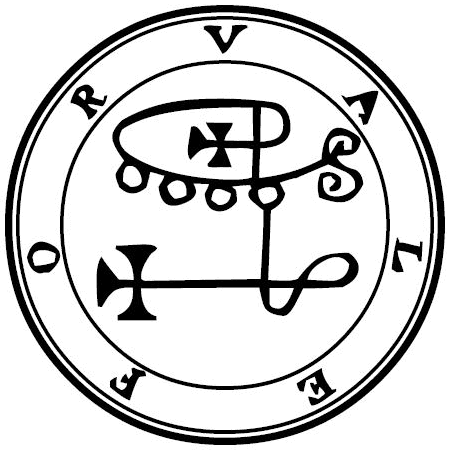
Valefar/Malaphar/Malephar
Valefar, also known as Malaphar or Malephar, is a Duke of Hell in demonology. He is notable for tempting individuals to commit theft and fostering camaraderie among thieves, acting as a beneficial familiar until they are apprehended. He commands ten legions of demons and is depicted with a lion's body and either a man's or a donkey's head.

Baphomet
Baphomet is a symbolic figure associated with Western esoteric and occult traditions, most famously depicted as a winged, androgynous human-goat hybrid. Its name first appeared in the 14th century during the trials of the Knights Templar, who were accused of worshipping it. The modern imagery of Baphomet was established by Éliphas Lévi in the 19th century, who presented it as a symbol of equilibrium and esoteric knowledge.