
Soissons Cathedral
Soissons, Laon, and Saint-Quentin·Roman Catholic·France
Soissons Cathedral is a Roman Catholic cathedral basilica in Soissons, France, serving as the seat of the Bishop of Soissons, Laon, and Saint-Quentin. Its construction began in the Gothic style in 1176, replacing earlier Romanesque and Carolingian structures, and has been a site of significant historical events and damage throughout its existence. Classified as a historical monument, it remains an active place of worship owned by the French State.
Key Facts
- ›The origins of the diocese of Soissons date back to the 4th century, with the first cathedral built in Romanesque style.
- ›The current Gothic cathedral's construction began in 1176 and was largely completed by the late 15th century, with the nave finished two centuries after the choir and clerestory.
- ›The cathedral suffered damage from fires, sieges, the French Revolution, and both World Wars, necessitating numerous restorations.
- ›Its western tower, completed in the MID-13th century, is an imitation of Notre-Dame de Paris and stands at 66 meters.
- ›The cathedral houses 13th-century stained glass in the choir and a 15th-century tapestry depicting its patron saints.
- ›Many original stained glass panels were auctioned and sold to collectors in the 19th century.

- 13th-Century Stained Glass In the Choir
- 15th-Century Tapestry Depicting the Life of Gervasius and Protasius
- Painting 'Adoration of the Shepherds' By Rubens
- Painting By Philippe De Champaigne
- Western Tower Inspired By Notre-Dame De Paris
- Collapsed West Rose Window
About Soissons Cathedral
Soissons Cathedral, officially known as the Cathédrale Saint-Gervais-et-Saint-Protais de Soissons, is a significant Roman Catholic cathedral basilica located in the city of Soissons, France. It has held the status of the seat of the Bishop of Soissons, Laon, and Saint-Quentin, tracing its ecclesiastical origins back to the 4th century when the diocese of Soissons was first established. The current edifice is a testament to centuries of construction, destruction, and renovation, reflecting various architectural styles and historical periods.
History and Construction
The history of Soissons Cathedral is marked by several iterations. The earliest known cathedral on the site was Romanesque, with records indicating events like the crowning of Pepin the Short in 752. This was followed by a second Carolingian cathedral consecrated in 851, which suffered fire damage in 948. The construction of the third and present cathedral began in 1176 in the Gothic architectural style, drawing inspiration from Chartres Cathedral. The choir and clerestory were completed by 1211, but the nave took another two hundred years to finish. The cathedral's completion was further delayed by events such as the Hundred Years' War and the Burgundian siege in 1414, which led to the repurposing of construction materials. Consequently, the south tower was never finished, and the north tower was also omitted due to insufficient funding. The cathedral was finally completed and dedicated in 1479 by Bishop Jean Milet.
Architectural Features and Damage
The cathedral's facade and nave exhibit the characteristic Gothic style prevalent in 13th-century French cathedrals. The southern transept, the oldest surviving part of the structure, differs in its internal division. The western tower, built in the mid-13th century, measures 66 meters and was designed to emulate those of Notre-Dame de Paris. Throughout its existence, Soissons Cathedral has faced numerous challenges. It was occupied and damaged by Protestant Huguenots in the 16th century, and further stripped of decorations during the French Revolution. In the 19th century, damage from a gunpowder factory explosion necessitated the auctioning of many original stained glass panels. The cathedral suffered severe damage during World War I, with parts of the nave, tower, and roof destroyed by artillery. While major reconstruction efforts were undertaken, a significant portion of its west rose window collapsed during a storm in 2017, damaging the organ below.
Significance and Preservation
Soissons Cathedral was classified as a historical monument in 1840 and is currently owned by the French State, with the Catholic Church retaining exclusive rights of use. Despite extensive damage and losses, including many of its original stained glass windows (some of which are now in museums worldwide), the cathedral continues to function as an active place of worship. Its history is deeply intertwined with the development of the Soissons diocese and the broader historical narrative of France, making it a site of considerable historical and architectural importance.
Source: Wikipedia ↗
Frequently Asked Questions
What is Soissons Cathedral?
Soissons Cathedral is a Roman Catholic cathedral basilica located in Soissons, France. It has served as the seat of the Bishop of Soissons, Laon, and Saint-Quentin since the establishment of the diocese in the 4th century.
When was Soissons Cathedral built?
The construction of the current Gothic cathedral began in 1176 under Bishop Nivelon de Quierzy. The choir and clerestory were completed by 1211, and the nave was finished much later, with the cathedral's dedication ceremony taking place in 1479.
What architectural style is Soissons Cathedral?
The facade and nave of Soissons Cathedral are constructed in the typical Gothic style, characteristic of many 13th-century French cathedrals. The southern transept is considered the oldest portion of the edifice.
Has Soissons Cathedral been damaged over time?
Yes, Soissons Cathedral has endured significant damage from various events, including fires, sieges during the Burgundian conflicts, occupation by Protestant Huguenots, the French Revolution, and extensive shelling during World War I. It has undergone numerous restorations throughout its history.
What are some notable features of Soissons Cathedral?
Notable features include its 13th-century stained glass in the choir, a 15th-century tapestry of its patron saints, and paintings by artists like Rubens and Philippe de Champaigne. Its western tower, inspired by Notre-Dame de Paris, is also a significant element.
What happened to the stained glass windows of Soissons Cathedral?
Many of the original stained glass panels were auctioned and sold to collectors during the 19th century to fund restorations. Further damage occurred during World War I, with most remaining windows lost, though some in the north transept and choir survived.
Related Cathedrals

Aix Cathedral
Aix Cathedral, officially Cathédrale Saint-Sauveur d'Aix-en-Provence, is a Roman Catholic cathedral in Aix-en-Provence, France. Situated on the site of the ancient Roman forum and a 6th-century Christian church, it showcases a remarkable blend of Romanesque, Gothic, and Neo-Gothic architectural styles, with elements dating back to its earliest Christian foundations. The cathedral serves as the seat of the Archbishop of Aix-en-Provence and Arles and is recognized as a national monument of France.

Church of St. Trophime, Arles
The Church of Saint-Trophime in Arles, France, is a significant Roman Catholic church renowned for its exceptional Romanesque architecture and sculpture. Originally constructed between the 12th and 15th centuries, it features a Romanesque nave and a Gothic choir, with its west portal and cloister sculptures being particularly celebrated examples of Romanesque artistry. Recognized for its historical and artistic importance, it is part of the "Arles, Roman and Romanesque Monuments" UNESCO World Heritage Site.
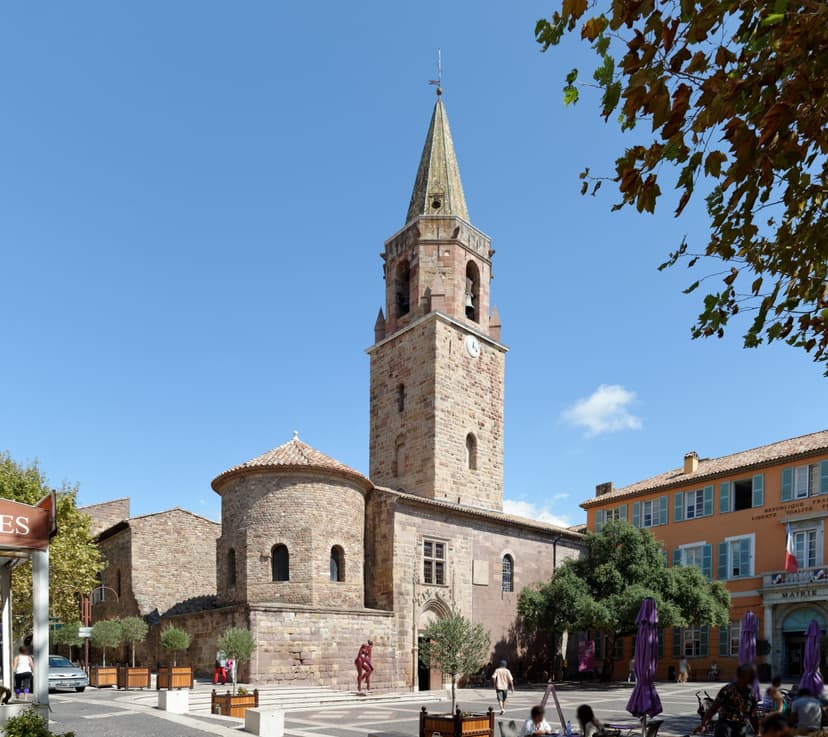
Fréjus Cathedral
Fréjus Cathedral, officially Cathédrale Saint-Léonce de Fréjus, is a Roman Catholic church in Fréjus, France, dedicated to Saint Leontius of Fréjus. It served as the seat of the Bishop of Fréjus from the 5th century until the diocese was merged with Toulon in 1957, after which it became a co-cathedral. The complex includes a baptistery considered the oldest Christian structure in Provence.