
Newport Cathedral
Newport Cathedral, officially known as the Cathedral Church of St Woolos, is the cathedral of the Diocese of Monmouth within the Church in Wales. Although modest in size, it is considered one of Wales's most interesting religious buildings due to its long history stretching from the 5th century to the present day, its unique blend of architectural styles, and its origins as the church founded by St Gwynllyw.
Key Facts
- ›Founded by St Gwynllyw in the late 5th century, originally as a wooden church and his burial place.
- ›Features a 12th-century Romanesque portal with zig-zag chevron motifs and Roman columns.
- ›The 15th-century tower is built in the Perpendicular style and houses the largest ring of bells in Wales.
- ›Became a cathedral in 1949, having previously served as a pro-cathedral since 1922.
- ›The east end was significantly rebuilt between 1960 and 1964, with modern artwork by John Piper and Patrick Reyntiens.

- 12th-Century Romanesque Portal With Roman Columns and Carved Capitals
- 15th-Century Perpendicular Tower With the Largest Ring of Bells In Wales
- St Mary's Chapel, Believed To Be On the Site of St Gwynllyw's Original Church and Tomb
- Modern East End Extensions and Artwork By John Piper and Patrick Reyntiens
- Memorial To Victims of the 1839 Chartist Uprising
Alban Caroe
About Newport Cathedral
Newport Cathedral, officially the Cathedral Church of St Woolos, is the principal church of the Diocese of Monmouth within the Church in Wales. While its size is comparable to a large parish church rather than a grand cathedral, its historical significance and architectural evolution make it a noteworthy religious site in Wales. The cathedral's origins trace back to the late 5th century, establishing it as one of the earliest Christian foundations in the region.
Origins and Early History
The site was founded by St Gwynllyw, a 5th-century Welsh king of Gwynllwg. According to tradition, he was guided in a dream to build a church on a prominent hill, which also became his burial place. This original church, likely constructed of wood, is believed to have influenced the footprint of the present-day St Mary's Chapel. Following Gwynllyw's death, the site became a significant place of pilgrimage, enduring periods of attack and plundering throughout the centuries, including raids by Irish pirates and Danes, and later by followers of Harold Godwinson.
Medieval and Later Development
Following the Anglo-Norman conquest, a castle was built in Newport in the late 11th or early 12th century, near Gwynllyw's church. The church itself would have been rebuilt, likely in stone, with a major transformation occurring in the late 12th century. A large new church was constructed in the Romanesque style to the east of the original site, attached to it, respecting the sanctity of Gwynllyw's burial place. This expansion reflects the enduring veneration of St Gwynllyw. The town of Newport grew near the castle and River Usk, with St Gwynllyw's church retaining its prominence and parish status on its hilltop location.
In the 14th century, the church underwent further development, with the nave featuring five Romanesque round arches. The aisles were rebuilt in the 15th-century Perpendicular style, coinciding with the construction of the tower. This period also saw potential damage from followers of Owain Glyndwr in 1402, and the wagon roof of the nave bears a 15th-century tree-ring date. The tower, built in the Perpendicular style, is a notable feature, traditionally associated with Jasper Tudor, uncle of Henry VII.
Architectural Highlights and Modern Additions
The cathedral's interior offers a journey through its history, typically approached from the west. Visitors pass through the tower, St Mary's Chapel (the site of Gwynllyw's original church and tomb), and a Romanesque portal before reaching the main body of the church. The 12th-century Romanesque portal is a significant architectural gem, featuring zig-zag chevron motifs, Roman columns, and capitals that scholars interpret as possibly depicting biblical narratives or hagiographical scenes. The nave showcases the Romanesque scheme with massive columnar piers, while the aisles exhibit 15th-century Perpendicular windows.
Between 1960 and 1964, the east end was rebuilt on a grander scale by architect Alban Caroe to create a more cathedral-like chancel. This modern extension incorporates striking artwork, including a round window designed by John Piper and executed by Patrick Reyntiens, and a large painted dossal. Other notable features include medieval effigies, Renaissance tomb work, and a memorial brass to the historian Octavius Morgan.
Newport Cathedral became a pro-cathedral in 1922 and achieved full cathedral status in 1949. It continues to be an active place of worship, with a long tradition of choral singing and a significant role in the life of the Diocese of Monmouth.
Source: Wikipedia ↗
Frequently Asked Questions
What is Newport Cathedral's original name?
Newport Cathedral is also known by its Welsh name, St Gwynllyw's or St Woolos' Cathedral. The English name 'Woolos' is an anglicisation of the Welsh 'Gwynllyw'.
When did Newport Cathedral become a cathedral?
It officially became a cathedral in 1949, after being designated as the pro-cathedral of the Diocese of Monmouth in 1922.
What are the main architectural styles found at Newport Cathedral?
The cathedral exhibits a mix of styles, including Romanesque in its 12th-century portal and nave arches, and Perpendicular Gothic in its 15th-century tower and aisles. More recent extensions feature modern designs.
Who founded the church that became Newport Cathedral?
The original church was founded by St Gwynllyw, a 5th-century Welsh king, who built a church on a prominent hill and was later buried there. This site became a significant place of pilgrimage.
What is notable about the Romanesque portal?
The 12th-century Romanesque portal is a significant feature, adorned with zig-zag chevron motifs. It incorporates Roman columns and intricately carved capitals, which scholars debate depict biblical scenes or stories from the lives of St Gwynllyw and his son St Cadoc.
Related Cathedrals

Llandaff Cathedral
Llandaff Cathedral is the principal church of the Diocese of Llandaff in the Church in Wales, located in Llandaff, Cardiff. It is dedicated to Saints Peter and Paul, and three Welsh saints: Dubricius, Teilo, and Oudoceus. The cathedral has a long and complex history, marked by periods of construction, destruction, and significant restoration, making it an important religious and architectural landmark.

St Asaph
St Asaph is a cathedral city in Denbighshire, Wales, situated on the River Elwy. It is notable for being the second-smallest city in the United Kingdom by population and for its historic cathedral, which has endured centuries of damage and rebuilding. The city's status as a city was formally granted in 2012.
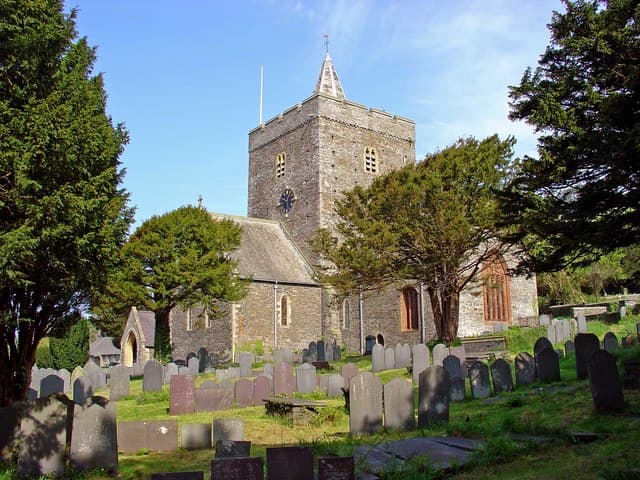
St Padarn's Church, Llanbadarn Fawr
Saint Padarn's Church is a historically significant parish church located in Llanbadarn Fawr, near Aberystwyth, Wales. As the largest medieval church in mid-Wales, it boasts a rich history dating back to the early sixth century, evolving from a Celtic monastic center to a Benedictine priory and eventually a parish church. Its enduring presence makes it a key site for understanding early Welsh Christian history and monasticism.