
Laon Cathedral
Laon Cathedral, officially Cathédrale Notre-Dame de Laon, is a significant example of early Gothic architecture, constructed primarily in the twelfth and thirteenth centuries. It served as the seat of the Diocese of Laon until the French Revolution and is celebrated for its stylistic unity and architectural innovation, including its unique four-tiered elevation and elaborate tower designs.
Key Facts
- ›Constructed between the 12th and 13th centuries, it is a prime example of early French Gothic architecture.
- ›Features a distinctive four-tiered elevation with side aisles, tribune, triforium, and clerestory.
- ›Notable for its seven planned towers, of which five were completed, including two flanking the western facade.
- ›The choir terminates in a flat wall, an unusual feature for Gothic churches, replacing an earlier apse.
- ›Contains significant 13th-century stained glass, including rose windows depicting biblical scenes and personifications of the sciences.
- ›Recognized as a monument historique in France since 1840.

- Seven Planned Towers
- Four-Tiered Interior Elevation
- Flat-Ended Choir
- 13th-Century Stained Glass, Including Personifications of the Sciences
- Stone Statues of Oxen In Western Towers
- Rose Windows
About Laon Cathedral
Laon Cathedral, officially known as Cathédrale Notre-Dame de Laon, stands as a preeminent example of early Gothic architecture, with its primary construction taking place during the twelfth and thirteenth centuries. Situated in Laon, Aisne, in the Hauts-de-France region of France, the cathedral served as the principal church for the Diocese of Laon until the early 19th century. Its architectural significance lies in its stylistic unity and innovative design elements, making it a crucial monument in the evolution of Gothic style.
History and Construction
The history of Laon Cathedral is marked by periods of destruction and reconstruction. An earlier church on the site was destroyed by fire in 1112 during an insurrection that saw the murder of Bishop Gaudry. The rebuilt structure, consecrated in 1114, proved insufficient for the growing population and burgeoning intellectual life of Laon, which boasted one of Europe's most acclaimed theology schools under Anselm of Laon. Construction of the current cathedral commenced in the late 1150s under Gautier de Mortagne, with the main edifice essentially completed by 1230. Subsequent phases extended the choir and added chapels, with significant modifications to the south transept facade in the early 14th century.
Architectural Features
Laon Cathedral is celebrated for its stylistic consistency, a rarity given the extended construction periods of many medieval cathedrals. It features a cruciform plan with a nave, transepts, and choir, all bordered by single side aisles. A distinctive characteristic is its four-tiered vertical elevation, comprising side aisles, a tribune with double arches, a triforium with triple arches, and a clerestory. The choir, unusually for Gothic churches, terminates in a flat wall rather than an apse. The cathedral was originally planned with seven towers, and five were completed: a central lantern tower over the crossing, two flanking the western facade, and two on the transepts. The western towers are particularly notable for containing life-size stone statues of sixteen oxen, commemorating the animals used in its construction.
Stained Glass and Later History
The cathedral retains a significant collection of 13th-century stained glass, including three lancet windows at the east end of the choir and elaborate rose windows. These windows depict a range of biblical scenes and, in the north transept, personifications of the sciences. During the French Revolution, Laon lost its status as a bishopric, and the building transitioned to a parish church under the Diocese of Soissons in 1802. The 19th century saw considerable restoration and modification, including the rebuilding of tower foundations and flying buttresses, and the controversial installation of a modern organ that partially obstructs western windows. Despite some damage during historical conflicts, Laon Cathedral has largely survived intact into the modern era and has been recognized as a monument historique since 1840.
Source: Wikipedia ↗
Frequently Asked Questions
When was Laon Cathedral built?
The current structure of Laon Cathedral was built primarily in the twelfth and thirteenth centuries. Construction began around 1160 and was essentially completed by 1230, with some later modifications.
What architectural style is Laon Cathedral?
Laon Cathedral is a highly significant and stylistically unified example of early Gothic architecture. It is noted for its innovative features that contributed to the development of the Gothic style.
What is notable about Laon Cathedral's towers?
Seven towers were planned for Laon Cathedral, with five ultimately completed. These include impressive western facade towers and transept towers, which are notable for their transition from square bases to octagonal peaks and the inclusion of stone statues of oxen.
What is special about the stained glass at Laon Cathedral?
Much of the cathedral's stained glass dates from the 13th century and is remarkably well-preserved. The windows depict various biblical narratives, the life of Mary, and unusually, personifications of the liberal arts in the north transept rose window.
What was the history of the Diocese of Laon?
The Diocese of Laon was established in the late fifth century. The cathedral served as its seat until 1802 when, following the French Revolution, it became a parish church under the Diocese of Soissons.
Related Cathedrals

Aix Cathedral
Aix Cathedral, officially Cathédrale Saint-Sauveur d'Aix-en-Provence, is a Roman Catholic cathedral in Aix-en-Provence, France. Situated on the site of the ancient Roman forum and a 6th-century Christian church, it showcases a remarkable blend of Romanesque, Gothic, and Neo-Gothic architectural styles, with elements dating back to its earliest Christian foundations. The cathedral serves as the seat of the Archbishop of Aix-en-Provence and Arles and is recognized as a national monument of France.

Church of St. Trophime, Arles
The Church of Saint-Trophime in Arles, France, is a significant Roman Catholic church renowned for its exceptional Romanesque architecture and sculpture. Originally constructed between the 12th and 15th centuries, it features a Romanesque nave and a Gothic choir, with its west portal and cloister sculptures being particularly celebrated examples of Romanesque artistry. Recognized for its historical and artistic importance, it is part of the "Arles, Roman and Romanesque Monuments" UNESCO World Heritage Site.
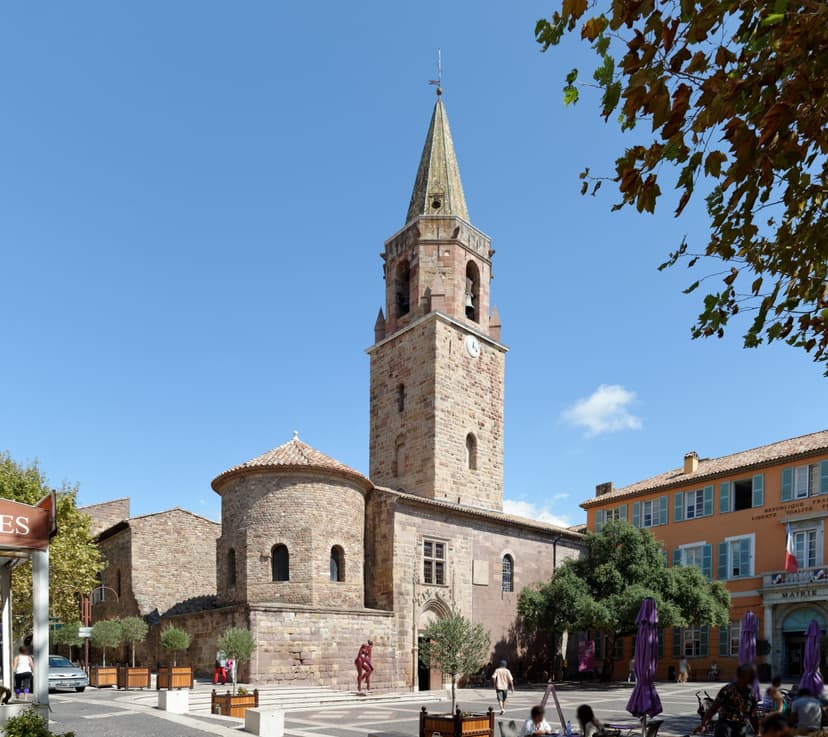
Fréjus Cathedral
Fréjus Cathedral, officially Cathédrale Saint-Léonce de Fréjus, is a Roman Catholic church in Fréjus, France, dedicated to Saint Leontius of Fréjus. It served as the seat of the Bishop of Fréjus from the 5th century until the diocese was merged with Toulon in 1957, after which it became a co-cathedral. The complex includes a baptistery considered the oldest Christian structure in Provence.