
Laoag
Roman Catholic Diocese of Laoag·Roman Catholic·Philippines
Laoag, officially the City of Laoag, is a component city and the capital of Ilocos Norte province in the Philippines. It is the most populous settlement and a major hub for commerce and industry in the region, boasting the busiest commercial airport in Ilocos. The city is known for its "Sunshine City" moniker due to its climate, despite occasional typhoons.
Key Facts
- ›Founded as a settlement by Spanish conquistadors led by Juan de Salcedo in 1572, who named the region "Ylocos" after the local inhabitants.
- ›Became the capital of Ilocos Norte on February 2, 1818, following the division of the Province of Ilocos.
- ›Was captured by the Japanese Army in December 1941, with its airport used extensively during World War II.
- ›Achieved cityhood on June 19, 1965, after a plebiscite.
- ›The Laoag Cathedral, built in 1612, serves as the seat of the Roman Catholic Diocese of Laoag.
- ›The city experiences a tropical savanna climate with distinct dry and wet seasons.

Laoag Cathedral, Laoag International Airport, La Paz Sand Dunes, Sinking Tower
Augustinian Friars
About Laoag
Laoag, officially the City of Laoag, is a significant component city and the provincial capital of Ilocos Norte in the Philippines. Situated in the northwestern part of Luzon, it serves as the region's primary political, commercial, and industrial center. The city is also home to the region's busiest commercial airport, the Laoag International Airport, making it a key gateway to East Asia.
History and Development
The history of Laoag dates back to 1572 when Spanish conquistadors, led by Juan de Salcedo, explored the northern territories. They established settlements in sheltered coves, naming the area "Ylocos" and its people "Ylocanos." The Spanish mission of Christianization led to the construction of churches and bell towers, a practice mandated by the Law of the Indies. Despite initial colonization efforts, the region saw several revolts against Spanish rule due to abusive practices by friars and colonial policies.
Laoag's importance grew substantially when it was designated the capital of Ilocos Norte on February 2, 1818, a move prompted by the province's rapid population growth and administrative challenges. The city's strategic location and economic potential were further recognized when it was captured by the Japanese Army in December 1941, and its airport became a crucial military base during World War II. In a significant administrative change, Laoag officially became a city on June 19, 1965, following a plebiscite.
Geography and Climate
Laoag is geographically positioned in the west-central part of Ilocos Norte, bordering the South China Sea to the west and the foothills of the Cordillera Central mountain range to the east. This location influences its climate, which is characterized as a tropical savanna. The city experiences distinct dry seasons from November to April and wet seasons from May to October. Despite being prone to powerful typhoons, Laoag is often referred to as the "Sunshine City" due to its generally pleasant weather patterns.
Economy and Tourism
As a strategic economic hub, Laoag benefits from its proximity to East Asian markets and a robust banking system. The city's economy is supported by a strong workforce and diverse industries, including small-scale food processing, rice milling, jewelry making, and metal crafts. Major retail chains have established a significant presence, contributing to the city's commercial landscape. Tourism is a vital economic driver, with attractions such as heritage sites featuring Spanish colonial architecture, baroque churches, the La Paz Sand Dunes, and the historic Laoag Cathedral.
Religious and Cultural Significance
The Laoag Cathedral, constructed in 1612 by Augustinian friars, stands as a prominent landmark and serves as the central church for the Roman Catholic Diocese of Laoag. Its architecture features an Italian Renaissance style with a distinctive two-story façade. The dominant religious affiliations in Laoag are Roman Catholicism and the Aglipayan Church, reflecting the complex religious history of the region. The city's cultural landscape is also shaped by its Ilocano heritage, with Ilocano being the dominant dialect spoken.
Source: Wikipedia ↗
Frequently Asked Questions
What is the population of Laoag?
According to the 2024 census, Laoag has a population of 112,117 people. The city has a population density of 970 inhabitants per square kilometer.
What is Laoag known for?
Laoag is known as the "Sunshine City" for its climate and is the capital and most populous city of Ilocos Norte. It is also a significant commercial, industrial, and transportation hub in the region.
What is the climate like in Laoag?
Laoag has a tropical savanna climate with warm to hot temperatures year-round. It is characterized by a dry season from November to April and a wet season from May to October, with occasional typhoons.
What are the main religious affiliations in Laoag?
The dominant religious affiliations in Laoag City are Roman Catholicism and the Aglipayan Church. Other religions present include Iglesia ni Cristo and various Protestant groups.
When did Laoag become a city?
Laoag transitioned from a municipality to a city on June 19, 1965, following a plebiscite. It has remained the capital of Ilocos Norte since then.
What historical events are significant in Laoag's history?
Key historical events include its founding by Spanish explorers in 1572, its designation as the capital of Ilocos Norte in 1818, and its capture by Japanese forces during World War II. The city also experienced revolts against Spanish colonial rule.
Related Cathedrals

Laoag Cathedral
Saint William's Cathedral, commonly known as Laoag Cathedral, is the principal church of the Roman Catholic Diocese of Laoag, located in Ilocos Norte, Philippines. Originally established by Augustinian friars in 1580 as a wooden chapel, the current stone structure was built starting in 1612 and has undergone several restorations and renovations throughout its history. It is recognized for its Italian Renaissance design and its unique sinking bell tower.
Blessed Sacrament Cathedral
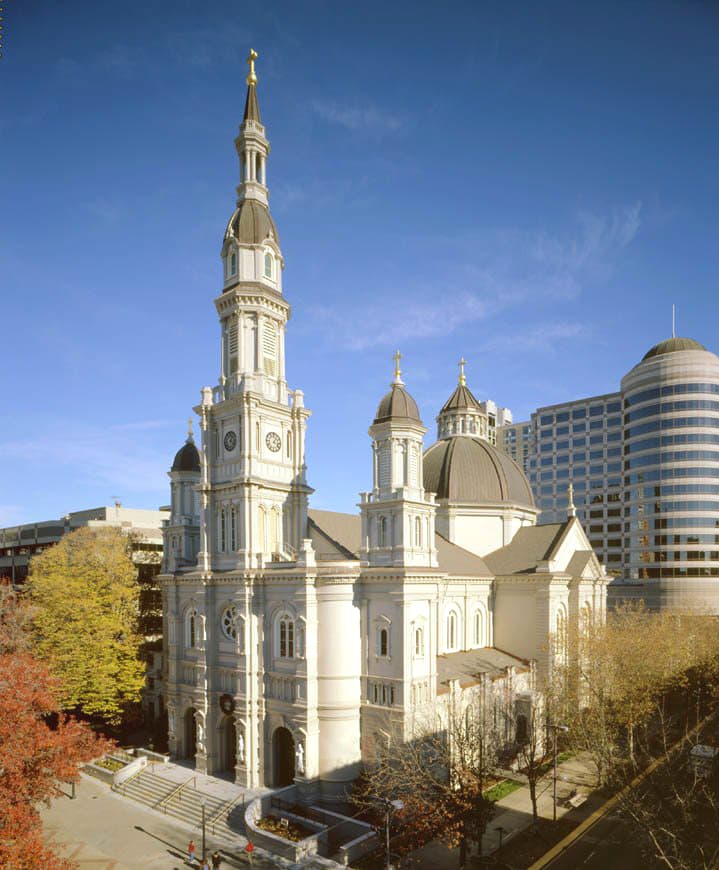
The Cathedral of the Blessed Sacrament serves as the mother church of the Roman Catholic Diocese of Sacramento, located in Sacramento, California. It is a significant religious and civic landmark, recognized as one of the largest cathedrals west of the Mississippi River. The cathedral's history is intertwined with the California Gold Rush and its architecture reflects both Italian Renaissance and Victorian styles, with extensive renovations aimed at preserving its historical integrity while adapting it for modern use.

Cathedral Basilica of Saints Peter and Paul
The Cathedral Basilica of Saints Peter and Paul is the principal church of the Archdiocese of Philadelphia, serving as its see church. Completed in 1864 and later designated a minor basilica, it is notable for its impressive scale, being the largest Catholic church in Pennsylvania, and its significant architectural features.