
Cathedral Basilica of Saints Peter and Paul
Archdiocese of Philadelphia·Catholic·United States
The Cathedral Basilica of Saints Peter and Paul is the principal church of the Archdiocese of Philadelphia, serving as its see church. Completed in 1864 and later designated a minor basilica, it is notable for its impressive scale, being the largest Catholic church in Pennsylvania, and its significant architectural features.
Key Facts
- ›Construction began in 1846 and was completed in 1864.
- ›Designed by Napoleon Lebrun, with later additions by John Notman and Henry D. Dagit.
- ›The basilica is the largest Catholic church in Pennsylvania, with a seating capacity of 2,000.
- ›It features a Roman-Corinthian style, with Italian Renaissance elements in its facade and dome.
- ›The cathedral has hosted papal masses by Pope John Paul II and Pope Francis.
- ›It is listed on the U.S. National Register of Historic Places.

Roman-Corinthian, Italian Renaissance
- Palladian Facade
- Aqua Oxidized-Copper Dome
- Vaulted Dome
- Ornate Main Altar
- Eight Side Chapels
- Stained Glass Apse
- Crypt of the Bishops
- Ceiling Mural 'the Assumption of the Virgin Into Heaven'
- Portraits of Evangelists On Pendentives
Napoleon Lebrun, John Notman, Henry D. Dagit
About Cathedral Basilica of Saints Peter and Paul
Overview
The Cathedral Basilica of Saints Peter and Paul stands as the primary church and see of the Archdiocese of Philadelphia. Located in Philadelphia, Pennsylvania, its construction began in 1846 and concluded in 1864, with a consecration ceremony occurring in 1890. It was elevated to the status of a minor basilica by the Vatican in 1976.
History and Context
The establishment of the Diocese of Philadelphia in 1808 necessitated a cathedral. Initially, Saint Mary's Church served this role, followed by Saint John the Evangelist Church as the Catholic population grew and a larger space was required. In 1846, Bishop Francis Kenrick announced plans for a new, grander cathedral dedicated to Saints Peter and Paul, acquiring a site at 18th and Race Streets. To fund the ambitious project without incurring debt, burial lots were sold for Cathedral Cemetery and New Cathedral Cemetery. The cornerstone was laid in December 1846, and the cathedral was dedicated in 1864 by Bishop James F. Wood.
Over the years, the basilica has undergone several renovations and additions. Archbishop Edmond F. Prendergast oversaw an interior repainting and roof repairs in 1915. The Chapel of Our Lady of the Blessed Sacrament was added in 1955, followed by a new apse in 1956. In 1979, Pope John Paul II celebrated a papal mass, and Pope Francis followed suit in 2015. In 2017, the shrine of Saint Katharine Drexel was relocated to the basilica.
Architecture and Design
The Cathedral Basilica of Saints Peter and Paul is recognized as the largest Catholic church in Pennsylvania and one of Philadelphia's most architecturally significant structures. Its design is rooted in the Roman-Corinthian style, drawing inspiration from the Church of St. Charles (San Carlo al Corso) in Rome, and incorporates Italian Renaissance elements in its Palladian facade and dome. The exterior features a dome clad in aqua oxidized copper.
The interior boasts a grand apse with stained glass and red antique marble, reminiscent of Roman churches. The main altar is crowned by a baldachin of Italian marble, and side aisles feature altars in the Italian Renaissance style. The architects involved in its construction and evolution include Napoleon LeBrun, who was responsible for the initial project, followed by John Notman who added the dome and facade. John Mahoney also contributed to the project, and LeBrun was eventually persuaded to complete the cathedral. Constantino Brumidi is credited with painting the ceiling mural in the dome, "The Assumption of the Virgin into Heaven," and the portraits of the Evangelists on the pendentives. D'Ascenzo Studios later executed the stained glass windows and mosaic murals in the apse.
Notable Features and Significance
Beyond its architectural grandeur, the basilica holds significant historical and religious importance. It is listed on the U.S. National Register of Historic Places. The Crypt of the Bishops, located in the basement, serves as the final resting place for several bishops and archbishops of Philadelphia, as well as other notable clergy and Saint Katharine Drexel. The cathedral's capacity to host large congregations and significant religious figures underscores its role as a central institution within the Catholic Archdiocese of Philadelphia.
Source: Wikipedia ↗
Frequently Asked Questions
When was the Cathedral Basilica of Saints Peter and Paul dedicated?
The Cathedral Basilica of Saints Peter and Paul was dedicated in 1864. It was later consecrated in 1890.
Who designed the Cathedral Basilica of Saints Peter and Paul?
The initial design was by Napoleon LeBrun. John Notman added the dome and facade, and Henry D. Dagit renovated the interior, adding the apse.
What is the architectural style of the cathedral?
The basilica is built in a Roman-Corinthian style, with its Palladian facade and dome rendered in the Italian Renaissance manner. It was modeled after the Church of San Carlo al Corso in Rome.
What is the seating capacity of the cathedral?
The Cathedral Basilica of Saints Peter and Paul has a seating capacity of 2,000 worshippers. Its main sanctuary is designed to comfortably hold this number.
Has the cathedral hosted any notable events or visitors?
Yes, the basilica has hosted papal masses by Pope John Paul II in 1979 and Pope Francis in 2015. It is also listed on the U.S. National Register of Historic Places.
Where is the Crypt of the Bishops located?
The Crypt of the Bishops is located in the basement of the basilica, under the main altar. It was opened in 1869 and contains the remains of several bishops and archbishops of Philadelphia.
Related Cathedrals
Blessed Sacrament Cathedral
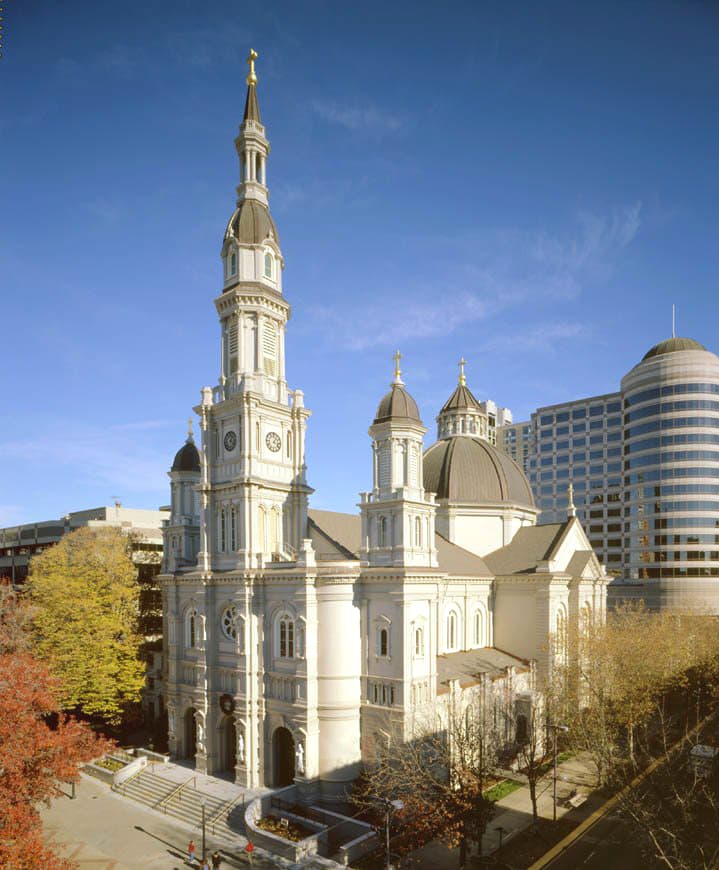
The Cathedral of the Blessed Sacrament serves as the mother church of the Roman Catholic Diocese of Sacramento, located in Sacramento, California. It is a significant religious and civic landmark, recognized as one of the largest cathedrals west of the Mississippi River. The cathedral's history is intertwined with the California Gold Rush and its architecture reflects both Italian Renaissance and Victorian styles, with extensive renovations aimed at preserving its historical integrity while adapting it for modern use.

Basilica of St. Louis, King of France
The Basilica of Saint Louis, King of France, formerly the Cathedral of Saint Louis and colloquially known as the Old Cathedral, is a significant Catholic church in St. Louis, Missouri. It holds the distinction of being the first cathedral west of the Mississippi River and played a crucial role as the sole parish church in St. Louis until 1844. Its historical importance is underscored by its preservation amidst the development of Gateway Arch National Park.
Cathedral of St. Paul
The Cathedral of Saint Paul, also known as Saint Paul's Cathedral, is the mother church of the Catholic Diocese of Birmingham in Alabama. Originally built as a parish church in 1893, it was elevated to cathedral status in 1969 following the creation of the Diocese of Birmingham. The cathedral is a significant example of Victorian Gothic architecture and has undergone several renovations and additions throughout its history.