
Cathedral of Saint Patrick
The Cathedral of Saint Patrick in Charlotte, North Carolina, serves as the mother church and seat of the Roman Catholic Diocese of Charlotte. Originally established as Saint Patrick's Church in 1938, it was elevated to cathedral status in 1972. The cathedral is known for its Gothic Revival architectural elements and its stained glass windows depicting biblical scenes and saints.
Key Facts
- ›Founded as Saint Patrick's Church on March 17, 1938, funded by philanthropist John Henry Phelan.
- ›Consecrated on September 4, 1939, by Bishop Eugene J. Mcguinness, becoming the first Catholic church in North Carolina consecrated after completion.
- ›Designated as the Cathedral of Saint Patrick in 1972 when Pope Paul VI erected the Diocese of Charlotte.
- ›Underwent significant renovations in 1979, 1996, 2012, and 2013, including altar repositioning and entrance modifications.
- ›Features stained glass windows designed at Henry Keck Studios in Syracuse, New York.
- ›Was included as a contributing property in the Dilworth Historic District on the National Register of Historic Places in 1987.

- Stained Glass Windows Depicting Biblical Scenes and Saints
- Relics of Saint Jucundus and Justina of Padua In the Main Altar
- Pipe Organ By W. Zimmer and Sons
- Shrines To the Blessed Virgin Mary and Saint Joseph
- Bell Cast In 1875
- Contributing Property To the Dilworth Historic District
Frank Frimmer
About Cathedral of Saint Patrick
The Cathedral of Saint Patrick, located in Charlotte, North Carolina, is the principal church and seat of the Roman Catholic Diocese of Charlotte. Its history began as Saint Patrick's Church, a mission church established in 1938 to serve the growing Catholic population in Charlotte, which was then under the jurisdiction of the Diocese of Raleigh. The construction was funded by philanthropist John Henry Phelan, and the Austrian architect Frank Frimmer was commissioned to design the church.
History and Development
Construction of Saint Patrick's Church commenced on March 17, 1938, and it was consecrated on September 4, 1939, by Bishop Eugene J. McGuinness. This consecration marked a significant milestone as it was the first Catholic church in North Carolina to be consecrated upon its completion. The parish expanded with the addition of a rectory and convent in 1941 and was officially designated as a parish in 1942. The church's status was elevated to that of a cathedral in 1972 when Pope Paul VI established the Diocese of Charlotte, appointing Monsignor Richard Allen as its first rector.
Over the decades, the Cathedral of Saint Patrick has undergone several significant renovations to adapt to its evolving needs and to preserve its architectural integrity. Major updates occurred in 1979, 1996, 2012, and 2013. These renovations included replacing the original high altar, repositioning liturgical elements such as the altar, baptismal font, and ambo, and restoring the interior to reflect its original 1939 appearance by removing dark oak wainscoting. In 2007, a 700-pound bell, originally cast in 1875, was installed in the bell tower. A family life center was added to the campus in 2008, and a Marian grotto was constructed in 2014. In 2013, a new main entrance with staircases was created. In recent years, the cathedral has faced challenges with roof leaks and water damage, prompting temporary closures and repairs.
Architectural Features
The Cathedral of Saint Patrick exhibits Gothic Revival architectural characteristics. Its exterior is marked by a gray stucco facade and a prominent 77-foot bell tower. The nave is designed to seat approximately 400 worshippers and features two side chapels dedicated to the Blessed Virgin Mary and Saint Joseph. The ceiling is adorned with 300 tiles.
A notable aspect of the cathedral's interior is its collection of stained glass windows, designed at the Henry Keck Studios in Syracuse, New York. These windows illustrate a variety of biblical narratives, including the Annunciation, the Nativity of Jesus, the Crucifixion, and the Ascension. They also depict scenes from the lives of saints such as Saint Patrick, Saint Cecilia, and Saint Joseph. The main altar is distinguished by its inclusion of relics from Saint Jucundus and Justina of Padua, Roman martyrs of the 4th century CE. The cathedral also houses a pipe organ, designed and manufactured by W. Zimmer and Sons, located in the balcony.
Significance and Recognition
In recognition of its historical and architectural importance, the Cathedral of Saint Patrick was designated as a contributing property to the Dilworth Historic District, which was listed on the National Register of Historic Places in 1987. Despite its historical significance and ongoing role as an active place of worship, plans for a new cathedral were announced in 2024 due to the current cathedral's limited seating capacity, though these plans were later postponed.
Source: Wikipedia ↗
Frequently Asked Questions
When was Saint Patrick's Church founded?
Saint Patrick's Church began construction on March 17, 1938, as a mission church of Saint Peter's Parish. It was consecrated on September 4, 1939.
When did Saint Patrick's Church become a cathedral?
In 1972, Pope Paul VI established the Diocese of Charlotte and designated Saint Patrick's Church as the Cathedral of Saint Patrick. Monsignor Richard Allen was appointed as its first rector.
What are the architectural styles of the Cathedral of Saint Patrick?
The cathedral exhibits Gothic Revival architectural elements. It features a gray stucco facade and a 77-foot bell tower.
What notable features are inside the Cathedral of Saint Patrick?
The cathedral houses two side chapels dedicated to the Blessed Virgin Mary and Saint Joseph. The main altar contains relics of Saint Jucundus and Justina of Padua, and a pipe organ designed by W. Zimmer and Sons is located in the balcony.
What is depicted in the stained glass windows?
The stained glass windows, designed at Henry Keck Studios, depict biblical scenes such as the Annunciation, the Nativity of Jesus, and the Crucifixion, as well as the lives of saints like Saint Patrick and Saint Cecilia.
Has the cathedral undergone renovations?
Yes, Saint Patrick has undergone several renovations, including major updates in 1979, 1996, 2012, and 2013. These involved changes to the altar, flooring, interior decoration, and the main entrance.
Related Cathedrals
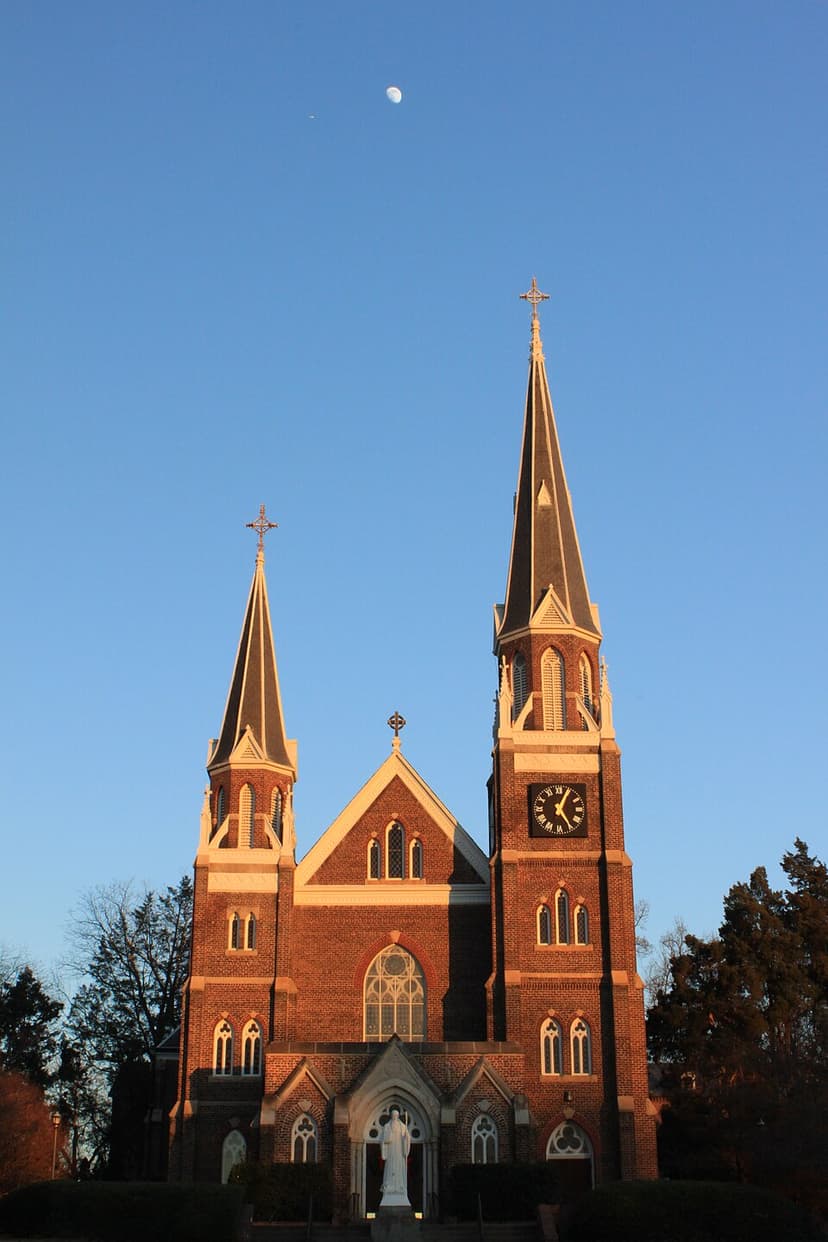
Cathedral-Basilica of St. Mary Help of Christians
The Cathedral-Basilica of St. Mary Help of Christians is a significant Catholic religious site located within Belmont Abbey in Belmont, North Carolina. Originally established as a Benedictine monastery, it has grown to encompass an educational institution and a shrine elevated to the status of a minor basilica. The basilica is notable for its Gothic Revival architecture and its historical connection to the American-Cassinese Benedictine Congregation.

Cathedral of San Agustin
The Cathedral of San Agustin is the seat of the Catholic Diocese of Laredo, Texas, and is one of the oldest cathedrals in the Southwestern United States still standing. Its current Gothic Revival structure dates from 1872, though its origins trace back to a chapel erected in 1767. The cathedral is a significant historical and architectural landmark in Laredo.

Cathedral of the Assumption
The Cathedral of the Assumption is the mother church of the Archdiocese of Louisville, located in Louisville, Kentucky. Established on the site of earlier Catholic churches, it was dedicated in 1852 and has undergone significant renovations throughout its history. The cathedral is a prominent landmark and an active center for worship and community services.