
Bury St Edmunds Cathedral
St Edmundsbury and Ipswich·Church of England·United Kingdom
Bury St Edmunds Cathedral, formally the Cathedral Church of St James and St Edmund, serves as the seat of the Bishop of St Edmundsbury and Ipswich in Suffolk, England. Originally a parish church dating back to the 11th century, it was elevated to cathedral status in 1914 and has since undergone significant enlargement and modernization.
Key Facts
- ›The site has had a church since at least 1065, with the current structure originating in the early 12th century.
- ›It was rebuilt in the Perpendicular style starting in 1503 by master mason John Wastell.
- ›Became a cathedral in 1914 when the Diocese of St Edmundsbury and Ipswich was created.
- ›Extensive rebuilding and enlargement occurred from 1959 onwards, transforming it from a parish church.
- ›Features a Gothic Revival Millennium Tower completed in 2005, standing 46 meters tall.
- ›Houses a ring of 12 bells in the adjacent Norman Tower, with additions made in 2012 and 2013.
Norman Tower, Millennium Tower, Susanna Window, Crucifixion Sculpture By Elisabeth Frink, Cathedral Treasures Display, Ancient Library
John Wastell, George Gilbert Scott, Stephen Dykes Bower, Alan Rome, Hugh Mathew
About Bury St Edmunds Cathedral
Bury St Edmunds Cathedral, formally known as the Cathedral Church of St James and St Edmund, is a prominent Church of England cathedral located in Bury St Edmunds, Suffolk. It serves as the ecclesiastical seat for the Diocese of St Edmundsbury and Ipswich. The history of a church on this site stretches back to at least 1065, with the current structure evolving significantly over centuries from its origins as a parish church.
History and Development
The earliest church on the site, St Denis's Church, was built within the precincts of Bury St Edmunds Abbey around 1065. In the early 12th century, Abbot Anselm rebuilt this church and dedicated it to Saint James, making it the parish church for the north side of the town. Abbot Anselm was also responsible for the construction of the Norman Tower, which served as the abbey gate and the church's belfry, a function it continues to this day. The church underwent a substantial rebuilding in the Perpendicular style, commencing in 1503 under the master mason John Wastell, who had also worked on King's College, Cambridge. Further modifications occurred in the 18th and 19th centuries, including the addition of a new chancel and a hammerbeam roof by George Gilbert Scott.
Bury St Edmunds Cathedral officially became a cathedral in 1914 with the creation of the Diocese of St Edmundsbury and Ipswich. A period of significant enlargement and transformation began in 1959, aiming to develop the former parish church into a full cathedral building. This involved demolishing the Victorian chancel and adding a new quire, cloister, transepts, and chapels. The cathedral architect from 1943 to 1988, Stephen Dykes Bower, made provisions for its completion, and his successor, Alan Rome, oversaw the construction of a new choir school and visitor's centre in 1990. A notable addition is the Gothic Revival Millennium Tower, designed by Hugh Mathew, which stands 46 meters tall and was completed in 2005. Further extensions in the 2000s include the Chapel of the Transfiguration, the East Cloister, and the Crypt Treasury.
Architectural Features and Interior
The cathedral's architecture reflects its varied construction periods. The Perpendicular style is evident from the 16th-century rebuilding, while the 20th and 21st centuries have seen the addition of modern elements like the Millennium Tower. Inside, the font was designed by George Gilbert Scott in 1870, and the chapel features a painting, "The Martyrdom of St Edmund" by Brian Whelan, and a 'Crucifixion' sculpture by Elisabeth Frink. The cathedral also houses the medieval Susanna Window, a west window depicting the Last Judgement, and displays of historic art and regalia in the Edmund Gallery and Cathedral Treasures.
Bells and Library
A ring of 12 bells is housed in the adjacent Norman Tower. The original ten bells were cast in 1785, with further bells added in 2012 and 2013. The bells are rung regularly for services and special occasions. The Ancient Library, founded by Miles Mosse in the late 16th and early 17th centuries, is located in a room over the north-west porch.
Source: Wikipedia ↗
Frequently Asked Questions
When was Bury St Edmunds Cathedral established?
A church has stood on the site of Bury St Edmunds Cathedral since at least 1065. The current structure began to take shape in the early 12th century, with a major rebuilding in the Perpendicular style commencing in 1503. It officially became a cathedral in 1914.
What is the architectural style of Bury St Edmunds Cathedral?
The cathedral showcases a mix of styles due to its long construction history. Significant rebuilding in the early 16th century was in the Perpendicular style. Later alterations include work by George Gilbert Scott and the Gothic Revival Millennium Tower completed in 2005.
What are the notable features of Bury St Edmunds Cathedral?
Key features include the Norman Tower (also serving as the church's belfry), the Perpendicular rebuilding from 1503, and the modern Gothic Revival Millennium Tower. Inside, visitors can find the medieval Susanna Window, a 'Crucifixion' sculpture by Elisabeth Frink, and the Cathedral Treasures display.
When was the Millennium Tower built?
The Gothic Revival style Millennium Tower was built starting in 2000 and its completion was officially celebrated on July 22, 2005. It stands 46 meters tall and was constructed from 600,000 bricks.
What is the significance of the Norman Tower?
The Norman Tower was built in the early 12th century by Abbot Anselm. It originally served as the abbey gate tower and also functioned as the belfry for St James's Church, a role it continues to fulfill today.
Related Cathedrals
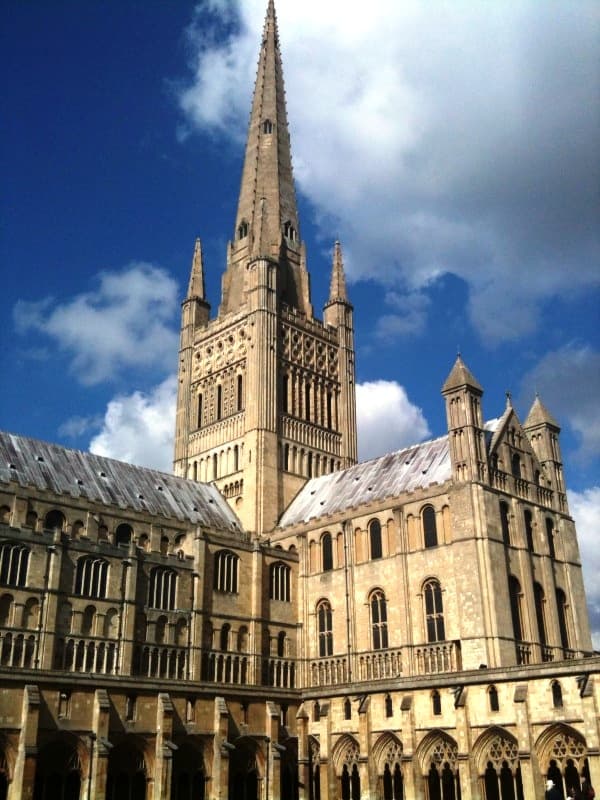
Norwich Cathedral
Norwich Cathedral, officially the Cathedral Church of the Holy and Undivided Trinity, is a prominent Church of England cathedral in Norwich, Norfolk, England. Construction began in 1096, resulting in a magnificent example of Norman architecture that has undergone significant additions and modifications over the centuries, including a notable spire and extensive vaulting.

Leicester Cathedral
Leicester Cathedral, officially the Cathedral Church of Saint Martin, is a Church of England cathedral in Leicester, England. Originally a medieval parish church, it was elevated to a collegiate church in 1922 and then a cathedral in 1927. It is famously known as the burial site of King Richard III, whose remains were reinterred there in 2015.

Oxford Cathedral
Christ Church Cathedral in Oxford, England, holds a unique dual role as both the cathedral of the Church of England's Diocese of Oxford and the chapel of Christ Church, a college of the University of Oxford. Its history dates back to a nunnery founded by St Frideswide, eventually evolving through Augustinian priory to its current status as a cathedral established by Henry VIII.