
Atri Cathedral
Teramo-Atri·Roman Catholic·Italy
Atri Cathedral, officially the Basilica concattedrale di Santa Maria Assunta, is a Romanesque Roman Catholic cathedral located in Atri, Italy. Originally the episcopal seat of the Diocese of Atri, it is now a co-cathedral and was declared a minor basilica in 1964. The cathedral is notable for its Romanesque architecture, significant artworks including a 15th-century fresco cycle, and its historical designation as a Holy Door.
Key Facts
- ›The present church was consecrated in 1223 and built over an earlier structure.
- ›The façade features a Gothic portal by Maestro Rainaldo and a large rose window.
- ›It contains a Holy Door, canonically designated by the Holy See, opened annually on August 15th.
- ›The bell tower stands 56 meters high and was completed in the 15th century by Antonio da Lodi.
- ›The choir showcases a fresco cycle by Andrea de Litio, illustrating the life of Jesus in Vulgar Latin.
- ›The crypt was originally a large Roman cistern.

Holy Door, Fresco Cycle By Andrea De Litio, Roman Cistern Crypt, 56-Meter High Bell Tower, Rose Window
Maestro Rainaldo, Raimondo Di Poggio, Antonio Da Lodi
About Atri Cathedral
Atri Cathedral, officially known as the Basilica concattedrale di Santa Maria Assunta, is a significant Romanesque Roman Catholic cathedral located in the town of Atri, within the Province of Teramo in the Abruzzo region of Italy. Historically, it served as the episcopal seat for the Diocese of Atri from 1251, later becoming part of the Diocese of Penni-Atri. Since 1986, it has held the status of a co-cathedral within the Diocese of Teramo-Atri, and in 1964, it was elevated to the dignity of a minor basilica.
History and Architecture
The current structure of Atri Cathedral was consecrated in 1223, built upon the foundations of an earlier church. Significant renovations and additions were undertaken over the subsequent two centuries. The cathedral's façade is characterized by its sober Istrian white stone, featuring a prominent portal crafted by Maestro Rainaldo in the Gothic style. Above this portal, a large rose window is adorned with a niche containing a sculpture of the Virgin and Child.
The south wall of the cathedral boasts three portals. The left portal, dating from 1305, is attributed to Rainaldo and is recognized as one of the Holy Doors. The central portal, from 1288, is distinguished by sculptures of lions and symbols of the Angevin dynasty, and was created by Raimondo di Poggio. The right portal, also by Raimondo di Poggio, is dated 1302. The designation of a Holy Door at Atri Cathedral dates back to at least 1295, with the current portal likely replacing an earlier, smaller one.
Adjacent to the cathedral stands a campanile, or bell tower, which reaches a height of 56 meters. This tower was completed in the 15th century by Antonio da Lodi and is crowned with a pyramidal roof.
Artistic and Historical Significance
The interior of Atri Cathedral holds considerable artistic treasures. The choir features an extensive fresco cycle by Andrea de Litio, a painter of the Abruzzi school from the 15th century. These frescoes were designed to be accessible to the less literate, utilizing Vulgar Latin for their accompanying inscriptions and depicting biblical scenes with relatable, informal settings and contemporary clothing to foster viewer identification. The cathedral also houses a large organ, and the diocesan museum is situated next to it.
Beneath the cathedral lie fascinating historical remnants. The crypt was originally a substantial Roman cistern, illustrating the area's ancient infrastructure. Further evidence of Roman water management systems can be found in the foundations of the ducal palace and a complex network of underground passages elsewhere in the town. The adjacent cloister is a two-story structure adding to the cathedral complex's historical depth.
Source: Wikipedia ↗
Frequently Asked Questions
What is Atri Cathedral dedicated to?
Atri Cathedral is dedicated to the Assumption of the Virgin Mary. Its Italian name, Basilica concattedrale di Santa Maria Assunta, directly translates to Co-cathedral Basilica of Saint Mary of the Assumption.
When was Atri Cathedral consecrated?
The present church of Atri Cathedral was consecrated in the year 1223. It was built on the site of an earlier ecclesiastical structure.
What is significant about the Holy Door at Atri Cathedral?
Atri Cathedral possesses a Holy Door, canonically designated by the Holy See. This door is opened annually on August 15th, the feast day of the Assumption of Mary, and remains open for eight days.
Who painted the frescoes in Atri Cathedral's choir?
The choir of Atri Cathedral contains a fresco cycle by the 15th-century Abruzzi painter Andrea de Litio. These frescoes were intended to educate the less literate population about the life of Jesus.
What is the height of Atri Cathedral's bell tower?
The bell tower, or campanile, adjacent to Atri Cathedral stands 56 meters (184 feet) high. It was completed in the 15th century by Antonio da Lodi and is topped with a pyramidal roof.
Related Cathedrals

Aix Cathedral
Aix Cathedral, officially Cathédrale Saint-Sauveur d'Aix-en-Provence, is a Roman Catholic cathedral in Aix-en-Provence, France. Situated on the site of the ancient Roman forum and a 6th-century Christian church, it showcases a remarkable blend of Romanesque, Gothic, and Neo-Gothic architectural styles, with elements dating back to its earliest Christian foundations. The cathedral serves as the seat of the Archbishop of Aix-en-Provence and Arles and is recognized as a national monument of France.

Ariano Irpino Cathedral
Ariano Irpino Cathedral, originally known as Ariano Cathedral, is a Roman Catholic cathedral dedicated to the Assumption of the Virgin Mary. Located in Ariano Irpino, Italy, it has a history marked by destruction and rebuilding, evolving from its 10th-century Romanesque origins to its current Baroque-influenced form. The cathedral serves as the seat for the Diocese of Ariano Irpino-Lacedonia and is noted for housing a relic believed to be a thorn from Christ's crown.
Altamura Cathedral
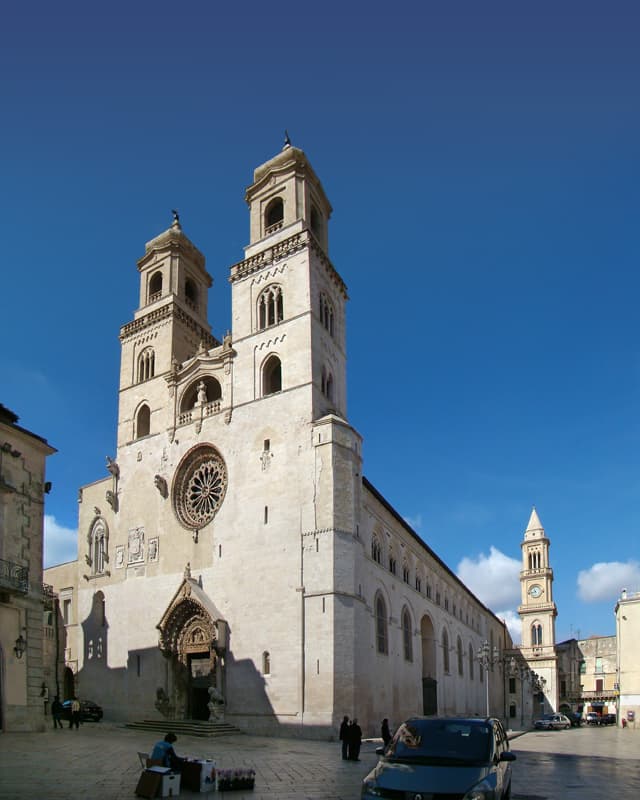
Altamura Cathedral, officially dedicated to the Assumption of the Blessed Virgin Mary, is a significant Roman Catholic cathedral located in Altamura, Apulia, southern Italy. Originally commissioned by Emperor Frederick II, it has undergone numerous expansions and alterations throughout its history, reflecting various architectural styles and historical periods. It currently serves as the seat of the Bishop of Altamura-Gravina-Acquaviva delle Fonti.