
Yunmen Wenyan
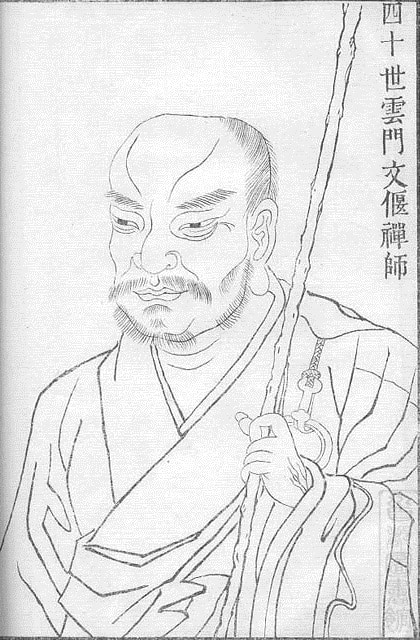
Yunmen Wenyan was a prominent Chinese Chan master of the Tang dynasty and a dharma-heir of Xuefeng Yicun. He founded the Yunmen school, one of the Five Houses of Chán, which significantly influenced the upper classes and contributed to the compilation of the Blue Cliff Record. Known for his forceful and direct teachings, often expressed through shouts and blows, Yunmen is also celebrated for his "One Word Barriers" and paradoxical koans.
Key Facts
- ›Founded the Yunmen school, one of the five Houses of Chán.
- ›Was a dharma-heir of Xuefeng Yicun.
- ›Known for his forceful and direct teaching style, including shouts and blows.
- ›Developed "one Word Barriers" and paradoxical koans, such as "Dried shitstick" and "a sesame bun."
- ›His saying "every day is a good day" became a well-known Zen phrase.
- ›His teachings were instrumental in the compilation of the Blue Cliff Record.
Important Relationships
- Xuefeng Yicun (teacher)
- Muzhou Daoming (teacher)
- Rumin Chanshi (friend and colleague)
- Liu Yan (patron, King of Southern Han)
- Dongshan Shouchu (successor)
- Baiyun Zixiang (disciple)
Yunmen's One Word Barriers, Koans Collected In the Blue Cliff Record, Koans Collected In the Gateless Gate, Koans Collected In Book of Equanimity
Jiaxing, Suzhou, Mount Xianggu, Fuzhou, Mount Lingshu, Mount Yunmen, Shaozhou
Xuefeng Yicun, Muzhou Daoming
Chinese
Monastic Vows
Chan Master
About Yunmen Wenyan
Yunmen Wenyan (862 or 864 – 949 CE) was a pivotal figure in Chinese Chan Buddhism, renowned as a master of the Tang Dynasty and a principal dharma-heir of Xuefeng Yicun. He established the Yunmen school, one of the "Five Houses of Chán," which exerted considerable influence, particularly among the elite, and played a role in the eventual compilation of the influential "Blue Cliff Record." The Yunmen school persisted into the Song Dynasty before being absorbed by the Linji school, though its lineage continues to the present day.
Life and Historical Context
Born into the Zhang family in Jiaxing, near Suzhou, Yunmen's early life as a monk began under Zhicheng. His spiritual journey led him to seek deeper understanding from Muzhou Daoming, who eventually guided him to Xuefeng Yicun. After years of study and receiving enlightenment, Yunmen traveled extensively, solidifying his reputation. He later became associated with Rumin Chanshi and, following Rumin's death, became head priest of the Lingshu monastery. During the politically turbulent Five Dynasties and Ten Kingdoms period, Yunmen gained the patronage of Liu Yan, the ruler of the Southern Han kingdom. This patronage facilitated the establishment of the Yunmen monastery on Mount Yunmen, from which he derived his monastic name.
Teachings and Koans
Yunmen Wenyan was celebrated for his direct, forceful, and often subtle teaching methods, which frequently involved sudden shouts and physical gestures. His wisdom and oratorical skills were highly regarded, though his teachings were also described as "difficult to understand" due to their indirect nature. He is particularly known for his "One Word Barriers," concise responses like "Guan!" (barrier), designed to provoke insight. Many of his sayings and dialogues evolved into koans, becoming integral to Chan practice. Notable examples include his responses to a monk's question about Buddha with "Dried shitstick," and his famous assertion, "Every day is a good day." Despite an apocryphal anecdote suggesting he discouraged the recording of his teachings, numerous koans and "live words" attributed to him were collected, influencing later generations of Zen masters and practitioners.
Lineage and Legacy
Yunmen Wenyan's disciples were said to number 790, with an unusually high number achieving enlightenment. The Yunmen school remained prominent for approximately 300 years. His legacy is evident in the enduring use of his koans in Zen practice, such as the "dried shitstick" koan, which has been contemplated by significant figures like Jack Kerouac and Robert Baker Aitken. His saying "Every day is a good day" was famously incorporated into contemporary art by composer John Cage. The influence of Yunmen's teachings and koans extended to figures like Ikkyū and Shuho Myocho, who experienced profound enlightenment through contemplating his teachings, with one master even referring to a disciple as "the second Ummon" (Yunmen's Japanese name).
Source: Wikipedia ↗
Frequently Asked Questions
When and where was Yunmen Wenyan born?
Yunmen Wenyan was born in the town of Jiaxing near Suzhou, China, to the Zhang family. His birth year is uncertain, but historical records suggest it was either 862 or 864 CE.
Who was Yunmen Wenyan's teacher?
Yunmen Wenyan initially studied under a "Commandment master" named Zhicheng. He later sought deeper understanding from Reverend Muzhou Daoming, who then directed him to study under Xuefeng Yicun.
What is the Yunmen school?
The Yunmen school was founded by Yunmen Wenyan and became one of the five major schools of Chán (Chinese Zen). It flourished into the early Song Dynasty, influencing the upper classes and contributing to the Blue Cliff Record.
What are Yunmen's "One Word Barriers"?
Yunmen's "One Word Barriers" were short, sharp, single-word answers, such as "Guan!" (meaning "barrier" or "frontier pass"). These were intended to aid practice, spur insight, and promote realization.
What is a famous koan attributed to Yunmen Wenyan?
One of Yunmen Wenyan's most famous koans is his response to the question "What is Buddha?" where he replied, "Dried shitstick." Another well-known saying is "Every day is a good day."
When did Yunmen Wenyan die?
Yunmen Wenyan died in 949 CE. He passed away while sitting in a full lotus posture after composing a farewell letter and delivering a final lecture to his monks.
Related Buddhists
Dharmakīrtiśrī
Dharmakīrtiśrī was a significant 10th-century Buddhist teacher, also known as Serlingpa or Kulānta, whose name indicated his origin from a region in Southeast Asia such as Lower Burma, the Malay Peninsula, or Sumatra. He is renowned for being the teacher of several influential Mahayana Buddhist scholars and for authoring a key commentary on the Abhisamayālaṃkāra.
Luipa
Luipa was a significant Buddhist mahasiddha and siddhacharya from the Pala Empire, active around the 10th century. He is recognized as one of the early poets of the Charyapada and a writer of various Buddhist texts. His name is often associated with consuming fish-guts, a practice he undertook to overcome pride and achieve enlightenment, and he became an exemplar for many later siddhas.
Tilopa
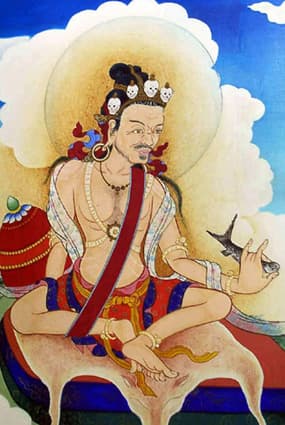
Tilopa was a 10th-century Indian Buddhist mahasiddha, a master of tantric practices, particularly known for his teachings on Mahamudra and the Six Yogas of Naropa. His life is primarily known through spiritual biographies, which describe his attainment of enlightenment through unconventional means and his transmission of profound teachings to his main disciple, Naropa. Tilopa is revered as a key figure in the Kagyu lineage of Tibetan Buddhism.