
Yonghe Temple
The Yonghe Temple, also known as the Yonghe Lamasery or Lama Temple, is a significant Tibetan Buddhist monastery in Beijing, China, belonging to the Gelug school. It served as the country's highest Buddhist temple during the Qing dynasty and is renowned for its impressive blend of Han Chinese and Tibetan architectural styles, housing remarkable artworks.
Key Facts
- ›Construction began in 1694 on the site of a former Ming dynasty eunuch residence.
- ›It was converted into a lamasery by imperial edict in 1744 during the Qianlong Emperor's reign.
- ›The temple houses a 26-meter tall statue of Maitreya Buddha carved from a single piece of white sandalwood.
- ›Two important steles, erected in 1744 and 1792, are preserved, written in multiple languages.
- ›It was declared a national monument after 1949 and reopened to the public in 1981.
- ›The temple is a major tourist attraction and a functioning monastery.

Important Relationships
- Kangxi Emperor
- Yinzhen (later Yongzheng Emperor)
- Hongli (later Qianlong Emperor)
- Seventh Dalai Lama
- Premier Zhou Enlai
- 18-Meter Tall White Sandalwood Statue of the Maitreya Buddha
- Five-Hundred-Arhat-Hill
- Three Bronze Statues of the Buddhas of the Three Ages
- Four-Language Stele Pavilion
- Cham Dance Performances
- Conversion From Princely Residence To Lamasery
- Imperial Edict To Replace Turquoise Tiles With Yellow Tiles
- Armed Revolt Against the Chinese Nationalist Government
- Closure As A National Monument
- Reopening To the Public
- Survival of the Cultural Revolution
Han Chinese, Tibetan
About Yonghe Temple
The Yonghe Temple, also known as the Yonghe Lamasery or Lama Temple, is a prominent Tibetan Buddhist monastery of the Gelug school located in Beijing, China. Situated in the Dongcheng District, it stands as one of the largest Tibetan Buddhist monasteries within China proper and was the highest Buddhist temple in the country during the Qing dynasty's middle and late periods.
History and Conversion
The site of the Yonghe Temple originally housed an official residence for court eunuchs during the Ming dynasty. In 1694, during the Qing dynasty, construction began on its conversion into the residence of Yinzhen, the fourth son of the Kangxi Emperor, who later ascended the throne as the Yongzheng Emperor. The building was officially designated as the 'Residence of Prince Yong of the First Rank' in 1709. Following Emperor Yongzheng's death in 1735, his coffin was temporarily housed here. In 1744, the Qianlong Emperor decreed the conversion of the palace into a lamasery, a transformation that was consecrated in 1745. Subsequently, it became a vital center for Tibetan Buddhist monks from Mongolia and Tibet, serving as the national administrative hub for Lama affairs and, from 1792, a site for the Qing dynasty's oversight of Tibetan and Mongolian lama reincarnations.
The temple experienced an armed revolt in 1929. After the Chinese Civil War concluded in 1949, it was declared a national monument and remained closed for 32 years. It is believed to have been preserved during the Cultural Revolution through the intervention of Premier Zhou Enlai. Reopened to the public in 1981, the Yonghe Temple is now a functioning monastery and a major tourist destination.
Architecture and Artworks
The Yonghe Temple exhibits a distinctive combination of Han Chinese and Tibetan architectural styles. Its layout follows a 480-meter north-south axis, encompassing five main halls separated by courtyards: the Gate Hall of Harmony and Peace, the Hall of Harmony and Peace, the Hall of Everlasting Protection, the Hall of the Wheel of the Law, and the Pavilion of Ten Thousand Happinesses. Among its most celebrated artworks are three bronze statues of the Buddhas of the Three Ages, the intricate Five-Hundred-Arhat-Hill carved from red sandalwood, and a colossal 18-meter tall statue of Maitreya Buddha carved from a single piece of white sandalwood, a gift from the Seventh Dalai Lama to the Qianlong Emperor. The temple also houses two significant steles, erected in 1744 and 1792, inscribed in Chinese, Manchu, Tibetan, and Mongolian, documenting its conversion and administrative roles.
Religious Practices and Administration
As a Tibetan Buddhist temple, Yonghe Temple incorporates rituals and dances from Tibetan traditions, including the Cham dance, which was revived in 1987 after a suspension during its closure. Administratively, it was directly under the Qing dynasty's jurisdiction, with a prince or junwang overseeing secular business, managed by the Imperial Household Department and Ministry of Foreign Affairs. Religious affairs are headed by a Khenpo lama, a position of high status, which since 1936 has been referred to as abbot.
Source: Wikipedia ↗
Frequently Asked Questions
What is the history of the Yonghe Temple?
The Yonghe Temple's construction began in 1694, initially serving as a residence for Prince Yong. It was later converted into a Buddhist lamasery in 1744 by imperial decree and became a central site for Tibetan Buddhist administration in China.
What are the most notable artworks at Yonghe Temple?
Key artworks include three bronze statues of the Buddhas of the Three Ages, the Five-Hundred-Arhat-Hill carved from sandalwood, and an 18-meter tall white sandalwood statue of Maitreya Buddha, which is one of the largest of its kind.
What is the architectural style of the Yonghe Temple?
The temple's architecture is a fusion of Han Chinese and Tibetan styles. It is arranged along a 480-meter north-south axis and features several main halls, courtyards, and pavilions.
When was the Yonghe Temple reopened to the public?
After being closed for 32 years following its designation as a national monument, the Yonghe Temple was reopened to the public in 1981.
What is the significance of the steles at Yonghe Temple?
The temple houses two significant steles. The Yonghegong Stele, erected in 1744, marked its conversion to a monastery, while The Discourse of Lama, erected in 1792, addresses the administration of Tibetan lama reincarnations.
Does Yonghe Temple still function as a monastery?
Yes, the Yonghe Temple is a functioning monastery and a popular tourist attraction. It houses a community of Tibetan Buddhist monks and continues to hold religious ceremonies.
Related Buddhist Temples

Tawang Monastery
Tawang Monastery, known in Tibetan as Gaden Namgyal Lhatse, is the largest Buddhist monastery in India and a significant religious and cultural center in Arunachal Pradesh. Founded in 1680-1681 under the guidance of the 5th Dalai Lama, it belongs to the Gelug school of Vajrayana Buddhism and holds importance as a pilgrimage site and a historical landmark situated near the borders of China and Bhutan.
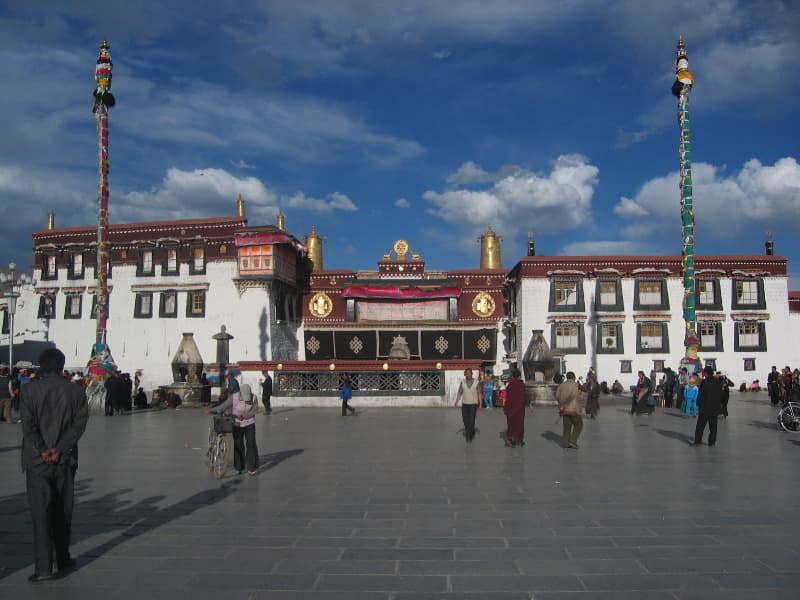
Jokhang Monastery
The Jokhang Monastery, also known as Rasa Trulnang or Zuglagkang, is considered the "heart of Lhasa" and is the most sacred Buddhist temple in Tibet. Built around 640 CE by King Songtsen Gampo, it was established to house important Buddhist statues brought to Tibet by his queens. The temple complex includes a monastery and serves as a focal point for pilgrimage and commercial activity.
Chokorgyel Monastery
Chokorgyel Monastery is a significant Gelugpa Buddhist monastery located in Gyatsa County, Tibet. Founded in 1509 by Gedun Gyatso, the 2nd Dalai Lama, it holds historical importance as a meditation site and a vital stopping point for senior lamas journeying to the sacred lake Lhamo La-tso. The monastery was severely damaged multiple times throughout its history, notably by Dzungar Mongols in 1718 and almost completely destroyed during the Cultural Revolution, but has since seen partial rebuilding and renewed monastic residency.